Sunday, 30 October 2011

True Love Spurned !


It was still dark outside, a thin shard of a paler shade of black was beginning to creep round the edge of the curtains drawn across the window. Not long now, and he would be with me. Snug under my covers, I could hear him move about in the room next door, the room where he spent his afternoons and evenings. Sometimes, of course, he left the house altogether, leaving me to snooze, idle and unwanted; without him I had no life, no life at all. It was he who tickled me into being, it was he who could awaken the song in my heart, every fibre of my body vibrating, wave after wave of happiness ringing out in delight, filling my soul with joy, shuddering to an overwhelming feeling of satisfaction when he finally came to a halt many hours later.

Yes, I looked forward to our regular meetings, when he concentrated fully on me and my needs. The whole morning belonged to me, I had his undivided attention. Knowing how lucky I was I never stopped being grateful, served him well, taking hardly any time off. Very rarely did I suffer from any kind of illness, but when it happened, he wrapped me up tenderly and carried me to a hospital, where I sat on a bench while somebody else's rough hands poked about in my innards, dripping grease over my sinews and adjusting my muscles. I disliked being touched by anyone but him, but his pleasure at having me all to himself again, back home, after an episode of absence, made up for the indignity.

Finally, I heard the door open and he came over to where I sat, still hidden from view. I could feel his hands lifting the covers, folding them back carefully, slowly exposing me to his full gaze. I shivered a little as he ran his fingers delicately over my keys. Contrary to his usual custom, he did not sit down in front of me, but stood poised above me, looking at me with troubled eyes.

For the first time in our long and mutually satisfying relationship I had no idea what was coming next.

"Well, old girl," he said, "It'll break my heart. You have seen me through many a difficult birth. Sitting here, stroking you, pounding you for so many years, and releasing my creative energies into you has brought me success and recognition. But let's face it, " he continued, "you have grown old in my service, your smooth bodywork and efficient rhythms have become rough and unreliable. It's time to replace you with one of the new-fangled machines, which, I hear, even tell me when I get the spelling wrong. Admit it, you never did that. "

He patted me on the head. "I'll always appreciate your stalwart nature and true heart and I'll never love anyone as I have loved you. Believe me, and I mean this most sincerely, it's not you, it's me."

I was shocked rigid. My keys sat stiff and unmoving; a small tinkle, like a funeral bell, rang out when he picked me up with both hands and deposited me unceremoniously on the bottom shelf of his bookcase, and covered me up again.

Here I've been sitting for weeks now, drying up and silent. I heard the usurper being lifted into my rightful place. Apparently the upstart needs a lot of juice delivered via electric cables and something called a provider to get him going; he is clearly a lot less accommodating than I was. Heartless, I would say.

As for him, my lord and master, the one whom I helped to create deathless prose? I know he is not happy now, not nearly as happy as he was with me. I have heard him shout and swear in frustration. Far be it from me to gloat, but I know for a fact, that the upstart has managed to lose a whole chapter of the new book.

I have to admit to a little frisson of Schadenfreude.


Thursday, 27 October 2011

CHARITEA PARTY

I don't agree that love is a human right but that would make a different post.


An afternoon fundraiser without a White Elephant stall!

In fact, there are no stalls visible of any kind. I'm relieved;  I have felt pressured into buying unwanted presents, off-loaded by ungrateful recipients, too many times in the past to feel guilty at spurning them;  rather than buying somebody's unloved cast-offs, with the sole purpose of returning them to an identical stall at the next opportunity, I now just put a few coins in the box.

A young girl in a pretty dress, which is rather too old for her, takes my entrance fee and, in return, eagerly sticks a label to my jacket to prove that I've paid. The label is destined to fall off almost instantly.
The entrance fee entitles me to eat and drink as much as I want. No further monetary transactions are due.

For the sake of formality, an adult stands next to her at the rickety table which holds a tin for the money and a small packet of sticky backed labels.  The child is bossy and self-important, giving me unnecessary directions to the back of the house;  few people have arrived as yet and she hasn't had time to grow bored.

There are tables set out in the sheltered courtyard, the forecast has promised a dry afternoon. It is part of the fun to huddle close together under umbrellas in the rain, and, if the weather should turn too inclement, for everybody to grab chairs and tables, teacups and plates and rush them indoors. We hope for the best, but kitchen and barn doors are open.

I arrive fairly early; not many tables have been taken and, for the moment, there are more helpers than there are guests.

This being Valley's End, everybody knows everybody. Introductions may be ignored but conventions must be observed.

'Would you like some tea?  Food is in the barn. Choose a table and I'll bring the tea out to you.'


I make my way into the barn; sitting down instantly would make me look stiff and unfriendly. I need to greet everybody first, both in the barn and the kitchen and everybody sitting in the courtyard. Going into the barn first makes me look greedy.


'Hi, lovely to see you. Thank you for coming. We have lots of food, far too much, really.'


The lady in charge apologises for the great abundance, it's the organisers' fault and she may well be one of them. Waste is bad, we are an old-fashioned lot, we all complain about young people nowadays throwing far too much food away. 


'It probably won't get eaten.'  She explains that 'The ramblers are out for a walk, they may get here too late and there's a bowling match on as well. Bad planning, as usual. There's always too much on at the same time, isn't there? I wish people would look at the village diary before they double-book.'  Yes, we have a village diary, printed on the back page of the 'Chronicle', available for a very modest sum once a month.

The lady by the food table is slightly breathless and excited. She waves a hand over the table and points: Anyway, we have egg & cress, cheese & pickle, ham & tomato and salmon & cucumber; we have scones & jam, chocolate brownies and we have fruit cake and sponge. And this massive cake here, well, Linda made it. We told her it's much too big but you know about Americans. They only know one size: big!  Linda is present, she hears the remark, and seeing me, she laughs and says 'Well, it's a German recipe, it's a Guglhupf, you can't blame me.'


Everything on the platters and cake stands looks inviting. I help myself to a small plate and pile some sandwich triangles on it. The tea lady finds me and tells me that she has put my tea on a table. While I stand chatting to the food lady another lady grabs hold of my arm and whispers urgently:

'Pauline has just arrived, she's on her own; would you mind speaking to her and sit with her?'


Of course, I wouldn't; Pauline is a good friend, recently widowed, but totally able to take care of herself. She has no need of me or anyone else, but that's how Valley's End functions: people look out for each other, whether you want them to or not. Soon Pauline and I are joined by several other people.

Are you exhibiting any paintings this year?
Well, of course, it always rains in the Orkneys; we've never yet had good weather.
Actually, I'm really busy at the moment; I'm going to stay with my daughter in Birmingham for a few days, before I'm off on my cruise.
I have several new paintings ready; the exhibition is previewing on Saturday; are you coming? there'll be wine and nibbles.
Oh, I know, the Shetlands are no better. But still, I love the North; never mind the weather. You can't go to Scotland in the summer, the midges . . . 
Have you been away this year?
Abstracts or landscapes?
They eat you alive.
Did I tell you I saw Jayne the other day? She's finally made up her mind about the new cottage.


One after the other, people get up for more food and tea cups are refilled. People change tables.


'I've just finished my fourth novel.'
This is a one-to-one conversation. My partner is an old gentleman, an ex music and English teacher, who has published a number of text books on poetry and music, but has so far been unable to find a publisher for his novels. I have read the first one, it was rather stiff and learned and showed how thoroughly the writer had done his research. A lifeless read; I have not read the subsequent works. He has, however, written a delightful little collection of children's verse, which I enjoyed very much.

'No, you can't even get an agent nowadays.'  He has published his first two novels himself and will no doubt do the same with the next two and any others he writes. I find it difficult to say anything constructive. He has written some very decent poems for adults too, which a composer has set to music.

Moving on, I join a larger table, where a discussion on politics is in full flow. Country people are conservative by nature, their politics tend to lean towards the Right. A lot of the newer inhabitants are professionals from the big cities, as well as writers, artists, teachers, with more liberal tendencies. In spite of these differences, everyone here is united in their wish to see the downfall of the Murdoch clan and News Corp. It's safe territory. When the talk turns to Mr. Cameron, whose current posturing in the face of the financial crisis hitting the pockets of ordinary people makes me feel nauseous, the differences become more obvious.

We have to live with each other, for the most part we are on friendly terms with each other and agree to disagree. Besides, we've only had tea, alcohol-fuelled pub rants have no place at the tea-table.

In the meantime, the ramblers have arrived, hungry and in need of refreshment. There is also a group of people whom nobody knows, a group of cyclists, male and female, who saw the sign advertising afternoon tea and followed it to the back of the house. The organiser beams a welcome smile.

It's getting cool and people are beginning to leave. The food lady comes over, bearing a large platter of left-over food, a few sandwich triangles, slices of fruit cake and brownies. Linda's big cake has all been eaten. Anybody who still has a corner to fill in their tummy, takes a piece; there is no embarrassment, that's what we do.

The fundraiser has been a success. Amnesty International will be given a decent sum of money.

Valley's End is rather good at fundraising, we do a lot of it.

Wednesday, 26 October 2011

Little Things Mean A Lot


This came in the post,
a coaster, which apparently reminded two very unkind
Canadian bloggers of me.

I realise that making fun of fellow bloggers
safely, from a distance,
is relatively easy; 
had you been close at hand,
 I might have used the rake with violent intent.

My polka-dotted dress
is strictly Sunday best; 
For the garden
I prefer tartan.


Just to prove that I may be down but most certainly not out, I'll let you have a look at three beauties which are brightening up this dreary season of grey skies. For the first time in my long and distinguished gardening career, I have a second flush of delphiniums. It's a big enough clump to take a bunch inside and still have plenty left for seconds and thirds. I have no idea how I did it.


Cotinus and spirea do what they are doing at the moment most years, I can't claim any special powers for their magnificent display.


Sunday, 23 October 2011

Of The House of Scorpio, Autumn Leaves and a Walk on the Wild Side

October

 Meister Albert
Zyklus der Monate 

From a group of frescoes in the
  Torre dell'Aquila, Castello del Buonconsiglio di Trento.


Sun enters the House of Scorpio

'The man born under Scorpio shall have good fortune. He shall be a great fornicator, and the first wife he shall have in marriage shall become too religious. He shall suffer pain in his privy members at fifteen years old. He shall be hardy as a lion; he shall be merry and love good company of merry folk. He shall be in danger of enemies at twenty-four years, and if he escape he shall live eighty-four years.

The woman shall be amiable and fair, she will not be long with her first husband, and afterwards shall enjoy with another by her good and true service. She shall suffer pain in her stomach and wounds in her shoulders, and ought to fear her latter days, which shall be doubtful by reason of venom. She shall live seventy years after nature.

Kalendar of Shepheardes 1604


My beautiful ornamental cherry tree, (Prunus sargentii) is almost bare. I'll be sad to see it go into hibernation, but as it will unfold its gorgeous, bronze-red leaves again in March, at the same time as it produces generous clusters of clear pink flowers, I will allow it a well-earned rest. Besides, its chocolatey bark is attractive too. It is a splendid tree for any garden where it can be given a sunny spot. It's fully hardy.

The trees here in the Shropshire Hills have given up early this year. Apart from the walnut tree, which didn't start to leaf properly until mid June and is still green now, all trees in the garden have dropped most of their leaves already. The book of The Knowledge of Things Unknown of 1729 states that about this time in the year leaves begin to fall from the trees and that signs of winter increase.


'when the leaves will not fall from the trees in October, or else when there are a great number of caterpillars on the trees, then followeth after a cold winter'.


Benno and I have been back to our favourite woods this week; it's getting a bit too chilly now to sit here for long. In summer we watch dragonflies and damselflies darting over the same stretch of water, back and forth, picking smaller insects and bugs off the surface of the water and the plants growing in  the muddy pond. They've gone now, the nymphs are possibly already overwintering deep in the mud.

We mainly came to see how the sloes are doing; soon it'll be time to pick the fruits to make wine and sloe gin. There is a blackthorn hedge along a field edge, which was absolutely laden with fruit last year. We usually wait with the picking until after a cold spell, but we'd best not leave it too long; some other creature might discover our secret hoard.


Friday, 21 October 2011

Farce Anyone? Not for me, thanks.


Farce:
A light dramatic work in which highly improbable plot situations, exaggerated characters, and often slapstick elements are used for humorous effect.  (Answers.com)


I think I'd better give up, and let yesterday's farce be the last one for me in this lifetime.  I just don't get it. While everyone else was practically rolling in the aisles, wetting themselves, I sat there, like the proverbial wet weekend in November, hard pushed to break into a tentative smile.

We went to the Theatre yesterday.
"One Man, Two Guvnors" has played to full houses and rave reviews at the National Theatre,  has toured the country equally successfully, and is about to open in London's West End.

Vaudeville discovered alive and well and living uproariously in  Richard Bean's terrific 1960s revamp of Goldoni's much-loved commedia dell'arte farce "A Servant Of Two Masters", directed by Nicholas Hytner. (To paraphrase The Guardian.)

Surely, I must be forgiven for giving such a highly praised production of a farce one more go. Surely, I'd get it this time?

The play is full of physical comedy which has been painstakingly choreographed and timed. In the opening moments of the show James Corden, star of The History Boys and Gavin and Stacey, somersaults over an armchair and by the final curtain he has punched himself in the face with a dustbin lid and caught his own nose in a mousetrap.

There is lots of interaction with the audience, ad-libbing and improvisation. Cordon is a genius at thinking on his feet, although he corpsed and dried up at one point and two fellow actors rushed on stage at the same time in an attempt to rescue him; only one of them was meant to be on, which only increased the general hilarity.

While I can appreciate the professionalism of the production, the physical and mental agility and all-round talent of the performers, the intelligently designed and very simple set, the comedy itself leaves me cold. Sorry, slapstick is not for me, a fact of life I will have to accept.


Postscript:
We went on the Culture Coach from Valley's End, a four hour roundtrip.
During the performance two chaps from the audience were dragged on stage to 'help' shift a trunk, one of the two was in clerical garb. It so happened that two of our number came across these two men during the interval and started a conversation with them. They learned that both men work for a catholic charity which helps to feed and house Colombian street children (honestly, no con, they had their credentials and could point to a tv programme about their work). They mentioned that the current financial climate means that donations are drying up and instead of feeding 600 children a week, their reduced means only allow them to care for 300 children. Our kind-hearted village ladies therefore decided to have a whip-round on the coach back to Valley's End. Everybody contributed.


Photos from various sources

Wednesday, 19 October 2011

In Praise of Getting Dirty


How often are you dirty and sweaty enough to need that shower or bath?

After having squeezed the last spongeful of gel out of the bottle for my morning shower, I opened the cupboard to get a replacement. Shampoos, conditioners, tablets of soap, bath foam, all present and correct, but no shower gel. For some reason it had got left off the shopping list.

The gel I use is quite ordinary, soap-free, perfume-free stuff, not expensive, but our little local shop doesn't stock it. The nearest supermarket, which is a 9-mile drive away, does.

So, on a free Saturday morning, a nice sunny morning I could have used for anything at all, I got the car out and drove the 18 mile roundtrip to buy a bottle of shower gel.

It was only afterwards that I realised how very foolish I had been.

Yesterday I had one of these conversations with a fellow dog-walker, a male in his early seventies, about the 'old days';  he told me about his life before the days of hot and cold running water; how the tin bath was taken off the nail on the wall once a week, put in front of the open fire and filled with hot water from the kettle. I've heard it said that the same water was used for bathing several children, one after the other. Being an only child I was spared the indignity of shared bath water. (He also told me about the privy at the back of the house, which his family shared with the people who lived upstairs.) In those days children got dirty, coming home muddy was a badge of honour. Mud meant fun.

The conversation with my dog-walking companion ended with a phrase elders are extremely fond of:  "....and it never did us any harm..."

Children don't get dirty nowadays, much less the ordinary adult.  Except on hot summer days I never normally get into a sweat, and the only time I get dirty is when I've spent a day in grimy London or another big city or worked in the garden.

I love it when I can see from the state of my arms and legs that I've done some real, honest-to-goodness dirty work, when I've been digging, planting, or on my knees, my face close to the soil and muddy hands  pinning my hair behind my ears.

Like today, in fact. Today I needed my shower. Lashings of hot water, a soapy sponge and a warm bathroom, what bliss.

If I'm honest, I have to say I'm glad that the days of tin baths are over.

Monday, 17 October 2011

Of Rats and Men


Gardener clearing leaves last autumn


The compost heaps need turning. Gardener is still on sick leave, and there's nobody else whom I would trust with my compost heaps.  He empties them, shovelful after shovelful, takes out all the bits which haven't finished composting;  all the nasty white roots, which are just waiting to pounce and turn into perennial weeds, end up in a special little pile. They are either donated to the Municipal Composter or burnt. The compost is put back into the neighbouring bin for further 'cooking' or, if ready for use, put into bags which can easily be transported from bed to bed.


my compost bins


Leaving the compost bins undisturbed this autumn, means that they will provide a cosy and warm refuge for mice and rats. I don't mind mice but rats scare me. It is said that you are never more than six feet from a rat in the UK. Some estimates also say that there are 50 to 60 million rats in the country, almost as many as there are people. They are nasty creatures, which carry diseases.

In our previous garden the compost heap was much smaller; I wasn't nearly as passionate about the gorgeous, dry, friable, blackish-brown treasure trove then as I am now. We made a pretence of turning it in a very haphazard manner. We'd only just acquired a large garden, had joined the local gardening society and tried to do what the experts advised.

On one occasion Beloved found a small cache of little pinky-white, naked creatures, with tiny limbs, about half way down in the heap. "Oh, how sad," said he, "look, I've disturbed a birds' nest. Shall I put the muck back?" He has a very kind heart. Anything small and vulnerable immediately brings out his caring and protective side.

I took a look. "A birds' nest? Halfway down a compost heap? Not-bloody-likely."

All of you who might now think less of me for swearing, let me reassure you: 'not-bloody-likely' is only a mild expletive and always used in this combination, or so I'm told by native English speakers.

"That's a rat's nest. Get rid of it," I screeched.

Beloved chucked them on the grass, where they squirmed for a second or two, then lay still. I couldn't bear to stay around; we went away and let the birds clear them away. Not a trace remained.

A long time ago, a rat took up residence in the pipes running through the cellar of the house where I lived in Germany. A ratcatcher was called to dispose of it, a man with a dog, a large Alsatian. I have no idea if poison was used as freely then as it is now; in those days, in the countryside, the ratcatcher was the proper authority to approach.

I remember standing in the cellar silently, hiding behind my Papa whilst not wanting to miss a thing. I had been told to stand absolutely still. For a long time nothing happened. The dog sat quietly, ears pricked, on a very short leash, the man himself frozen, like a statue.

After what seemed an eternity, but was probably no more than thirty minutes, the man whispered :"he's here". I strained to see what he had seen, shivering in anticipation. I saw nothing. And then, in the blink of an eye, a large black shadow darted along the upper pipe, and appeared to jump straight into the dog's open maw. Dog and rat moved as one, there was the sound of bone crunching, the dog swallowed and silence returned. The actual kill was over in seconds. Even now, so many years later, I can see the rat taking a flying leap and the trajectory somehow ending up in exactly the spot where the dog was waiting.

"He was a big one", the man said, when my father paid him.

Sunday, 16 October 2011

Sweet and Sour


Tess Kincaid's MAGPIE No. 87


Sneak a Pe(e)k in Duck Shop!


Friday, 14 October 2011

Bloggers and Friends! A Celebration of Five Hundred Posts


Five hundred times my shadow touched the world wide web,
with thought and story, laughter, tears and image.
Where did each shadow go?

Each time my finger bid the cursor send the shadow on its way,
I hoped that someone, somewhere, saw me flit across their screen,
arrest the movement for a moment,
and share my thought.
my story, tears or laughter.

If you then came to tell me that you liked what was on offer,
I thank you kindly, the pleasure was all mine.
Your words have given me much joy. 
You touched my heart, 
and taught me what it means to join in friendship
with kindred spirits from across the seas.

To those of you who joined the band of followers
I say I thank you from the bottom of my heart.
Each new recruit has made me glad to be a part of our world.
To those of you who left again
I say I'm sorry;
I never meant to hurt or give offence.
Perhaps we simply found no common ground.

So on we go,
we merry band of bloggers.
may others criticise and scoff.
When times are hard, or when a pleasure must be shared,
when something new or unexpected calls for close attention,
when world events beyond control cause anger or despair,
or when we simply want to say hello, I'm here,
where are you, friends,
 we send our shadows out into the world,
embracing goodwill, love, benevolence and joy;
We hope that they will fall on fertile ground,
bring forth a world of peace and understanding.


USW


Wednesday, 12 October 2011

A Day in the Life . . . . .

Market Hall, Shrewsbury


The last traces of the week of woe have been tidied up, health problems are resolved and most importantly, we have a new fridge freezer, which is doing its job. I know how boring it can be when  bloggers tell each other about mundane trivialities of daily life, but bear with me, this is my excuse for having been absent for a few days and not visiting. All shall be remedied in due course.

Beloved had his second skin cancer operation yesterday, which brings us to the end of this current spate of hospital visits. Everything seems to have gone well and we are looking forward to opening a bottle tonight, having something  extraordinarily extravagant for dinner and letting the stresses and strains of enforced contact with the medical profession for both of us dissolve while watching a fluffy, undemanding film.

I felt pretty tense yesterday, not an advisable state to be in after my own recent health scare, but Beloved took it all in his stride. What it is to possess a calmly benevolent and imperturbable demeanour.  At times I envy him, but it can also also be utterly infuriating.

Finalising the last bits of organising for the day (he had packed his own bag), I called to him,  "We have about an hour." (The hospital is an hour's drive from us and what I meant was "Get on with it.") Whereupon he assumed his best bass voice and burst into the phrase the gaoler sings to  Cavaradossi before the latter's execution in TOSCA.

Il resta un hora. Un sacerdote i vostre ceni attende . . . . . .

I'm not at all sure that I've got the Italian right, having only ever heard the words sung, but "You have an hour, a priest is here, should you wish to see him . . ." is roughly what it means in English. Did I say he also has a sense of humour?

If I tell you that I very nearly broke into somebody's car yesterday, you get an idea of my own state of mind. After I left Beloved in the Day Surgery Unit I went grocery shopping in the town. The new fridge/freezer - second attempt at getting the size right - only came on Tuesday; the job to fill the appliance awaited; spending a few hours shopping was as good a distraction as any and fulfilled a useful purpose into the bargain.

After stowing the final load in the boot, I took the trolley back to its parking space and went for a coffee.

When I came back to retrieve the car, I found the aisle without any trouble, I am quite good at remembering where I've parked. I blipped, heard the click of the doors opening and tried the handle. It didn't give. I blipped again, the click came and I pulled once more. Still no luck. I pulled harder, tried to rattle the handle, pulled, pushed, blipped again; nothing doing. I could hear the click each time I blipped but the blasted door just wouldn't budge.

Frantic now - this sort of thing would have to happen on the day when my schedule was fairly tight anyway - I looked into the car for help. The bag on the passenger seat was gone! I checked the boot through the back window. No shopping!

Something wasn't right, my car had sprouted fancy black seats instead of grubby pale tan ones. Finally, I understood: the blipper click had come from the car next in line, an identical red to the one I was attempting to break into, and therefore mine.

Back at the hospital Beloved was still perfectly calm; he allowed himself a slight feeling of irritation at the time it all took, but he was glad when the nurse brought him tea and toast; it had been a long day without food or drink.  

I got us home safely (I hate driving on these drizzly dark evenings) and my stiff-upper-lipped man finally cracked. "Thank you for looking after me", he said, "I'm so glad it's all over."

Sunday, 9 October 2011

The Break-Up

Tess Kincaid's Prompt for Oct 9th

Image: Michael Sowa - from the Little King


I always knew it couldn't last, they were just too different. She wanted the paper early in the morning, he wanted to sit over a leisurely cup of coffee mid-morning, and have what the Brits call  'elevenses', while slowly perusing and neatly folding back page after page.

She wanted to hear the thud of the paper on the doormat while she was coming out of the shower; she liked slipping into a robe and scanning the headlines while slurping her boiling hot coffee. It didn't take her long, but it helped her to face the day.

 He wanted to have his shower, shave and get dressed, clear last night's bottle and glasses away, let the dog out and feed the cat, have a quick cup of tea and a piece of toast while checking his messages. He would then stroll down to the shop in the village, to pick up the paper and the latest gossip. 

When she first moved in, the question of who read the paper when didn't arise. They'd stay in bed for as long as they decently could to savour each other's presence, then get up at the same time and, more often than not, shower together. I'm sure you all get the picture. But they had been together for some time before she even moved in and now, after two years of intimacy, love's first, sweet, careless rapture had worn a little threadbare. 

It wasn't just the paper, of course, other long established habits had crawled into their relationship; minor irritations had emerged and, as so often happens when goodwill is overtaken by impatience, cracks had appeared which threatened the fabric of their lives together.

It was inevitable, they broke up. Everything they had bought together, they split fifty/fifty; when she finally left, his apartment seemed very empty all of a sudden. He was surprised by how sad he felt.

I tell you though, not half as sad as me; when she left, she took with her the love of my life, Juliet to my Romeo, Hero to my Leander, Laura to my Petrarch, Isolde to my Tristan, Beatrice to my Dante  -  I could go on, but I think I'll stop here  -  my one and only Queen. We'd sit together on the table, she filled with sweetener, my belly holding the sugar, happy in the knowledge that we were a pair no man could put asunder. 

How wrong we were.


Friday, 7 October 2011

Writing Group


New season, new school year, new writing group. Who said I give up easily?

After the fiasco with the Creative Writing Class last spring, I thought I'd see who else might have it in for my style of writing, so why not give the newly founded Creative Writing Group of the local  u3a a try?  Most of you will know that U3A stands for University of the Third Age and is open, free of charge, to people of age 50 and over. Whatever you wish to study, whatever your previous level of expertise, there will be a course for you. And if there isn't one, somebody will start one.


This CW group is run by members, there is no lecturer, nobody is in charge. Naturally, there will be one member who will dominate the group, talk the most, be the most decisive, the most easily offended and generally let the rest know that her/his word is law. That is as inevitable as one person in the group being the tallest, or the oldest.

The inaugural meeting took place in a private bungalow in the bubble end of a cul-de-sac in the rabbit warren of identical streets above the old town. You might have been on any new housing estate on the edge of any erstwhile small market town in the UK. I do wish town planners weren't chosen on the basis of who can produce the nastiest, dullest, most unimaginative and repetitive rows of dwellings; no wonder the families inhabiting them are pretty interchangeable themselves, their highest ambition in life being to own wall-to-wall home entertainment units to watch reality tv.

However, the owner of the bungalow where we met, a delightful elderly lady, softly spoken and slightly vague in manner, seemed to have no tv at all; instead the tiny sitting room held a piano, a sofa and easy chairs, a small table and bookshelves. There was barely room for the resident thinly elegant lurcher to weave through, much less for the eight people, plus hostess, assembled to discuss procedure. Everybody seemed very keen, ideas were produced as to frequency of meetings,  possible venues, subjects to tackle; it was decided, for the time being, that members should produce a piece of writing for each meeting, leaving us free to choose poetry, short stories, memoirs, non-fiction, and even chapters of novels; in short, the new group's success was assured. One person went so far as to suggest that we should publish a book containing the best of our writing at the end of the first year.

Calling yourself 'a writer' and actually writing something have very little to do with each other. When the next meeting came round, I was the only person present, apart from the hostess, who had attended the inaugural get-together. Only one of the others had sent apologies for absence, all the rest of them had quietly faded away. Luckily, there were three new people who had been unable to come before, two of whom had the good sense to bring their manuscripts.

We have now had the third meeting, in a private room in a pub in the old town; a much more suitable venue, where we all fit easily round a large table. One further member dropped away, but another two new participants appeared, with one apology, bringing the group to a possible grand total of between six and nine members.

This process of natural elimination will eventually come to an end and I am hopeful that we will soon settle down to a manageable number of people who want to write. Hopeful, because everybody present happily read a poem, a bit of a memoir, a short story; we are getting to know each other and characters are beginning to emerge.

We meet for two hours mid-morning. As this is England, a tea break is expected by all; two hours without the obligatory drink is unthinkable. In the pub this is no problem, we simply order before we sit down and a waitress brings a tray. When I mumbled apologetically, that I could manage without refreshment for two hours, my fellow writers pitied me. " It's nice to have a drink, makes it more comfortable and we can have a little chat." I was afraid of that, but I'll be happy if the chat concerns itself with writing.

The end of year best-of-writing collection was mentioned again; we'd better get down to it.

Wednesday, 5 October 2011

Musicians: The Professional Approach


At Rehearsal


Mud From A Scraper
No. 4 in an Occasional Series

"I say 'silver sound', because musicians sound for silver"
Shakespeare


The first rule that must be learnt by those who would understand the character of musicians is that few members of an orchestra are interested in music. Each plays his instrument because that is his trade - because that is the job for which he is physically and mentally suited, and that is the best way he knows of earning a living.

His aim is, like the average man or woman, to earn the maximum income with the minimum effort, though this is not so straightforward as it sounds, and even the minimum effort is very strenuous. Owing to the fact that there are a few eccentrics in the profession, who exhibit excessive interest in their work, who are insensitive to the hostility they arouse, and who have relations in the management, an unnecessarily high standard of conduct has come to be expected. It requires a great deal of skill to find the mean between doing as little work as is compatible with an artistic conscience, and doing as much as a conductor demands.

The location of this compromise is determined not only by the general pattern of behaviour of the particular orchestra, but by the position of the player in question: The further back in the section the musician is, the less he needs to keep up appearances. Those at the back may need to make a better showing than their immediate superiors in order to remain in the orchestra at all; those at the front, who are heard and watched by all, are expected to look efficient even to laymen, and must behave as though they enjoy playing the same old hackneyed works year after year.

All other points of orchestral technique are based on this principle. It governs the posture the player adopts, the energy he expends in playing, the time he arrives at rehearsal and the colour of the socks he wears for concerts.

It may be thought that the height of a musician's professional ambition would be membership of one of the top symphony orchestras. It is not so; even members of the top symphony orchestras yearn to be invited to play with the small, light combinations which broadcast so frequently under so many names. A contract job is considered stultifying, and though the financial security is useful, a free-lance player with the right connections can earn in a week as much as a symphony player receives in a month, though he may be unemployed for the two subsequent weeks.

Above all, a player must have the attitude of mind which goes with this concept of the profession. The biggest crime one can commit used to be called 'arty-crafty' or 'British West Hampstead'.  This consist of understanding counterpoint, going to concerts, tracing the influence of Stravinsky in the works of Villa-Lobos, and working out unconventional fingerings. Such behaviour may make a good impression on an amateur orchestra or on the lunatic fringes of the profession. It is anathema to the experienced player.


Monday, 3 October 2011

Territorial Wars - Our World


Crows and buzzards
whirl above the ancient stones
in angry circles,
their dissonant disputes
concerning ownership
of pockmarked, eyeless walls
as merciless 
as bitter centuries of war  
 fought by the marcher lords before them.


A Marcher Lord is the English equivalent of a margrave in the Holy Roman empire. In this context the word march means a border region or frontier, and is ultimately derived from Proto-Indo-European *mereg-, "edge" or "boundary". This particular border lies between England and Wales and its exact lines have been fought over for centuries.


 More contribution to Our World Tuesday No. 6

Saturday, 1 October 2011

October Delights


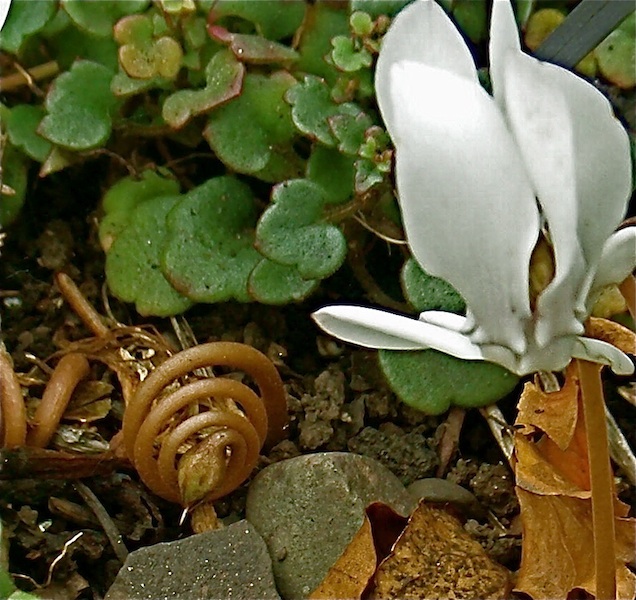
The unfurling stem of this white autumn cyclamen looks like a small snake uncurling its sinuous body. Those of you for whom snakes in the garden are commonplace will no doubt put me right. As I have never seen a snake here, this pretender will have to do. You can even see the tongue,  unfortunately unforked, testing for whatever snakes test their environment for.


The October Bunting is out. Virginia creepers are a magnificent sight at this time of year. The one above grows on an ancient stone wall and the one below has sneaked its tendrils into the welcoming arms of a conifer.


October is not only golden, it also decks itself out in the most glorious shades of red. Below is another example:


Ripe elderberries have been picked, laboriously removed from every little bit of stem and stalk, left to ferment in a bucket for a few days, and are now sitting in their demijohns, fitted with fermentation locks and bungs, to complete fermentation, before they are bottled and stored for a year or two to mature. The homely sound of  bubbles escaping from the locks will accompany us throughout October.

It is such a shame that I simply cannot get my personal wine drinking tastebuds adapted to fruit wines. Beloved drinks his fruit wine with pleasure, whereas I demand the fermented grape. I am more than happy to use his product for cooking, though; it adds the most deliciously fruity tang to many of my stews and casseroles and a meat sauce or hearty gravy is much improved by it.


When I opened the back door this morning I walked straight into the gossamer threads of a spider's web.

It's a slightly unpleasant feeling and I instinctively swiped at my face and flapped my hands in front of me. Luckily, the centre of the web was higher up, against the doorframe and I damaged very little.


I quickly looked for the spider itself; it was hiding a long way from the web, with a fine signal line  leading from its secretive retreat in the angle between doorframe and wall. Araneus diadematus is one of the most common and best known orb weavers. It is easily identified by the distinctive white cross on its back (although in some specimens it is indistinct or missing). This spider is most commonly called the 'garden spider' in England, it is also known as the cross spider. They are common in woodlands, heathlands and gardens. I am not sure if this representative of its kind still has the requisite number of legs.

The garden spider is mature from summer to autumn and at its largest in late autumn and often full of eggs. After laying their eggs the females die and only the eggs and the spiders that hatched in spring that year will overwinter. I couldn't see a nest; although I am not frightened of spiders and quite a fan of wildlife, I probably wouldn't want to share my house with a large family of them.