Showing posts with label Mythology. Show all posts

Monday, 28 November 2016

Nemesis Day

How utterly exhausting it is to get tangled up in politics for weeks on end; it’s draining, physically and mentally. True, we need to get angry when we, our lives and our Earth are threatened; we should act on that anger if there is the smallest chance that our action matters, but for far too many of us there is little we can do to change things in the short term; we might as well continue with our day to day life and make what we can of it. Dreary, dark November is a joyless month anyway, looking for added misery only exacerbates the gloom.

I would love to believe in the truth of this quote by Lord (George Gordon) Byron 1788-1824, that most notorious and flamboyant Anglo-Scottish poet. :

“Time and Nemesis will do that which I would not, were it in my power remote or immediate. You will smile at this piece of prophecy - do so, but recollect it: it is justified by all human experience. No one was ever even the involuntary cause of great evils to others, without a requital: I have paid and am paying for mine - so will you.”

Were he living now he might vulgarly call it Payback Time.

In ancient Greek religion, Nemesis was the goddess who enacted retribution against those who succumb to hubris (arrogance before the gods). Another name was Adrasteia, meaning "the inescapable”. The Romans knew her as Invidia.
Alfred Rethel “Nemesis"

The ancient Greeks knew a thing or two about retribution, in the shape of the Goddess Nemesis it was a recurrent theme of many Greek tragedies. Nemesis was to be feared and a sure and inevitable reward for arrogance and conceit, self-importance and egotism.

I came across Nemesis in a very much more modern setting, in one of the short stories by Saki (HH Munro). Clovis complains that there are remembrance days throughout the year which persistently harp on one aspect of human nature and entirely ignore the other: we have Christmas and New Year, Easter, Birthdays and Anniversaries, when we are encouraged by convention to send gushing messages to all and sundry; to pretend optimistic goodwill and servile affection to people whom we can scarcely abide in reality.

Clovis continues:” There is no outlet for demonstrating your feelings towards people whom you simply loathe.”

Does he perhaps have a point?

Would a recognised Nemesis Day be such a terrible idea? Would we all wait for it impatiently and look forward to taking much pleasure in the settling of old scores and grudges being “gracefully vindictive to a carefully treasured list of people who must not be let off” ?

Or do we turn the other cheek by responding to injury without taking revenge?

Questions questions, problems, problems. I am not one for turning the other cheek, but neither am I a great one for openly seeking revenge, openly being the operative word. Besides, nurturing grudges is such a waste of precious time. I only learned that lesson in the second half of my life and have thereby saved myself a lot of heartache.

There may be a third way of coping with a world we find hard to understand and that is to take to heart the words of Wendell Berry, a poet whom I love and admire more and more:

When despair grows in me
and I wake in the night at the least sound
in fear of what my life and my children's lives may be,
I go and lie down where the wood drake
rests in his beauty on the water, and the great heron feeds.
I come into the peace of wild things
who do not tax their lives with forethought
of grief. I come into the presence of still water.
And I feel above me the day-blind stars
waiting for their light. For a time
I rest in the grace of the world, and am free.


Thursday, 18 September 2014

Self Pity And Other Vices


When delving into the philosophy of how best to live life in midlife and beyond, many bloggers stress the importance of remaining productive, being positive, keeping busy, working for others via charitable deeds, and practicing gratitude for everything life hands out, every breath we take, every additional day we are granted. Idleness, self-indulgence, a bout of self-pity, a moan about ’the unfairness of it all’, some healthy self-interest, are castigated as unworthy, foolish, sinful. There’s that little word ‘self’ again. Perish the thought it should get a foothold!

Well, I don’t agree. Not in the blanket, no-deviation-allowed-ever way.

What did the ancient Greeks call a person who takes the afternoon off instead of concentrating on filing her (overdue) tax return? A lotus-eater! A diet not to be sniffed at in my opinion. What’s the point of having reached that famous midlife and beyond point if I’m still flogging myself into a frenzy of activity?

I am looking up poems for tomorrow’s poetry group meeting. The subject is ‘Happiness’, which, according to the advocates of all those virtues mentioned in the first paragraph, is the sure-fire result, if only you practice what they preach.

Guess what, not a single poem on Happiness I found, praises relentless positivity, busyness, rattling through the days on a quest for achievement, aching muscles and a to do list with every item crossed off. A bunch of lotus-eaters if ever there was one, these poetry merchants. They are happiest lying on their back in the grass, watching drifting clouds,  their reverie interrupted by the cries of a flock of geese. That’s all they need to set off a train of thought ending in something as fleeting and immaterial as a poetic idyll. (Unless they are enclosed in an attic, starving and warming their hands on the pitiful flame of a candle stub.)

I’m all for it. (The lying in the grass, not starving in a garret)

As for the most vilified sin of all, self-pity, who can say that they are entirely free of the occasional bout? Why is it considered to be particularly disgraceful? I see it as neither a virtue nor a vice, but simply an inevitable emotion. Others may sympathise with our misfortune, but the moment affairs of their own divert their attention, we are alone again, unconsoled. We have to be sorry for ourselves: nobody else can sympathise with us as steadily, as loyally as we, and it is from such sympathy that we draw strength to put a decent public face upon our misfortunes.

I’ll allow gratitude. Aesop, another ancient Greek, said ‘Gratitude is the Sign of a Noble Soul’. But I doubt he meant it in the sense of being grateful for all the nasty surprises life has in store for us. When the people of Delphi sentenced him to death on a trumped-up charge of temple theft, he cursed them. After they’d thrown him to his death off a cliff, the Delphians suffered pestilence and famine.


Sunday, 16 February 2014

The Wonders of the WWW

or How to Spend a Profitable Afternoon. (It’s still raining)

What started me off I no longer know.  I remember I was idly looking for poetry by Wilhelm Busch, to enliven a meeting of the German Conversation Group next week.  Heinrich Christian Wilhelm Busch (1832-1908) was a German humorist, poet, illustrator and painter. He published comic illustrated cautionary tales from 1859; the one most people know is the tale of Max Und Moritz, a Rascals’ History in Seven Tricks:


Ah, how oft we read or hear of
boys we almost stand in fear of.
For example, take these stories
of two youths, named Max and Moritz
. . . . . . .

Busch was a wise old bird and I enjoyed my trip down memory lane. How Busch led to Tannhauser I have no idea now, but Tannhauser was the next port of call. I am frequently surprised that the obscure subjects which interest me can be found on the internet at all;  I am duly grateful, nevertheless.

Wagner’s Opera Tannhauser is well-known; I wasn’t after Wagner, I was after the legend on which Wagner based his libretto. Tannhauser was a knight who,  based on his Bußlied, (song of atonement) became the subject of legend. The story makes Tannhäuser a knight and poet who found the Venusberg, the subterranean home of Venus, and spent a year there worshipping the goddess. Not from afar, either. As these things go, he duly became aware of his sinful behaviour, left the Venusberg, asked Pope Urban for forgiveness but was told that forgiveness was as likely as it would be for the papal staff to burst into blossom. Which it promptly did, it’s a legend, after all. But Tannhauser had already gone back to ground with Venus and was never seen again.

Tannhauser wasn’t only a legendary figure, he was an active courtier at the court of Frederic II in the 13th century,as I found when I clicked on a learned text, the Codex Manesse, the single most comprehensive source of Middle High German Minnesang poetry. The manuscript is famous for its colourful full-page miniatures, one each for 137 minnesingers.The Codex was compiled in the first half of the 14th century and lists the names of Minnesingers of the mid 12th to early 14th century, Tannhauser among them. (How he became the stuff of legend is not immediately apparent. I expect somebody somewhere knows but I’d have to go on clicking for a lot longer to find out.) The Codex itself has had a very turbulent destiny, having changed ownership in many wars, disputes, a succession of rulers and even for filthy lucre at times. Now it’s back in its spiritual home of the University Library of Heidelberg.

The www is a wonderful tool, but rather lonely. Beloved and I used to do this sort of journey of exploration via books in the old days; ending up with piles of them, each reference leading to another, until books and time ran out. So, come suppertime, I told him of my researches and we instantly fell into the old habit, minus the pile of books. Wagner’s Tannhauser came first, Beloved being knowledgable about opera, but then we went off at a tangent, confusing Tannhauser with Lohengrin, who is a character in German Arthurian literature. The son of Parzival (Percival), he is a knight of the Holy Grail sent in a boat pulled by swans to rescue a maiden who can never ask his identity. His story, which first appears in Wolfram von Eschenbach's Parzival, is a version of the Knight of the Swan legend known from a variety of medieval sources. Wolfram was a German knight and poet, regarded as one of the greatest epic poets of his time. As a Minnesinger, he also wrote lyric poetry. (The miniature is taken from the Codex Manesse, as is the one of Tannhauser above.)

Naturally Elsa, the maiden whom Lohengrin rescued and who became his wife, asked after his origin, which made Lohengrin take up boat and swan and disappear back down the Rhine, never to return.


We hadn’t quite finished with our exploration; having been to Kleve (Cleves) and the Schwanenburg with the tower from which the legendary Elsa espied her knight in shining armour floating down the Rhine to rescue her, we briefly revisited our memories of the trip but soon got back to more ancient times, i.e, Anne of Clevesthe Flanders Mare, who became Henry VIII 4th wife from January to July 1540. They clearly didn’t hit it off and the marriage was speedily annulled. Holbein’s painting of her is said to be more flattering than realistic.

Having arrived at Henry VIII, about whom we know far too much to feel the slightest interest in exploring him further than in theatrical plays on the stage, we finally gave up.

I had a lovely time, we both did. I even enjoyed writing this post.


Monday, 21 October 2013

The Day of the Little Bear

The Martyrdom of St Ursula
German art - 16th century

It’s been my name day today. In mainly catholic countries in Europe as well as Latin America, somebody’s name day is at least as important as their birthday, sometimes more so. In olden days a child was christened the day after birth and given the name of the saint who had died or been martyred on that day. For instance, Martin Luther was born on the 10th November and christened on the 11th, the feast day of Martin of Tours.

Birthday celebrations have taken over in secular life and when I mention name days I always get “what’s that?” in return. But for my aunt Katie and her friends, who lived in a small rural community on the Lower Rhine, name days were the highlight of their personal year. Each one of them baked cakes and pastries in advance of their  own great day and invited the others and anyone whom they valued, brothers and sisters and cousins, to ‘Namenstag Kaffee und Kuchen’ and a little something home brewed to round off the festivities. They made fruit liqueurs in those days, potent enough to redden checks and loosen tongues; wine and ready bottled alcohol was beyond their means. Everybody brought flowers, often pot plants, and a small present. The more friends and family you had, with whom you were on good terms, the more often you were part of this harmless indulgence. My father disapproved and when he made his usual dog-in-the-mangerish remarks, my mum said “nothing to do with you; let them have their fun”; living in town she wasn’t part of aunt Katie's jolly circles. I am sure she often regretted it.

I got my Christian name quite by accident. Mum and Dad had lost their first child and may therefore not have wanted to be too certain that the second child, i.e. me, would live; anyway, they didn't discuss names. When the nurse came to enquire, they looked at each other and said “we don’t have a name for her.” (Good start, wouldn’t you say?) Babies were kept away from mothers in communal nurseries until they were handed over to be fed.  The next time the nurse distributed her squalling and hungry charges, she said to my mother: “and for you I have a little Ursula”. “So be it”, my parents said, “one name’s as good as any other.” That’s how I became “the little bear”.


The legend of Ursula is based on a 4th- or 5th-century inscription from the Church of St. Ursula (on the Ursulaplatz) in Cologne. It states that the ancient basilica had been restored on the site where some holy virgins were killed. St Ursula is no longer wholeheartedly endorsed as a Christian martyr, too many different versions of her story exist and there is little evidence that any of them are true. Ursula and 11.000 virgins were supposedly killed by the Huns when they overran Cologne. The figure of 11.000 is probably a misreading of the Latin text, and the 11.000 virgins were more likely 11 ladies of Ursula’s royal train.

Be that as it may, I quite like the idea of being named after a Romano-British royal personage, who did good deeds and led a short but exemplary life. Granted, her ending wasn’t much fun, I’d have probably married the Hun prince rather than opted for martyrdom - where there’s life there’s hope of getting out of a sticky situation - but she wouldn’t have become famous if she had.

I didn’t celebrate my name day but I had a lovely present anyway: the absolutely delightful Frances of City Views Country Dreams came all the way from New York to Ludlow, in the pouring rain, to spend a glorious afternoon with me, no sacrifice required.


PS: that’s Ludlow in the UK, so from New York, NY to Ludlow, UK, is quite a distance.


Thursday, 9 May 2013

Green Man Day 2013


The Green Man may have won the battle for supremacy over Frosty, the cruel Ice Queen, and installed the May Queen on her throne for what is laughably known as summer hereabouts, but there’s no guarantee that he can defeat regular English weather gods, who have been throwing bitter winds and driving rain at us today, just three days later.


The Battle on the Bridge is the dramatic focal point of the Green Man weekend, and always takes place at noon on Mayday (Spring Bank Holiday Monday). The Green Man and Ice Queen each have their entourage and approach the Bridge in procession from opposite sides. The Green Man comes down the hill from the Church with the May Queen, whilst the Frost Queen descends Bridge Street with her little icicles. Thousands of visitors come for the weekend to join in the spectacle, while half the inhabitants barricade themselves in and don’t appear until the last teacups and beer mugs have been fished out of the river and village dogs have retrieved and eaten all remnants of burgers, stuffed bread rolls and ice cream cones.

The weather was glorious, the crowds lively, and the many different bands, canned music, the man with the chainsaw carving animal shapes, and whistling public address systems, all competed with each other for attention.


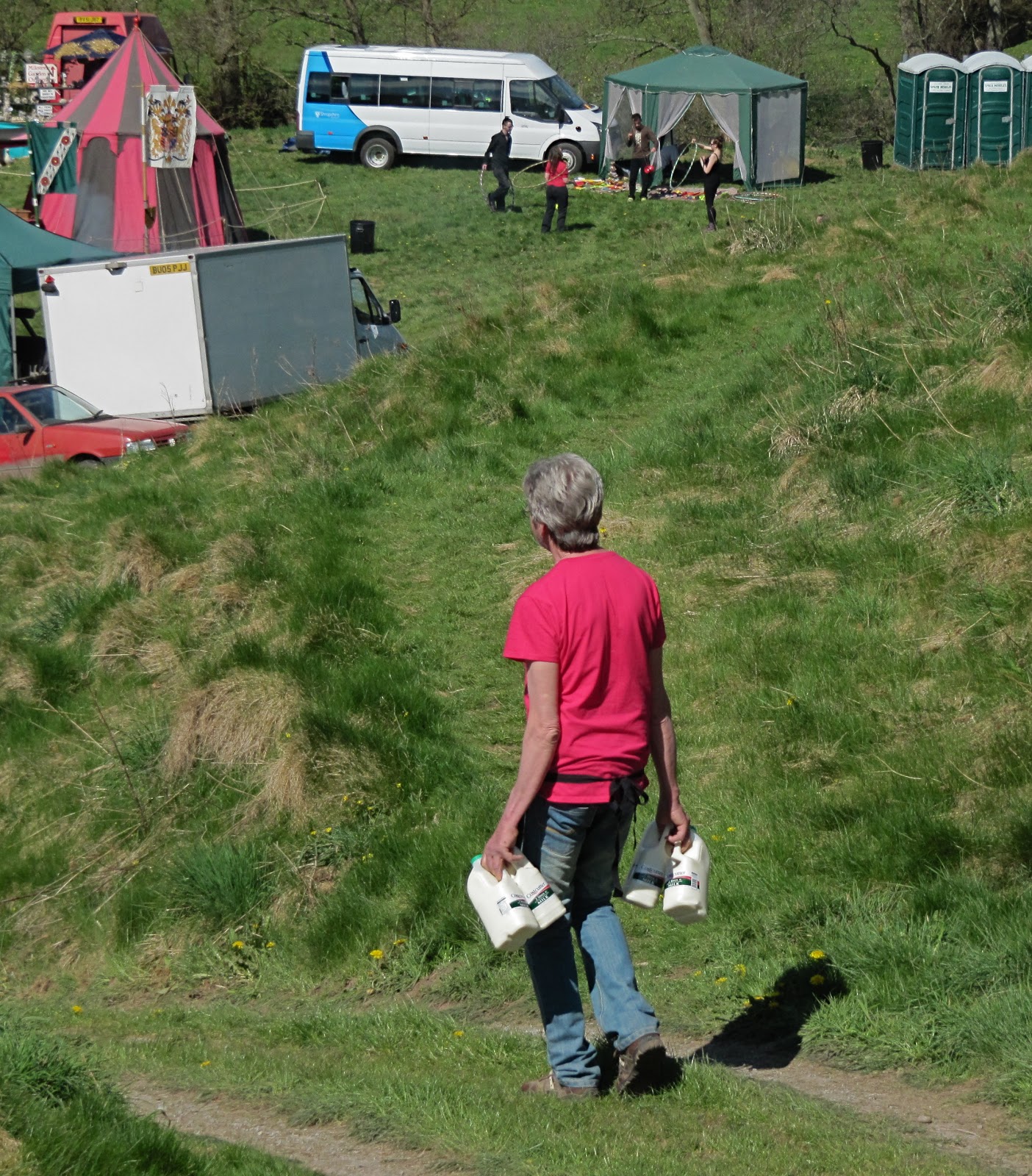
 Mid-morning stallholders set up tents and gazebos.

 Getting in supplies for the tea tent.


 Portable toilets handily placed behind the large beer tent.
One in - one out, 
quick turnover assured.

 Let the fun begin.


Friday, 15 March 2013

Friko’s solitary Alphabet Game - H is for Halcyon

Photograph by Charlie Fleming


Currently mired in a period of blogger’s paralysis, and struggling to find anything in the least post-worthy, I remembered that quite a long time ago I started to play a solitary alphabet game, had a look where I’d stopped and found ‘H’ to be the next letter up. ‘H’ is a very common first letter in English; I wanted something impressive and asked Beloved for inspiration. He came up with 

“ haruspicy, haruspication "
a form of divination from lightning and other natural phenomena, but especially from inspection of the entrails of animal sacrifices.

The man is priceless.

“Thank you dear, but I think I’ll give that one a miss, delving in entrails is not what I had in mind for the moment."

But there is a word I’ve always liked, even before I knew what it meant “Halcyon”. Just try it on your tongue: hal-cy-on.  Doesn’t it sound beautifully mellow and promising? It reminds me of those long-ago days of summer when we children went to swim in flooded gravel pits, where the ground water was deep and came up icy cold and the black surface of the artificial lake hardly reflected any sunlight, making it appear opaque enough to walk on. For safety’s sake we had an older sister or brother in attendance but they were usually too busy eyeing up other teenagers to watch over us small fry. One or two dads were sprinkled among the children, spread out on a blanket and in charge of drinks and sweets and ready to bundle a shivering child in a towel before it died of hypothermia. We never had a dad of our own present but other children’s dads served as communal guardians. And not only guardians, but teachers as well. Long before I went to big school and officially learned to speak High German I had no qualms about attempting it anyway. Always willing to show off ‘big words’ and ‘long sentences’ I frequently got it wrong enough for any educated adult present to show signs of distress. One dad clearly couldn’t take any more and rounded on me, correcting my grammar in schoolmasterly tones, thereby embarrassing not only me and himself, but the other children around. “Don’t talk so much”,  the teenaged sister of my little friend said, “what I’m wearing to the dance is not your business.”

The 'halcyon days of old' is the expression mostly used. But halcyon is also the Greek name for the Kingfisher, born out of a gentle tale from mythology. Alcyone  was the daughter of Aeolus, either by Enarete or Aegiale. She married Ceyx, son of Eosphorus, the Morning Star.They were very happy together in Trachis, and according to Pseudo-Apollodorus's account, often sacrilegiously called each other "Zeus" and “Hera”. This angered Zeus, so while Ceyx was at sea (going to consult an oracle according to Ovid's account), the god threw a thunderbolt at his ship, causing it to founder, with all hands drowned.  Soon after, Morpheus (God of Dreams) disguised as Ceyx appeared to Alcyone as an apparition to tell her of his fate, and she threw herself into the sea in her grief. Out of compassion, the gods changed them both into halcyon birds, named after her.

A pair of kingfishers can be seen flitting under the bridge at Valley’s End at certain times of the year. You have to be very quick to follow the blue flash with your eyes. A flash is all I’ve ever caught up to now,  low over the water when the river is fast enough for fish to collect in the basin on the other side of the gravel bank.

Sunday, 11 December 2011

On The Banks of The River Acheron


On the banks of the River of Woe,
Forsaken by the gods,
I await your return from Hades,
O Charon.
Sullen and wrathful my life,
In death condemned
 To wander
These shores,
My soul yearns for release.

I beseech you,
O Charon,
Ferry me across the dark river
To the mouth of Hades,
And the Adamantine Gates
Guarded by Cerberus,
Take me to
Eternal bliss
In the Elysian Fields.
My Obol be your reward.