Showing posts with label Permutations. Show all posts

Tuesday, 16 April 2019

The Pursuit of Happiness

Lately I haven been thinking about happiness. Not only asking what it is but is there anyone who is likely to have more than a few months of positive happiness during a lifetime? Let’s assume that most of you are familiar with the full quote in the-declaration-of-independence, that is not what I am concerned with here. For the first time this year I heard of the annual International Day of Happiness on March 20th; this year’s theme is Happier Together, focusing on what we have in common, rather than what divides us. So this is what set me thinking of the rather strange phrase The Pursuit of Happiness, which first of all, brought me to the lines in Philip Larkin’s poem for Sally Amis, 'Born Yesterday'

In fact, may you be dull —
If that is what a skilled,
Vigilant, flexible,
Unemphasised, enthralled
Catching of happiness is called.

Nothing Earth shattering, gut busting, deliriously heart palpitating here, nothing pursued at full tilt, nothing desperately grabbed and held and jealously guarded here.

How can you pursue happiness? Isn’t it rather something that falls to your lot unexpectedly, that catches you unawares; if I were to set out to be truly happy deliberately, I wouldn’t have the first idea how to go about it. I am more likely to follow Emily Dickinson's’ Little Stone, of which she asks:

How happy is the little Stone
That rambles in the Road alone,
And doesn’t care about Careers
And Exigencies never fears —
Whose Coat of elemental Brown
A passing Universe put on,
And independent as the Sun
Associates or glows alone,
Fulfilling absolute Decree
In casual simplicity —

Independence, without a care in the world, not seriously striving but rambling happily, are what set the little stone - and therefore us - on the path to happiness.

Even simpler - and more fun is AA Milne’s John who

          had
Great Big
Waterproof
Boots on;
John had a
Great Big
Waterproof
Hat;
John had a
Great Big
Waterproof
Mackintosh --
And that
(Said John)
Is
That.

Yes, John and that great big puddle is waiting for you and what greater happiness can there be than jumping right in with both feet?

But Judith Viorst, the American writer, newspaper journalist, and psychoanalysis researcher - someone I had not come across before I ruminated about happiness - and what a happy find she turned out to be - sums it up for me perfectly:

Happiness (Reconsidered)

Is a clean bill of health from the doctor,
And the kids shouldn't move back home for
more than a year,
And not being audited, overdrawn, in Wilkes-Barre,
in a lawsuit or in traction.

Happiness
Is falling asleep without Valium,
And having two breasts to put in my brassiere,
And not (yet) needing to get my blood pressure lowered,
my eyelids raised or a second opinion.

And on Saturday nights
When my husband and I have rented
Something with Fred Astaire for the VCR,
And we're sitting around in our robes discussing,
The state of the world, back exercises, our Keoghs,
And whether to fix the transmission or buy a new car,
And we're eating a pint of rum-raisin ice cream
on the grounds that
Tomorrow we're starting a diet of fish, fruit and grain,
And my dad's in Miami dating a very nice widow,
And no one we love is in serious trouble or pain,
And our bringing-up-baby days are far behind us,
But our senior-citizen days have not begun,
It's not what I called happiness
When I was twenty-one,
But it's turning out to be
What happiness is.

None of the poets and writers here has mentioned the one cause of happiness that started me off on my small quest: other people. I may leave that for the next post.


Tuesday, 1 March 2016

Permutations, Perambulations and Pictures

Millie is throwing me a dirty look from under lowered, speckled-white eyebrows: “Can we Please go out? It’s a lovely day.” 

“Oh, very well then.” She’s right, it’s chilly but the sun is out and I really shouldn’t waste the morning. I’m still very much up and down, given to mood swings, feelings of depression one minute, hopeful the next. A brisk walk in bright sunshine would surely do me good. 
It is indeed a cheery morning. We go up the old track leading out of Valley’s End towards Bishop’s Castle until we get to the crossroads, where we turn right, with our backs to Bicton Hill.

Ever since we’ve first lived here I have called this crossing of two field edge footpaths “Gallows Corner”. I can no longer remember who told me this but today, wanting to find out more about this gruesome, now disappeared, relic of past justice I asked several long time residents and local historians; none of whom had ever heard of it. Mr. Wells remembered the stocks next to the Town Hall, now the village museum, where wrong ‘uns, who had celebrated market day a little too carelessly, were shackled by their legs; I suppose they were lucky not to have been thrown into the lock-up proper from where they wouldn’t even have been able to see the fun, there being no window in the mouldy cell. On the other hand, well-meaning burghers might have pelted them with rotten vegetables?

Having walked along 'The Modems’ (again, I must find out why this track across the hill on the Southern edge of Valley’s End has this name), towards Radnor Hill we climbed the stile conveniently cut into the hedge into the next field.  Radnor Hill is mainly limestone, discovered and quarried by the Romans when they colonised this part of the country in the middle of the first century AD, and even today there are remnants of very early quarries on top of the hill, with several smaller and more recent quarries nearer the base.

Back down in the village, having slithered down a still muddy and steep path, via the old pool which has caused so much controversy and falling out of neighbour with neighbour, and along a small stretch of road past the entrance to the alms houses, we turned left to the allotments and the kissing gate, which leads to a track between two fields.  A kissing gate is a type of gate which allows people to pass through, but not livestock. The normal construction is a half-round, rectangular, or V-shaped enclosure with a hinged gate trapped between its arms. The kissing gate is often the subject of chatter about the origins of its amorous-sounding name. The prosaic answer is that it derives from the fact that the hinged part touches – or ‘kisses’ – both sides of the enclosure rather than being securely latched like a normal gate.

That hasn’t stopped many clinging to a more romantic notion: that the first person to pass through would have to close the gate to the next person, providing an opportune moment to demand a kiss in return for entry. I know which answer I prefer.

Kissing gates are often found at the entrance to church graveyards but there is no evidence that this has any symbolic significance.

Once we are through the gate - I have to hold it open for Millie and she snakes through without demanding a kiss - the field track to 'The Green’ lies ahead. (in spite of its name, ‘The Green’ is our tiny industrial estate consisting of three low and rather attractively built structures - one even has arched windows, like church windows. The industry pursued here is entirely rural, causing neither pollution nor noise.) The lower slope of Radnor Wood  is getting closer.


Three ponies and three sheep live in the paddock  at present. The field on the left has some kind of crop growing, possibly rape. Or perhaps winter wheat? I have no idea why just three sheep, when they are so plentiful everywhere else and are certainly never given any special treatment.
One of the ponies comes to inspect us. I often have an apple in my pocket, perhaps that’s why. Millie and the pony sniff each other but then lose interest. (‘The Green’ industrial estate is visible over the hedge on the other side of the paddock). At the other end of the field edge track we climb a stile and return to the village and the ford across the river.

Snowdrops and daffodils brighten he banks of the river. The waters have receded, although the river ‘was out’ when we had those endless heavy rains earlier this year and at the end of last year;  the levels have sunk, roads are clear and 4x4s can cross the ford again. I wouldn't like to try crossing in my small and ordinary car but then, I don’t have to. Valley’s End has a perfectly good humpback bridge built as recently as anno 1450 and still going strong. Well, with the fairly regular exception of lorries crashing into it, causing the locals no end of amusement while watching desperate drivers trying to extricate themselves without doing too much further damage. Many times drivers who had miscalculated the angle from road to bridge simply shot off, leaving the scene of the crime in as great a hurry as our narrow country lanes would allow. But, no more. Valley’s End has installed a camera! The guilty party will be caught and made to pay! Unfortunately, the parish finances are none too healthy and I am not sure that there was enough money in the kitty for both camera and film.


Millie was right to get me out. I am feeling much better. Tired, of course, after little in the way of exercise for several weeks, but I might take heart and go off again tomorrow.


Monday, 30 November 2015

Reporting Failure


I knew I would regret starting a week-long series of posts on positivity. It’s just not like me to go searching for 'reasons to be cheerful’, (as in Ian Dury and the Blockheads’ song), or ‘Looking on the Bright Side of Life’ (Monty Python and the ‘Life of Brian’) or ‘Counting my Blessings’ as the hymn tells me to do.

Don’t get me wrong, the attitude of looking at life through positive spectacles is to be welcomed; perhaps one needn’t go as far as Pollyanna and play the Glad Game whatever happens. Finding a pair of crutches in the Christmas stocking would make me cross enough to hit the giver over the head with them. At the other end of the spectrum, Ambrose Bierce in the Devil’s Dictionary writing off ‘positive’ as ‘mistaken at the top of one’s voice' is just plain unkind towards people whose philosophy tends to embrace certainty, tiresome though these people can be.

There have been plenty of good things happening this week, which ended in the first Sunday in Advent and with it the first pheasant dinner of the season: a live screening of Shakespeare’s ‘The Winter’s Tale’ at a local theatre, a pleasant meal at a cosy pub, some clothes shopping, and the poetry evening and beauty treatment already mentioned in the previous posts. Actually, it’s been an exceptionally good week. It would be hard to see it in anything other than a positive light. But these are not the cosy things bloggers praise when they write about appreciating humble, small joys. Heart-warming stuff, good stuff. For my week I needed leisure and a reasonably well stocked wallet. Bragging about it in detail would be bad taste. Of course, at times I am a smug git, but I’ll try not to show my true colours here.

I am profoundly grateful that I live in a peaceful country, that I am not one of the desperate people fleeing torture, bombs, destruction, hunger, disease and the horrors of civil war.  Not for me the undignified queueing up on Europe’s borders, begging to be admitted to shelter, food, work, and a life free from fear. Not for me the fate of being called a terrorist, a scrounger, a welfare tourist. Winter is coming and too few European nations seem to be aware that help is urgently needed to prevent chaos and save lives. Although in the UK we are spared pictures of the footsore and shivering crowds making their way across Europe from East to West - compassion fatigue sets in quite quickly here, the subject seems to have been swept out of sight recently - I have access to European TV channels and find myself utterly fascinated by and unable to look away from so much misery.

Being aware of my good fortune and counting my comfortable little blessings seems almost shameful in the face of suffering humanity. Therefore, rather than listing a week’s worth of pleasures, small or otherwise, I shall try to emulate those of you who find unexpected joy in the moment and, if I think about it in time, perhaps share it here.


Wednesday, 25 November 2015

Wednesday’s fortuitous facial with a sneeze thrown in.

Image Wikia - Miss Piggy

No small pleasure this, more a great bit of luck: Helen, the beautician, rang to say she had a cancellation and did I want to make use of it, my original appointment having fallen through. I’m always happy to have a shave and some hot towels applied to my face, I’ll even put up with a massage and a mask, and today’s treatment was a joy, as always. 

Something in one of the products she used made me sneeze; as this would be a very meagre little post otherwise, I’ll add some wisdom which might come in useful during the winter months:

“Concerning Sternutation or Sneezing, and the custom of saluting or blessing upon that motion, it is pretended and generally believed to derive its original from a disease wherein Sternutation proved fatal, and such as Sneezed died . . . . Yet Sneezing being properly a motion of the brain, suddenly expelling through the nostrils what is offensive to it, it cannot but afford some evidence of mental vigour. Sir Thomas Browne 1646

Another bit of luck: I met no one on a three mile stretch of very narrow country lane, with both edges muddy and deeply rutted; I’d have had a heck of a job to get out of the way of another vehicle, particularly if that vehicle had been a tractor.


(Only day 2 of my positive thinking week and I’m already scratching around in the mud for material).


Tuesday, 24 November 2015

Tuesday’s Positively Pleasurable Permutation

Two moments of awareness in one day, who’d have thought it: -

It’s not that I wouldn’t have seen this chink of light breaking
through the darkness of the afternoon but today I made an effort 
to let it please me instead of just shivering and scuttling for home
as quickly as possible.

Paul came this morning to start the great tidy up of the woodland garden.
He also took the time to strim a path for me from the side gate down to the moat.
This path, which is normally very overgrown, becomes slippery once rain 
freezes and icy patches form. Now I can see where I put my boots and
 may save myself from a tumble down the bank.
Thank you Paul.


There is one pleasure yet to come tonight: it’s poetry evening chez Friko. The subject is ‘Battle’ (as opposed to war poetry). Not a subject I find riveting but I’ve found a couple of potboilers, one of which is funny: "The Battle of Hastings", which ends with ‘Arold on ‘is 'orse with an eyeful of arrow and a ‘awk on 'is ‘and, preferably to be read in a Cockney accent. while the other is a patriotic, gung-ho thing - "The Battle of the Baltic” - which is full of cannon, gore and hearts of oak.

I’d better get the wine and nibbles ready.


Monday, 23 November 2015

A Week’s Worth of Positive Thought

birch in November

maybe.

Try as I might I can’t find anything good about November, except that it’s nearly over and hasn’t been too onerous a month this year. In fact, it’s been flying by; what happened to it, where did it go? There’s been barely enough time to indulge in proper misery and the trough of despond and I hardly touched sides, although I tried my best. (Any more cliché-d phrases and I shall make myself sick).

Misery and I are good friends, and sometimes I positively relish her. Still, I’m going to try and give her up, at least for a week. The fault for this decision lies with a friend I met in the village yesterday. We were standing in the middle of the roadway - we do that here in Valley’s End, cars frequently have to make their way around gossiping villagers - catching up. It was dark and dank and dismal and I was hoping she would join me in a moan and a whinge about  . . . .  well, anything really. I’m not fussed. But no, she said she had decided to find something to be pleased about in every day, little, unimportant things maybe, but something to cheer herself up. I had always thought of her as made of sterner stuff, stiff-upper-lip stuff, after all, she is a scientist, but there you are, this mania for ‘positive thinking’ can hit anyone at any time.

Alison was particularly chuffed yesterday because she had been making mayonnaise; the mayonnaise had promptly curdled and she was about to throw it out when she pulled herself up, addressed herself in a firm voice and set about uncurdling it. She succeeded and she has a jar of decent mayonnaise to show for it.

So, just to see what it feels like, I too am going to try to find a small pleasure in every day for one week. And shall report on success or failure here.

I do so hope I won’t regret this. 


Friday, 28 November 2014

Permutations on Lamps and The People Who Owned Them - (V)

At Grammar School my trials and tribulations hadn’t quite come to an end, but I learned to keep my head down and follow the rules. I was now a pupil at a fee-paying Catholic Girls’ School, the child from a poor background and the offspring of communist/socialist atheists, who took their convictions seriously; I should therefore have been totally out of my element. Like many children lacking in confidence, I was only too happy to blend into the background; I’d had enough of being the focus of attention, temporarily anyway.

I made friends with girls whose background was as unlike mine as possible; girls whose parents were well on the way to renewed prosperity, girls from professional backgrounds, business people, farmers who had got rich during the period when most people were starving, and the daughters of minor ex-Nazis. Germany's ‘economic miracle’ was taking hold but there was still a lot of confusion.

The last time a lamp made a particular impression on me was at a birthday party at the house of one of these friends. Birthday parties were rare and modest affairs, and I didn’t really feel like going because Mum couldn’t give me money to buy a present. On the very few occasions I accepted an invitation all I could take was a tablet of chocolate or a second hand paperback. Sigrid was the daughter of a businessman, she had new clothes and a proper haircut and lived on one floor of a large house in a once well-to-do area. I remember the living room as enormous, although it would probably not be as grand today as it seemed to me then. The room was well and comfortably furnished, with a special and separate seating area near the large window: three upholstered easy chairs around a small table, and a standard lamp in the corner behind it. The lamp drew me like a magnet and I asked if we could sit there instead of at the dining table at the other end of the room. Sigrid was surprised when I sat down in the chair under the lamp, leaned back and stretched out my arms on the arm rests. In the end we sat on the carpet and admired her presents, until her mother came in with hot drinks and cake for the three of us, Sigrid,  Elke, whose war widow mother was a teacher, and me.

I’ve got used to all sorts of lamps now; our lighting is slightly haphazard, some lamps have permanent positions, others are moved about the room to wherever they are needed. Ceiling lights are strong and have shades; Beloved with his poor eyesight likes them best and, if he had his way, they would all blaze away at the same time and cosy little corners with dim lighting would be done away with in our house.


Afterword

Writing this necessarily abbreviated series has not been easy. I’ve smoothed over some of the rough edges, yet a whole host of painful memories came flooding back and I felt great pity for the sad and lonely girl who didn’t really fit in anywhere. As an only child I carried the full weight of my parents’ hopes and aspirations; inevitably, they were disappointed many times. Ungrateful, they called me when I displeased them yet again. “How sharper than a serpent’s tooth it is to have a thankless child. Away Away!” so said King Lear in a fit of rage to Cordelia, and, like her, I left.

None of that matters now, one can’t live ones life in permanent regret for what happened in the past; it becomes a story to tell like so many other ups and downs one lives through; looking back, events become distant and unreal. There is, however, one aspect I regret very much nowadays, particularly when I read bloggers’ posts or listen to friends’ accounts about their close connections with siblings, the places they lived in as children and throughout adulthood, from school years to university and through professional lives. I envy the continuity and the ties that keep such lucky people firmly anchored and deeply rooted. I know that rarely do two people remember their joint past in quite the same way but I would love to be able to argue about it. I have lots of unanswered questions and no one left to ask, much less answer them.


Monday, 24 November 2014

Permutations on Lamps and The People Who Owned Them (IV)

Yes, there had indeed been a meeting, possibly the sort of thing that might be called an emergency council. We didn’t know about it at the time, it was much later that a fellow pupil in my new school told me in confidence, urging me never to reveal the ‘secret’. Or else her Dad, who was a member of the school’s governing body, would get into deep trouble. She also confided that her Dad and my Dad shared political sympathies; if these were known they would jeopardise his position. I was a loyal little body but also so cowed by now that I obeyed without thought, not even telling my parents. I don’t think I ever did.

Herr Thomanek stood above us on the level half landing with Mum and me on the steps below him. His physical attitude was that of a bully but his voice had softened a little. He seemed to be uncomfortable and spoke quietly. I was crying enough not to be able to hear him anyway; Mum listened, she didn’t speak for a long time. She nodded and appeared to agree with him and said to me “I’ll tell you when we get home.” They didn’t explain or ask my opinion..

Before we turned back down the stairs to leave I urgently wanted to make Thomanek understand that I never meant to be ‘cynical’ (whatever the word meant) and that I only smiled at him during lessons because I liked them. Hopefully, I lifted my tear-streaked face, but he turned abruptly, without looking at me.

In the German Secondary School System Middle School was the less academic branch of higher education. Although core subjects were taught, i.e. foreign languages, maths, geography, history etc., the school for academically gifted children was the Grammar School, where subjects included classics, science, music, German literature, etc. School fees were higher and students stayed on to 18/19 years of age.

At that time, in the 1950s and early 60s, both Middle and Grammar schools were occupying the same large building. It was one of the few in the town left unbombed and everywhere schools and other establishments budged up to make room for those who had lost their premises.

The heads of both schools, their senior staff and representatives of the governing body, including my fellow student’s Dad, had decided that the situation in Thomaneks’ classroom had become toxic and it would be impossible to restore order. I would have to leave. I would be offered a place in the same year at the Grammar School; school fees would be waived and I would continue to receive a scholarship. It was to be hoped that I was bright enough to catch up. It was fait accompli. Take it or leave it. The alternative was to return to basic education in the ordinary compulsory state system for all children, which precluded any chance of further academic education. Nowadays the choice would be called a No-Brainer.

Within days I was a Grammar School pupil. Some teachers disliked me from the beginning, rumours of misconduct had gone round both schools but, as now and always, gossip and rumours come and go. The girl whose Dad had spoken up for me and my parents befriended me, we discovered a joint liking for literature and poetry. I didn’t catch up in all subjects, certainly not in those I hadn’t been taught for three years, and I slipped from being top of the class to somewhere in the middle. By and by new, younger teachers came for whom I was an ordinary pupil, not tainted with having caused a teacher’s fall from grace, and we took/didn’t take to each other as such things are arranged in the natural course of events.

Middle School and Grammar School took outdoor breaks at different times but on the same school playground. Sometimes we’d overlap slightly and I’d see Thomanek doing supervising duty. I knew better than to smile at him and besides, he always turned his back on me.


there’s a paragraph or two to do with another lamp to come and a bit of an afterword. But the drama is all over.


Saturday, 22 November 2014

Permutations on Lamps and The People Who Owned Them (III)

“You can’t just barge in here without an appointment”, he blustered. “This is my home and my family and I are about to eat our supper. If you have anything to say about what happens at school you have to bring it up there.”

Mum stood her ground, but he wouldn’t budge. “You have no right to invade my privacy.” He continued to attack us, insisting that he was not going to discuss any complaints except at school. A time was fixed for the next day and we left, having achieved nothing. He had bullied us into submission but his extreme reaction made Mum determined not to let the matter rest. Thomanek knew this, he knew that he would have to answer for his behaviour; Mum, working class, with no more than a basic education and quite unsophisticated, would demand answers from the school establishment.

Alas, she never got them. At least, not in so many words. In 1950s Germany most ordinary people kept their political allegiance, past and present, quiet. My parents, however, were among the few exceptions, foolishly perhaps, but definitely bravely, as they and the family had been during the whole of Nazi-Germany, for which they paid a heavy price. In the 50s the Cold War was raging, with divided and four-sectored Germany the buffer zone between East and West. Twelve million people had fled and migrated from East to West and, until the erection of The Wall in 1961 put an end to it, the mass exodus still continued.

In the end, Herr Thomanek's persecution of me was not due to personal antipathy, but the politics of hatred and fear. He was one of those who had gone on the long trek from East to West.

As a child I was sickly. Weak, under-nourished, too tall, too thin, with lung disease and all the ailments that befell children who had had a poor start in life. I wasn’t the only one, there were many of us. Twice I had been sent to sanatoria, once during the war to the mountains of Bavaria and once after the war to the island of Norderney in the North Sea. It was hoped that mountain and sea air would heal, or at least strengthen, my lungs.

During the time I was a student in Herr Thomanek’s class, Dad was offered a place for me in a sanatorium on the Baltic coast by one of his friends in the Socialist Movement; the problem was the holiday would have to be during term time and require permission from the school authorities. Permission would probably have been granted had the sanatorium been anywhere else but in East Germany, the place many of the teachers at the local schools had called home and had been forced, or had chosen, to leave. Dad, in his naiveté, had committed a monumental blunder. Permission was refused and Herr Thomanek turned against one of his star pupils.

Mum and I still had to meet him. She knew nothing about the politics of the staff room, all she knew was that her child was hurting and she wanted to know why.

We met him during morning break on the half-landing between two floors, leaning against the stone banister. Thomanek was standing above us, looking down. I was half sitting in a window embrasure, crying bitterly all the time of the interview. Although he was physically in a position of superiority, he was noticeably quieter, even conciliatory. The Headmistress had spoken to him and advised that he try to calm Mum down. There had been a meeting, he admitted as much as that.

But what would happen to me?


to be continued


Monday, 17 November 2014

Permutations on Lamps and The People Who Owned Them (II)

I caught a cold, a snot-rattling, throat-rasping, eye-watering, croaking-voiced cold.

Fräulein Optenberg was certain the cold would be gone by the day of the concert. All would be well. I begged to differ. The cold was the perfect excuse for backing out. What teacher didn’t know was that I had long had cold feet and the nearer the day came the more terrified I became. "No, Miss, I am certain the cold won't be gone in time and please excuse me from going on stage”.

Snivelling little idiot.

Frl. Optenberg was frantic. I hadn’t ever heard the phrase ‘The Show Must Go On’; Miss begged, cajoled, implored. I sneezed pitifully, then I had an idea. If it meant that much to her I’d get her a replacement. I’d get her Klara. Klara was plump, small, stupid and in possession of a much healthier, more powerful voice than my lung-sick one. Klara jumped at the chance and was so abjectly grateful that I began to doubt the wisdom of my abdication. Aladdin’s cave was no longer mine for half an hour twice a week.

My cold evaporated, the day of the Christmas concert came and Klara was a great success. Neither Mum, Dad or I were in the audience.

This was the beginning of a lifetime of doubt in my own abilities.

Then came Middle School; I passed the entrance exam with flying colours and was granted a scholarship. There were school fees which my parents couldn’t afford, ends were barely meeting. Still pig-tailed, tall and very skinny and ten years old I joined children from varying backgrounds, some already well-off, particularly the children of farmers and professional people, and some from poor backgrounds like mine, on scholarships. We scholarship kids were the bright ones, the kids from the farms the least able. (That’s not prejudice, that’s how it was. After the war many farmers were rich, had their girls been bright enough they would have gone to Grammar School, where the fees were higher.)

Herr Thomanek was my form master. I adored him and he seemed to enjoy teaching me. For three years all went well. When kids from professional households made fun of my pronunciation of foreign words he shut them up and patiently explained where these words came from and how to pronounce them. Herr Thomanek was my favourite master and I had a bit of a crush on him, as a thirteen year old  might.

When from one day to the next he turned on me I was devastated. Open-mouthed incredulity met every unkindness, every jibe at my expense, every shouted term of abuse. It’s no exaggeration to say that my form master bullied me unmercifully. He focussed the attention of the whole class on me. “There she goes, sneering again. That cynical grin of hers, look at it. What makes you so superior, I would like to know." Once I just couldn’t stand it anymore. I got up from my seat, howling in fear and frustration, making for the door. “Look at her, look how she runs and howls; exactly like one of the Furies.” I went home and finally told my Mum.

That same afternoon Mum grabbed me and we went to Herr Thomanek’s house. His wife came to the door and said we couldn’t come in, they were about to have their evening meal. Mum insisted. For once she believed me without looking for confirmation elsewhere and she was going to get the truth out of him there and then.

We were let into the sitting room. I was probably too distraught to take in details, but I instantly saw an old fashioned roll top desk in an alcove, with lots of papers on the open flap and a lit desk lamp on the shelf above. Otherwise the room was in shadow. Herr Thomanek turned towards us as we entered, his face, illuminated by the lamp, a study in angry discomfort.


to be continued


Saturday, 15 November 2014

Permutations on Lamps and The People Who Owned Them. (I)


"I can’t stand a naked light bulb,
amy more than I can a rude remark or a vulgar action”,

Tennessee Williams’ Blanche Dubois in “A Streetcar Named Desire” gives herself away with this line as someone who prefers illusion to reality; who believes that dressing up naked truth prettily makes everyone happier and everything pleasant and easy. “I don’t want realism, I want magic,” she says in a later scene.

I woud hate to take Blanche as my role model but I admit, that as far as the softly glowing light of a prettily shaded table lamp - or standard lamp - is concerned, I am firmly of her opinion. It’s the kind of magic I want for myself. Standing lamps have always fascinated me, perhaps because such luxury was never my lot as a small child. Naked bulbs dangling from the low ceilings of cellars where Mum and I hid, the narrow glory hole of my bedroom or the slightly higher ceiling of the kitchen/sitting room in which we spent most of our time provided sufficient light but no comfort.  The apparent security and privacy of an individual light wasn’t mine to enjoy until I was an adult, in my own home. Once the hardship of the early postwar period was over, my parents had the means to buy lamps but, although ceiling lights were now provided with lampshades, table lamps were outside any experience they themselves had ever had. Light was a matter of necessity, not comfort; light had to be efficient, nothing more.

Fräulein Optenberg was my Infant School teacher;  she lived with another woman and it was in their sitting room where I saw my first ever upright lamp. It was Advent and a school Christmas concert was planned and I was to go on stage and sing some songs, solo. I was bright and enjoyed singing;  for teacher to choose me from all other children was flattering beyond all measure. But I was also shy and inhibited. I had none of the natural confidence some children are handed in the cradle. Rehearsals were to be held at Frl. Optenberg’s and progressed well. The first time I went, properly cleaned up, my long hair plaited and in my Sunday smock, the two ladies invited me into a room the like of which I’d never seen before. It was probably very modest by today’s standards but to me it was like Aladdin’s cave. There was a carpet, a small dining table and chairs, a desk in a corner, a pair of easy chairs and, in the alcove by the window, a piano, and, on the piano, a table lamp. It was afternoon, the lamp was lit. Immediately I knew that I had no right to be in this room, a room like this was not for me, and that all my life I would strive to win one. I was seven years old.

During the course of rehearsals a nasty episode happened. On the way home from school I daily passed  the house where Frl. Optenberg and her friend lived. On this particular day a group of boys, some infants like me, others up to fourteen years old, stood in front of her house, shouting and jeering. I couldn’t make out what it was they were shouting and when I did, I couldn’t understand what the word meant. ‘Mannweib’, the boys shouted, over and over. (Literally ‘Mannish Woman’, ‘Virago’.) I saw Frl. Optenberg appear at the window and I ran off, I didn’t want her to think that I was part of the rowdy group of children, the numbers now swelled by other girls returning home from school. I told my Dad what I had heard and he said to take no notice, that the boys were naughty and rude. The next time I went to rehearsals I stammered that “it wasn’t me who shouted at you” to Frl. Optenberg and she smiled and said “I know, child.”

The day of the concert came nearer and I caught a cold.


to be continued.


Wednesday, 18 June 2014

Weather for Chickens - Permutations 3

We are not far from home now; there’s just the castle field to come. I promised Millie a paddle in the river and I must keep my promise.

Here is another reason why I am not a great enthusiast when it comes to summer days: our daily walk takes us through lush meadows, where grass and wildflowers reach chest height in places. As I come down the slope to the river I can hear a great cry of joy going up “DINNER!” Before I go out I have to put on Jeans, socks and shoes, nettles sting me and bloodthirsty creatures feast on bare arms and legs.


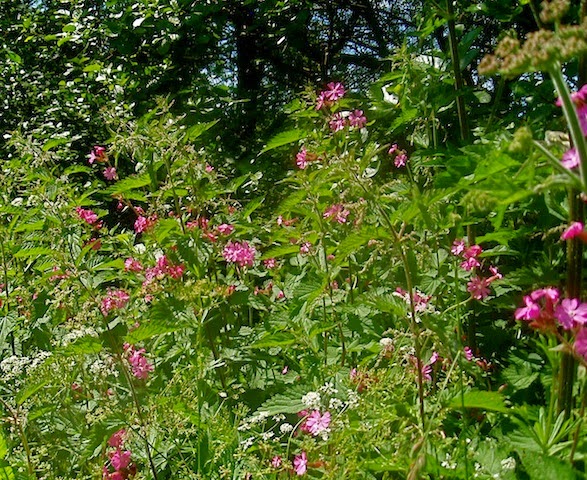
The tallest plants to wade through are the common hogweeds (not giant hogweed) with their large flat umbrella-shaped (hence ‘umbels’) flower heads.  Reflecting sunlight they are very pretty but by moonlight they turn luminous, ghostly. They are a bit of a menace in one of the meadows by the river because lack of access makes mowing impossible.


Another large spreader by the river is water balsam; very pretty, but another eager coloniser. I think there have been efforts to remove it; as you can see, without much success. 


And here she is, almost at the end of our walk, enjoying a bit of a splash before we make our way through buttercups and clover, our errand done and tea waiting for us in the garden.


 Not bad for a total of thirty minutes’ walk, give or take 20 minutes either way for contemplation.


Monday, 16 June 2014

Weather for Chickens - Permutations 2 (rewritten)

Perhaps they’re not ‘weeds’ but wildflowers. After all, a weed is simply a flower growing in the wrong place. "It is not the business of the botanist to eradicate weeds. It’s enough for him if he can tell just how fast they grow.” (C. Northcote Parkinson) The average gardener, on the other hand, is obsessed with them; under no circumstances will he tolerate them in his tidy beds. The gardener knows only too well how fast they grow and spread.

Some weeds (okay, back to calling them weeds) prefer poor, free-draining soil. No wonder that the small patch of land left over by the new bungalows for disabled and elderly people has this wonderful display of Orange Hawkweed, also called fox-and-cubs. It’s easy to see why the nestling clusters of tawny-orange flowers and buds are so-called but one of the hawkweed’s other names,  Grim-the-Collier, is harder to explain.

Some years ago Beloved saw these pretty flowers and thought he’d love some in the garden. He went round collecting seed and spread them on the grass at home. We were extremely lucky that the seed didn’t take except for a few straggly specimen which soon disappeared with mowing. Unless you want to use toxic weedkiller the only other remedy is salting the lawn.


Contrary to the English preference for a manicured lawn I am not at all bothered about our grass. As it is it consists mainly of moss and clover which keep it nice and green looking. But applying generous quantities of salt would have been a bit too much even for me. 

The next swathe of weeds along the footpath is this Lesser Trefoil. It’s a tiny plant, another grass weed, and probably the true Irish shamrock, - the seamrog, or 'cloverlet’.  It’s only really noticeable because where it grows - usually stoney ground or on the edge of tarmac - there are fairly large patches.


A bit further along this very short path running from the High Street to Trinity, a wonderful enclave of ancient almshouses, via the sheltered housing, is this luminous strip of geraniums. Somebody probably had a few too many plants in their garden - the old people’s bungalow gardens are very small - and they simply planted them on the verge between hedge and footpath. Nobody minds that sort of thing in Valley’s End. Geraniums can be a weed, they multiply before you can get the secateurs out.


 Millie was panting; all my stopping and starting obviously did not please her, so I promised her a dip in the river. But before we got to the castle ground and from there to the river we had to pass the children’s playground. No children were in evidence but chicken escapees from the surrounding gardens were using the ramps for a bit of harmless fun, clucking away peacefully and contentedly.


PS: I had to rewrite this whole post; there is no way lost blogposts can be retrieved and Blogger is no help. Best thing is to draft all posts as a document first, then copy and paste.

All of you who responded to my cry for help, thank you very much.


Saturday, 14 June 2014

Weather for Chickens - Permutations 1


I am not a summer person; I also know we haven’t quite got there yet except meteorologically, but yesterday and Thursday we definitely had the kind of day that passes for summer in these islands. I am itching already and the bits of me that have caught the sun are turning spotty. I can’t abide getting sweaty just breathing.

 It has to be said, however, that you get a better class of weeds in summer than at any other time. 

I had an errand at the other end of the village, all of ten minutes walk away if you use the High Street, but I chose the scenic route, which takes another five minutes each way. and to distract myself from the heat of the morning I took pictures, while dodging sunlit open spaces and seeking any kind of shade I could find along the way. Millie came too and she was huffing and puffing, her tongue flopping at the side of her mouth and her pace leisurely. No mad dashing about following smells, more a patient and long-suffering acceptance expressed in every flap of ear and flick of tail. A less superior being would have raised its eyes and sighed deeply at the imposition.


Not exactly a weed, this laburnum tree, but there it was, hanging over the wall by the petrol station. Yes we have one of those; it sells bread and a few other kinds of long-life groceries and you can rent videos too.  Although the pumps are set in concrete, the surrounding yard is tufty grass and there is a flower bed in front of it and round the back and sides you have hedges. And a laburnum tree. Gardener calls it Chains.There is a big shed where you have repairs done and buy 4x4s and trucks, old ones, of course. A small Jack Russell, one of the yapping, bossy kind, guards the forecourt. I am surprised to see he has lasted as long as he has without getting squashed. I don’t like Jack Russells, they attack Millie.

Gardener isn’t very well again. I rang his wife this morning to see if he was coming and she said “oh no, he won’t”. Bang, just like that. She sounded really cross. “Oh?” I said, putting a whole questionnaire into the sound.

“He’s not well, he’s had a turn.”
“What kind of turn?” She really was making me earn every utterance.
“Same as before.” She was unbending just a smidgen. “He hasn’t worked all week.”
“Has he seen a doctor?”
“No”,  a bark; back to basics.
“Can’t you send him?”
“No.”
“Have your tried?”
“No, I’ve given up on him. He’s worked too much, and when he works, he works like a maniac. Just won’t listen. I’ve given up.”

Since the weather has warmed up I’ve noticed Gardener sitting down more. You are my witness, I have said before that he’s not the man he used to be. And I’ve been happy to sit with him. Neither am I the woman I once was.

What with Gardener and Paul’s frequent ’turns’ not much gets done.  It seems to be time that I hired myself a gardener, a fit and able one who will last at least as long as me. Number three. I’ll try not to get confused. Poor Austin, I shall miss him. Dreadfully. I love the contrary old goat. (Did you notice I called him by his name? First time ever)


Anyway I am still on my errand. Right opposite the garage, in  Hospital Lane, on the wall surrounding the Methodist Church, a whole long and wide swathe of campanula has taken up residence without a by-your-leave. Nobody’s planted it, it just arrived years ago and has settled in nicely, thank you. It probably escaped from somebody’s rockery originally and cannot be called a weed either.

That reminds me, this was to be a post about weeds, among other things. I’ll have to come back to you on that. Tomorrow. I wonder how many posts I can get out of a 30 minutes’ walk.


Thursday, 6 February 2014

And Back Again To Simple Permutations

Definition of Permutation: "Each of several possible ways in which a set or number of things can be arranged.”
as in “Friko’s thoughts ranged in a dozen different directions of what she could do or would like to do.”

Nostalgia has been the basis for these posts; persistent rain and the pressure of nose against window pane while the owner of said nose stares out at a sodden and gloomy world, lend themselves to equally gloomy thoughts. Nostalgia was invented in 1688 by a Swiss medical student, Johannes Hofer, who described it as a “neurological disease of an essentially demonic cause.” The German word ‘Heimweh’ was eventually translated into the nationally unspecific ‘homesickness’, which means anybody can catch it, of whatever nationality.  In the 19th century, due to vast numbers of immigrants, America was the most openly homesick society known.

'Home is where the heart is’ or some such drivel. Platitudes don’t help. I am not sure if the feeling of displacement ever leaves a first generation immigrant. Nowadays we call them ex-pats; the word implies an eventual return to the mother country, a temporary sojourn in a country other than the country of origin, for whatever reason.

In London I knew lots of immigrants to the UK who said they would go ‘home’ again some time in the future; people of many nationalities who had lived here for decades, like me. In Valleys End there are just a few of us, less than a handful, all residents to the end of life. Probably.

Going ‘home’ is a fantasy. In any case, it is far too late for me. In spite of watching German thrillers, documentaries and clever talk shows on TV, I wouldn’t know my way around, wouldn’t know modern life, wouldn’t be able to conform anymore. Worse than that, I have got into English habits. I am no longer used to excellent workmanship, efficiency and cleanliness. I have no better way of describing it than saying that I have got into the habit of sitting down on a bench in the open without wiping it  first.

Also, I no longer have any close family there.

So, here I am, and here I’ll stay.

But there is one thing I can do. I have made arrangements with those in my family who still speak to me that I want my ashes to be chucked into the nearest river that flows into La Manche/Nordsee/The Channel. However diluted, I will eventually wash up on home ground. 

There’s a thought for a rainy day!


Tuesday, 4 February 2014

Permutations to the Power of Four

I wasn't planning to publish any of this but let me start with the definition of ‘dysfunctional families’ acc. to Wikipedia:

A dysfunctional family is a family in which conflict, misbehavior, and often child neglect or abuse on the part of individual parents occur continually and regularly, leading other members to accommodate such actions. ...
http://en.wikipedia.org/wiki/Dysfunctional_family

While there are entire blogs dedicated to accounts of dreadful, abusive childhoods and the damage they have caused to victims now they’re adults, I also read all these blogposts about deliriously happy families, the frequent visits, the wonderful relationships amongst parents and children and siblings. The unalloyed joy of grandchildren, the generous help the young give to the old, and vice versa. Lovely. I am very happy for you.

But!
Where are all the middle-of-the-road families, the broken and re-assembled families, where good periods and bad periods follow each other as sure as night and day? Are there only two sorts? Hellish or paradisiacal?

To my utter amazement both my own children recently referred to their childhood as “dysfunctional”. Blimey! I know we had quite a rocky ride for long stretches; there was nothing ‘ideal’ about our lives for about fifteen years. It was a mainly single-parent household with a frequently absent father and a very much present working mother, who put food on their plates, a roof over their heads and clothes on their backs. And in between there were rows and cheerful times, tears and laughter and one or two seriously hairy events.

Dysfunctional? One of them appears to have been gracious and forgiven me, while the other seems to want a wholesale apology and thinks it would probably be for the best if we called it a day.

It’s been a few months since I was told of my inadequacies; it’s taken me all this time to absorb and digest it. You know how it is when you hear something which strikes you as really far-fetched and you put it away as unreal? That’s what I did. But, of course, the word has been niggling away at me since.  I finally looked it up.

The outlook is good. My reaction has surprised me: I am entirely reconciled to the situation as it is. It’s not the first time we’ve fallen out.

Much worse is that the rain just won’t stop.


Monday, 3 February 2014

Permutations Cubed


We had a whole day without rain yesterday; it blew and blustered, of course, but there were minutes when the sun pushed through a gap and showed its face. I know that lots of you are worse off than us in the Shropshire hills. Some of you have ice and snow and heat waves and biblical floods. I am truly sorry for all of you, but somehow that doesn’t make it any easier to bear what we have here: rain and permanent grey cloud cover. It’s like telling somebody to eat up their greens because there are starving children in Africa who’d give their eyeteeth for a plate of food. Your own experience of misery is always greater than an imagined one.

Millie and I grabbed the opportunity and took the lane up the hill; only tarmac walking is possible at the moment. Small streams of water running downhill met us and the ditches were full to bursting. No matter, at least we weren’t drenched. Even Leonard Cohen coming over the earphones couldn’t dampen my newly resurgent spirits.

I said yesterday that I was going to explain about music in our house. Beloved is a professional musician. All his life he has played with, and for, extraordinary performers, singers and soloists. He is incapable of listening to a piece of music, any piece of music, without judging and dissecting and analysing. It used to drive me mad. In the end I gave up unless I knew it was something or somebody he would listen to without comment. My tastes  are eclectic, you might even say, indiscriminate. For me it all depends on the mood of the moment.  Having finally got round to modern technology, late, as with everything, I am now able to indulge my musical preferences at any time, even in the same room as Beloved. Mind you, I still have to be careful when and where I give croaky voice in enthusiastic accompaniment!

If only I had had children to introduce me to the powers of modern technology; I could have been dancing and singing years ago. Oh, hang on, I did have! One of these days I might even tell you what happened to them.


Sunday, 2 February 2014

Permutations Squared

Having stirred the hornet’s nest so late at night, naturally I couldn’t sleep. Busy minds are a sure way to keep the sleep angels away, you know the ones I mean, the four that stand at the corners of your bed and softly rock you to sleep, bestrewing your covers with rose petals and fragrant cloves; surely you know Brahm’s Lullaby? No? Your loss.


Try it, this is only a short excerpt. I sang it when I was small; I can’t recollect my mum singing it to me, although I remember her singing, a lot, once times were normal again. I, in my turn, sang it to the youngest child of an English family, usually in the rose garden, just before her bedtime. I spent less than two months with them and long after I’d gone again, every female voice she heard singing on the radio, she’d stop what she was doing and say:”that’s U.”

Anyway, I decided to get up and make for the drawer with the sleeping pills and promptly got side-tracked by the computer. The next time I looked it was 3.30 in the morning. Still raining outside.

Talking about singing: I had been feeling particularly happy the  previous afternoon, because I’d managed to grapple with downloading some of my old CDs on to my iphone via the mac desktop. I also bought, via the ipad, a few CDs of German folk music and Lieder, stuff I hadn’t heard in decades. Going through my CD shelves I found a collection of Mittel-European music, songs my mum used to listen to on the radio and hum or sing along to. Operettas,  Kaffeehaus songs, Chansons,Viennese songs. Not being a techno whizz and working with three different digital gadgets, I could feel myself getting more and more excited when it all came together. I was also looking forward to getting stuck in with the earphones. Excitement and happiness are not good for me, a visit to the medicine drawer was indicated,  for a tranquilizer to take me back down a bit.

Music can be a little problematic in our house. ( I shall have to explain about that tomorrow.) Music via earphones is fine, I can listen undisturbed, even when I’m in the same room as Beloved. There I was, stretched out on the sofa in the living room, stupid smile on my face, positively swooning. The perfect occupation for a wet afternoon. Beloved reading, Millie dreaming by the fire, Not such a bad life after all!

Except that, by the time Marlene Dietrich oozed nostalgia and the heartbreaking strains of ‘Lili Marleen' into my ears, I was bawling, tears streaming down my face, more homesick than ever.

This version is in English.


I want to wallow in peace, so no comments. Yet.