Wednesday, 29 December 2010

Will It End Soon?

Look, no crowds.
Andrew's Fireplace.


I am more and more aware of how much I prefer silence and quietude to social chatting nowadays. Not that I’ve ever been a chatterbox; an only child growing up in a small family rarely is. They do say that people living on their own feel the need to talk at length when they get together with others and I have frequently been the victim of such unfortunates myself. It’s almost as if such people need to pin you down with a flood of verbal diarrhoea whenever they get the chance.

At three different parties  in the last two weeks have I been reminded of this dislike of crowds. Moving from room to room, standing and shouting to make yourself heard above the din, balancing a glass and a small plate, at any time of the day, has not been a pleasure.

Conversations are pretty dull on these occasions. As you are moving from person to person and group to group you ask and are asked a pre-ordained series of questions. It’s like ticking multiple choice boxes:

Will you be at home for Christmas?
Are you going away for Christmas?
Do you have family coming?
When, who and for how long?

Answers are equally predictable, a variation on the same theme.

Frankly, I don’t care. I am glad if you are happy but, for a while now, I am going to try and avoid you because the sole topic of conversation would surely be :

Did you have a nice holiday? With all the details repeated.

So how wonderful to have received one final invitation ‘to an informal lunch’. When we got there we were delighted to find that we were the only guests and that the very civilized host had provided a small but delicious meal to be eaten at a very civilized table. No mention of Christmas, families, travel arrangements, not even the weather; idle chatter to be sure, but about books and music, food and art and gardening.

Bliss.

Beloved and I are so used to living in our quiet bubble that major disturbances are almost an affront.  Right at this moment I am escaping from family; lovely people, intelligent, sweet and friendly, all four of them but I simply needed time and space to myself. Coming up here to my study, unburdening myself to ‘virtual’ blogging friends, has been such a relief.

Thank you all for being there and thank you for listening.

I hall be coming visiting at the earliest opportunity. Roll on the end of the festive season!

Sunday, 26 December 2010

Was that Comment Rude?


After two years of blogging, did I have my first rude comment?

Maria Ethelle said "whatever bitches" in her comment to my last post. Just that, nothing else. 

I am sure it means something, but what? Did she (I assume it's a she) leave out the comma, as in "whatever, comma, bitches", using 'bitches' in the vocative case? In other words, calling the rest of the commenters and me 'bitches'?

Or did she use bitches as a verb, as in 'whatever being in the process of bitching'. In that case I can't make sense of the phrase because I'd need the 'whatever' part explained. Who or what is 'whatever'? To be able to bitch, do you need to be a person? If so, the 'whatever' needs to be replaced with 'whoever'.

Maria Ethelle, dear, may I call you Ethel? (Maria Ethelle is such a mouthful). I tried to access your blog but 'Profile Not Available' it said.  Don't be shy, dear Ethel, Blogger positively encourages us to forego anonymity. 

Or is 'whatever bitches' just a modern phrase the meaning of which escapes me?

Do enlighten me, somebody.

And if anyone else wishes to send rude comments, please add the explanation in a PS. Or point me to the right place in the dictionary. Otherwise you'd be wasting your time, which is surely not what you were doing anyway, was it?


PS: Is anyone else glad Christmas is over? No more for me for at least a year now, thank you.

Thursday, 23 December 2010

Christmas Eve At Home - 23rd Window


Most years, there were only the three of us for Christmas Eve, mum, dad and me.

All day long an electric tickle crackled in the atmosphere, starting in the morning, straight after I got out of bed. A quietly subdued sense of anticipation made me feel like I was holding my breath and stepping more lightly than on any other day of the year.

Breakfast over, dad and I went to the market to collect the tree we had chosen the day before; we carried it home, me holding on to the thin, top end and dad holding the trunk.  Getting the tree to fit into the holder was always a complicated job; the trunk never quite fit and had to be sawn off a bit, planed a bit, cut some more, filed a bit, until dad was satisfied. By now the trunk had lost some of its length, dad was not the most handy of men.

Neither was he very patient, in spite of the festiveness a mild curse or two accompanied his labours.

If mum was finished ‘doing’ the little Christmas room we were allowed to carry the tree into its place, the same place as every year, in the corner by the window.

By now it was time for lunch, which was a hasty meal; there was much left to do before the magic hour of six o’clock when our family celebrations would begin.  By three in the afternoon things calmed down, jobs were done and it was time for a bath. Christmas Eve was the only day in the year when we had a bath in the middle of the afternoon; mum decreed it and dad and I obeyed.

The winter’s day’s early dusk fell and it was time to dress the tree. This was a job for mum and me, while dad sat smoking his pipe and giving advice:

“There’s a hole here, a red bauble would fit in over there, this branch needs gold, that one needs silver, that candle is too close to the branch above”. Finally, lametta thrown over the tree haphazardly, “naturally”, to cling where it would, all three of us declared ourselves satisfied.

“A beautiful tree, it’ll be spectacular when we light the candles”.

All the while the radio played festive music, a request programme for the more discerning taste; I can’t remember any discordant jingles, although I may be wrong.

Six o’clock and the magic hour had arrived.

Mum had prepared supper earlier; when we were on our own, the meal was simple, yet festive, the traditional potato salad, a green salad, smoked fish, smoked meats, black bread; I was allowed a small glass of wine, probably watered down, although I didn’t know it then.

In large families, after the meal, one person would go into the Christmas room and light the candles, before the rest of the family was called in, but in our house all three of us went in together and dad and I watched mum carefully light the candles. We had already brought our presents from where they had been hidden and put them under the tree after dressing it.

“Ah, Oh, it is the most beautiful tree we’ve ever had, don’t you agree?”
We did.

It was time to unwrap the presents; this never took very long, there were never very many in those days, mine were most often books I had asked for; presents were certainly important but there was so much else to Christmas Eve that they were simply a small part of the ritual.

Dad was waiting for his treat. “Will you sing for me? Please, do sing now”.
The radio had fallen silent at six o’clock.

Mum had a lovely mezzo voice. When I had become confident enough to let my childish treble ring out she began to harmonise and we sang all dad’s favourite songs.

I too had a request for mum. She had a wonderful way with a harmonica; she owned several of these simple, folksy instruments and she could make them break into such hauntingly soulful, yearning melancholy that the hairs on my arms stood on end. She always ended her repertoire with Silent Night, Holy Night, with dad and me singing full out.

This usually finished dad off; there’d be tears in his eyes, and to get him (and ourselves too) back on an even keel, Mum or I fetched dad’s mandolin. It didn’t take much pleading before dad plucked a few chords, mum took up her harmonica and I sang along, happier, jollier songs now.

Wine, even my watered down cup, music, many “do you remember” reminiscences, a table laden with my books, dad’s cigars and mum’s small trinkets, plates of delicacies to nibble, the warmth and glow of the candles and a genuine feeling of contentment and goodwill all served to make Christmas Eve truly memorable.

For several years mum and I went to Midnight Mass. We’d bundle ourselves up, often wearing new scarves, gloves and hats and go to the largest of the churches in the town, the deep bells from all churches ringing us on our way.  I seem to remember that we always sank into deep snow. The church was packed with worshippers and others like us, who had come for the music. We slipped in at the back; a thousand candles lit up every stone, and the sound of the massive organ filled the vast edifice.

In common with every one there we lifted our voices and sang our hearts out.

Going home, mum and I stayed silent. There was nothing left to say.

Wednesday, 22 December 2010

The Twelve Days of Christmas - 22nd Window


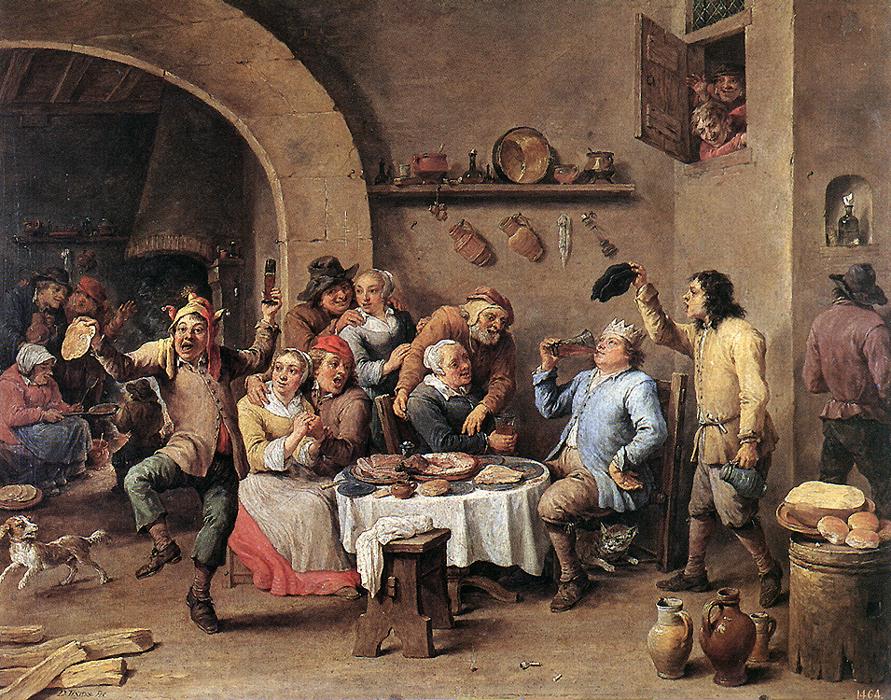
"Twelfth Night" by David Teniers the Younger (1634-40)


The Twelve Days of Christmas begin on  December 25 and end on Epiphany, January 6. In the Middle Ages this period was one of continuous feasting and merrymaking, which climaxed on Twelfth Night, the traditional end of the Christmas season.

During the twelve days of Christmas, traditional roles were often relaxed, masters waited on their servants, men were allowed to dress as women, and women as men. Often a Lord of Misrule was chosen to lead the Christmas revels. Some of these traditions were adapted from older, pagan customs, including the Roman Saturnalia. Some also have an echo in modern day pantomime where traditionally authority is mocked and the principal male lead is played by a woman, while the leading older female character, or 'Dame' is played by a man.

Everybody knows the hardy perennial
"The Twelve Days Of Christmas'.

Here is a rather different version in the form of
A Correspondence


25th December

My dearest darling
That partridge, in that lovely little pear tree! What a
enchanting, romantic,poetic present! Bless you and thank you.
Your deeply loving Emily


26th December

Mr dearest darling Edward
The two turtle doves arrived this morning and are cooing
away in the pear tree as I write. I'm so touched and
grateful.
With undying love, as always, Emily


27th December

My darling Edward

You do thinks of the most original presents: whoever
thought of sending anybody three French hens? Do they really
come all the way from France? It's a pity that we have no
chicken coops, but I expect we'll find some. Thank you,
anyway, they're lovely.
Your loving Emily


28th December

Dearest Edward

What a surprise - four calling birds arrived this morning.
They are very sweet, even if they do call rather loudly -
they make telephoning impossible. But I expect they'll calm
down when they get used to their new home. Anyway, I'm very
grateful - of course I am.
Love from Emily

29th December

Dearest Edward

The postman has just delivered five most beautiful gold
rings, one for each finger, and all fitting perfectly. A
really lovely present -lovelier in a way than birds, which do
take rather a lot of looking after. The four that arrived
yesterday are still making a terrible row, and I'm afraid
none of us got much sleep last night. Mummy says she wants
us to use the rings to 'wring' their necks - she's only
joking, I think; though I know what she means. But I love
the rings. Bless you
Love, Emily


30th December

Dear Edward

Whatever I expected to find when I opened the front door
this morning, it certainly wasn't six socking great geese
laying eggs all over the doorstep. Frankly, I rather hoped
you had stopped sending me birds - we have no room for them
and they have already ruined the croquet lawn. I know you
meant well, but - let's call a halt, shall we?
Love, Emily


31st December

Edward

I thought I said no more birds; but this morning I woke up
to find no less than seven swans all trying to get into our
tiny goldfish pond. I'd rather not think what happened to
the goldfish. The whole house seems to be full of birds - to
say nothing of what they leave behind them. Please, please
STOP
Your Emily


1st January

Frankly, I think I prefer the birds. What am I to do with
eight milkmaids - AND their cows? Is this some kind of a
joke? If so, I'm afraid I don't find it very amusing.
Emily


2nd January

Look here Edward, this has gone far enough. You say you're
sending me nine ladies dancing; all I can say is that judging
from the way they dance, they're certainly not ladies. The
village just isn't accustomed to seeing a regiment of
shameless hussies with nothing on but their lipstick
cavorting round the green - and it's Mummy and I who get
blamed. If you value our friendship - which I do less and
less - kindly stop this ridiculous behaviour at once.
Emily


3rd January

As I write this letter, ten disgusting old men are
prancing abour all over what used to be the garden -before
the geese and the swans and the cows got at it; and several
of them, I notice, are taking inexcusable liberties with the
milkmaids. Meanwhile the neighbours are trying to have us
evicted. I shall never speak to you again.
Emily


4th January

This is the last straw. You know I detest bagpipes. The
place has now become something between a menagerie and a
madhouse and a man from the Council has just declared it
unfit for habitation. At least Mummy has been spared this
last outrage; they took her away yesterday afternoon in an
ambulance. I hope you're satisfied.


5th January

Sir
Our client, Miss Emily Wilbraham, instructs me to inform
you that with the arrival on her premises a half-past seven
this morning of the entire percussion section of the
Liverpool Philharmonic Orchestra and several of their friends
she has no course left open to her but to seek an injunction
to prevent your importuning her further. I am making
arrangements for the return of much assorted livestock.
I am, Sir, Yours faithfully,
G.CREEP
Solicitor-at-law
Messrs. Sue, Grabbit & Run


John Julius Norwich


Tuesday, 21 December 2010

The Spirit of Giving - 21st Window


The other day there was a news item about people getting into debt to buy Christmas presents, particularly people borrowing from loan sharks and  finding that they have somehow committed themselves to repaying vast amounts of interest, a £100 loan turning into a £1000 debt.

One mother was actually shown saying: "the kids want their presents as much as other kids do, I don't want them to go without just because I don't have the money". It is sad, of course, and I can understand the mother's feelings but I can't understand her acting on them. I can't understand the logic. I've been very hard up during some periods in my life; my attitude was and is, 'if I don't have the money for it, it doesn't get bought'. I don't think I'm mean, just sensible.

Since then I've been thinking what presents mean to me.

I wish giving nowadays didn't have to be on such a noisy, spectacular scale. People my age tend to go on a bit about the 'good old days', how we were satisfied with a cardboard box and a dustbin lid and a quarter share of a mince pie; perhaps we weren't, not really, but I think we were more modest in our requests.

In our family presents have always been modest. When my father, who was a very kind man, was asked what he wanted for Christmas (or his birthday), he invariably said : "don't make a fuss, I already have everything I want. It would be nice to receive a small token of appreciation, just some little thing to show you care, but really, don't make a fuss".  In other words "It's the thought that counts".

We made fun of him, this little speech was so predictable, we mouthed the words while he was uttering them. He usually ended up with a box of cigars, a bottle, something sensible to wear, like a cardigan.

I enjoy presents, both giving and receiving, but they have to be well-chosen and thoughtful. The best present I ever had as a child was  a pile of books, which included every single book I'd asked for that year. I was so proud, I told everybody, whether they'd asked me or not, what I'd got for Christmas. With my grandchildren books would just be a stocking filler.

A present has to mean something, it has to be a sign of love, appreciation, goodwill; dare I say, it has to come from the heart. A smile, a kind word, a helping hand can be presents. The worst giver is the calculated giver, the one who 'throws a sausage to gain a chop", as they say where I come from. That person may be good at adding up his sums but has no idea of giving.

Monday, 20 December 2010

Two Famous Christmas Menus - Part 2 - 20th Window

Christmas Dinner at Mount Vernon.

The Christmas Menu of George and Martha Washington is a grand feast indeed, with archetypally American delights as squash, homily and cranberry already listed.

Perhaps American readers will tell me if this menu is at all typical of today's grand occasion, even if not all of these dishes would appear on the table at the same meal.


An Onion Soup called the King's Soup
Oysters on the Half Shell   Grilled Salt Roe Herring
Boiled Rockfish
Roast Beef and Yorkshire Pudding   Mutton Chops
Roast Suckling Pig   Roast Turkey with Chestnut Stuffing
Round of Cold Boiled Beef with Horse-radish Sauce
Cold Baked Virginia Ham
Lima Beans   Baked Acorn Squash
Baked Celery with Silvered Almonds
Hominy Pudding   Candied Sweet Potatoes
Cantaloupe Pickle   Spiced Peaches in Brandy
Spiced Cranberries
Mincemeat Pie   Apple Pie   Cherry Pie   Chess Tarts
Blancmange   Plums in Wine Jelly   Snowballs
Indian pudding
Great Cake   Ice Cream   Plum-Pudding
Fruits   Nuts   Raisins
Port   Madeira


A fine dinner, although some of the dishes are unknown to me.
Does anyone know why no wines are mentioned except the two at the end of the menu? Presumably, these two were served at the end of the meal to the men only, after the ladies had left the dining room.


Sunday, 19 December 2010

Christmas Eve At Aunt Johanna's - Fourth Sunday in Advent


Aunt Johanna was the pretty one, the dainty and delicate one, the one with the nicest house, the smartest clothes and the best taste in Christmas decorations. She also cried a lot. “She’s built her house too close to water”, the others used to say. When I was little I didn’t understand what they meant by that, but I often saw her cry.

Aunt Johanna’s house was different from the other aunts’ houses.  There wasn’t as much joy as at aunt Little Kate’s, who was my favourite, it was a lot less smelly than at aunt Maria’s, who lived with my other grandfather, the holy one, and a little less tidy than mum’s, but more grown-up, somehow. It was bigger too, that’s why we sometimes went there for Christmas. Mum and dad and I went there by train the day before and mum used to make fun, in a mean sort of way, of the way aunt Johanna fussed over her tree. Mum and aunt Johanna were sisters.

The most festive part of Christmas in Germany is Christmas Eve, the Silent Night, Holy Night of the carol.  In those days everything stopped after three o’clock in the afternoon; no shops, no trains, no anything at all, except for essential services. And the sailors at sea, I remember them in particular, because people would ask for music to be played for them on the radio.

I was always very excited to go to aunt Johanna’s, it was so different from anywhere else I went. Cousin Dieter and I were the same age but his two sisters were big girls, older than me, much superior in looks and understanding. Dieter was superior too, he made fun of me, but because we were the same age I could punch him. Besides, I was cleverer than him. Aunt Johanna really didn’t like that.

Most of the afternoon we spent in the kitchen. We’d missed lunch, but aunt Johanna made us wait a long time before she offered us anything to eat. I remember being quite hungry sometimes; she gave us a cup of coffee and a biscuit to tide us over but there were no other concessions to our traveling day. The last time we went there for Christmas mum had brought sandwiches for us, which we ate in aunt Johanna’s kitchen. I remember being glad of them but there did seem to be an atmosphere while mum and dad and I were eating them.

Only at Christmas was dinner served in the dining room. The living room was next to the kitchen, it was shabby and warm and uncle Hans’ big desk was in an alcove. We couldn’t go in  because he was still working and spent a lot of time in there, shouting on the telephone, which made aunt Johanna cry. “Does he have to work even today”, she sobbed.

We couldn’t go into the dining room because that was also the best parlour,  a large room running along one side of the house, the room where the Christmas tree stood. The door was firmly shut. Only over aunt Johanna’s dead body would anyone go in there before she was ready to display her annual masterpiece, her Christmas tree.

Finally, uncle Hans relented and joined us. He brought out a bottle or two and dad and he smoked and drank, mum had a glass too, but aunt Johanna refused. She had been wronged, she wasn’t ready to forgive.

We children had been amusing ourselves, staying in the kitchen or using the scullery; everywhere else in the house it was cold; it was an old house, unheated for the main part. I already dreaded the thought of the freezing bedrooms.

Little by little the atmosphere thawed and at long last it was time to open the dining room doors and pay homage to ‘the tree’. Aunt Johanna had disappeared into the room about fifteen minutes earlier, alone, but now she threw open the modest doors with a flourish. “Do come and look at the tree”, she called. We obediently obliged, we were well trained. We stood awkwardly halfway inside the dark room, which was lit only by the wax candles on the tree.

It has to be said, her tree was magnificent, a magical vision in green and silver, reaching from floor to  ceiling. Aunt Johanna only ever used silver ornaments. But what made her tree stand out from all others was the tinsel, thousand of strands of silver tinsel, the sort that is called 'lametta', each one hung on the tree separately, long and smooth and unimpeded. She must have spent hours getting it just right, adjusting and tweaking and smoothing each strand.

In the light of the white wax candles in their silver holders the whole tree came to shimmering, trembling, other-worldly life. “It’s not a very good one this year”, Aunt Johanna said proudly.

It took a long time before I could look away from the tree and notice that the long dining table was laid  for the Christmas Eve meal. Aunt Johanna had done herself proud, she had brought out the family china and silver and the best glasses which were rarely used and never normally when there were children around.

I hardly dared touch anything. By now I wasn’t even very hungry anymore. Mum looked cross; by rights, at least half of the splendour displayed on the table should have been hers, she’d said it often enough to dad and me at home.  I am not sure that she would ever have used any of it if it had been hers.

In spite of the setting the meal was a nervous one. Every so often Aunt Johanna rushed up to extinguish another candle burning too close to its holder. Gradually, the tree lost its lustre and Christmas Eve came to an end.


Saturday, 18 December 2010

Two Famous Christmas Menus, Part I - !8th Window

WARNING:
The following is not for the fainthearted!


During the Franco-Prussian War  of 1870/1871 the Prussian Army lay siege to the grand city of  Paris from September 19, 1870  to January 28, 1871.

On December 25th 1870, the 99th day of the siege dinner was served at the

Café Voisin, 261 rue Saint-Honoré, Paris


Hors-d'oeuvres
Butter radishes, Stuffed Donkey's Head, Sardines

Soups
Purée of Red Beans with Croûtons
Elephant Consommé

Entrée
Fried Gudgeons, Roast Camel English Style
Jugged Kangaroo
Roast Bear Chops au Poivre

Roasts
Haunch of Wolf, Venison Sauce
Cat flanked by Rats
Watercress Salad
Antelope Terrine with Truffles
Mushroom Bordelaise
Buttered Green peas

Dessert
Rice Cake with jam
Gruyère Cheese

o-o-o-o

The Paris Zoo had been held in reserve for a Christmas Dinner.

The Wine List made up for any shortcomings in the food,
I doubt that a greater list has accompanied any meal since:

o-o-o-o


First Service
Sherry
Latour Blanche 1861
Château Palmer 1864

Second Service
Moutin Rothschild 1846
Romanee Conti 1858
Grand Porto 1827


Friday, 17 December 2010

Christmas and Chocolate - 17th Window


I have made much of the wonderful specialist shops in the small town of Ludlow in the Shropshire Marches before. One of my favourites is the chocolatier. We can't afford to go in very often, every chocolate, hand-made from the finest ingredients, is priced in the region of a king's ransom, but at Christmas we do; we buy chocolates as presents for others, as gifts to take to dinner parties and even for ourselves. I'd almost be willing to commit a minor crime if you promised to pay me in dark chocolate coated orange peel strips;  whoever invented them has my undying gratitude. However, they are very expensive.


It is only a small shop but when you go in your nose is assailed by the aroma of real chocolate, spices, sugar and marzipan confections and standing at the glass topped counter, below which are several  shelves of tray upon tray filled with delectable and delicious truffles,  many of them laced with alcohol, I
salivate in anticipation.

If I were a dog, I'd slobber and drool.

"Two of this one and two of that and two of those at the back," is how I buy them; Slowly the girl fills a small bag for me. When I get them home they are put at the back of the fridge, well out of the way of any searching fingers. They are exclusively for us, we do not share the ones we buy for ourselves (and don't feel guilty at all) and we don't start eating them until Christmas Eve; not from the bag, mind you, but from a pretty dish. The Japanese tea ceremony has nothing on me and my chocolates!


WARNING - Be careful how much Christmas chocolate you eat!

Chocolate's reputation as an Aphrodisiac originated in South America over one thousand five hundred years ago, where it is known that it was thought to have mystical and aphrodisiac qualities by both the Mayan and Aztec cultures - the Aztec emperor, Monteczuma drank fifty golden goblets of chocolate a day to enhance his sexual prowess, it is said.  However, I recently came across this snippet of warning originating in 17th century England:

"The confection made of Cacao called Chocolate or Chocoletto, which may be had in divers places in London at reasonable rates, is of wonderful efficacy for the procreation of children: for it not only vehemently incites to Venus, but causes conception in women  . . . . . . and besides that, it preserves health, for it makes such as take it often to become fat and corpulent, fair and amiable."


William Coles Adam in Eden 1657

Thursday, 16 December 2010

Christmas Miscellany - 16th Window


Musical Santas at Dobbie's the plant sellers.

We needed to find a present for gardener. Where better to look than in a large plant nursery-cum-garden tools-cum tat emporium. Gardener doesn't read my blog so he won't know that he is getting a pair of secateurs for Christmas. I almost bought him these Santas but they were part of the shop display only.

They played and sang non-stop Christmas carols. We didn't stay for long.

Don't you all hate supermarkets at this time of year? In spite of trying my hardest to avoid them the need for a visit could no longer be ignored. Cleaning materials, bog roll, every day groceries, potatoes, dog food and such boring stuff I buy there; the cold weather is forecast to return and my stores have to be replenished. So off we went to the supermarket.

Twenty minutes into the experience I was ready to commit murder. At this time of year they change their stock around; I normally try to get in and out as fast and efficiently as I can, but some very inconsiderate person had messed up my familiar aisles just to confuse me. Where there had been juice there were spirits, where there had been rubber gloves there were Christmas crackers. All I wanted were some food bags and clingfilm for leftovers.  And while I was stomping through the aisles, backwards and forwards, I was forced to listen to an endless loop of Christmas jingles, a tinny, badly arranged, flat, featureless cacophony of sound.

The more I resented it the more obtrusive it became. I went through those aisles like a thing possessed, hissing 'ssshhhut-up-ssshhhut-up-ssshhhut-up' with every step I took. I actually came across several people singing along to the atrocities on the sound system! Morons! I have no idea why they stared at me and gave me and my trolley a wide berth. 

I was still fizzing with nervous tension driving home.


How much more civilised it was to sit after dinner and write Christmas cards. A few chocolates, a glass of mulled wine and a CD by the The Sixteen playing quietly. Sublime. My rage melted like snow in the sun.


Today, on the 16th December, is traditionally the beginning of mince pie season, according to some ancient household books. Originally rectangular in shape and said to represent Christ's manger, mince pies were abominated as 'Popish and Superstitious' by Puritans, and described thus in 1656:

Idolatry in Crust! Babylon's whore
Defiled with superstition, like the Gentiles 
Of Old, that worshipped onions, roots and lentils.

Later however, the 'solid, substantial, Protestant mince pie' became the champion of the English Christmas against ' imported foreign kickshaws'.

Eat mince pies made by as many different cooks as possible: for every cook's pie, you will have a lucky month in the coming year.


Don't blame me, I'm only the messenger.


Wednesday, 15 December 2010

The Kindness Of Joseph - A Legend - 15th Window


While I was researching items for this Advent Calendar I came across a legend which people in the lowlands of Northwest Europe, between the two big rivers, the Meuse and the Rhine, told about St. Joseph, that unassuming, almost invisible figure, who was the husband of the Virgin Mary.  Hundreds of years ago, during long, dark winter nights, when they sat by the flickering light of peat fires creating restless shadows on the walls of their huts they told stories; stories which had been handed down through the generations and were accepted as truth.

One of these was a rather endearing story about Joseph's kind heart and presence of mind. We know that he was a carpenter and must therefore have a been a practical man, a man who knew how to solve practical problems; or so my forebears, the earthbound, simple peasants of the wide lands between the two big rivers believed.


The story they told was about the Nativity and the baby Jesus in his crib in the cold and draughty stable. They lived in a land which was bitterly cold at this time of year, the days were short; life was hard in the unforgiving icy winds which blew unhindered over the plains and they therefore assumed that the conditions in Bethlehem must have been similar. When babies feel the cold, they cry. It was the most natural thing for them to see the child's discomfort as something to wring the heart of a kind man like Joseph and for him to do something to alleviate the suffering.


The legend says that Joseph took off his long woollen stockings. He unrolled them and carefully cut them into lengths that would serve as swaddling clothes for the baby crying with cold and the discomfort it must feel sleeping in a crib lined with nothing but straw and hay.

This story must have made a deep impression on the poor, put-upon peasants whose own hardship was so great. They knew deprivation and poverty too well not to be touched by a story telling of kindness.

The legend was widely held to be true in the 14th and 15th Century not only by the common people but also by painters and poets of the time. The two most famous representations showing Joseph cutting up 'his hose' are by two Flemish painters, in particular Rogier van der Weyden (ca. 1460) and Melchior Broederlam (ca. 1390). Both show Joseph in the left hand corner of the painting holding the long woollen stockings. There are several poems referring to Joseph's act of kindness in old German,  one by Bruder Hans (15th Century) still exists in its entirety.

During the Reformation the legend lost its potency; perhaps the story wasn't 'holy' enough or too un-biblical. But it couldn't do away with it completely: among the items kept in the sacred shrines at  Aachen Cathedral pilgrims still come to visit 'Joseph's Hose' today.


Tuesday, 14 December 2010

Punch 'n' Pies - 14th Window

Christmas is a time for charitable giving.

Here at Valley's End this giving is usually combined with a jolly occasion for meeting villagers,  drinking mulled wine, eating mince pies and buying home-made cakes, jams and chutneys, 2nd hand books and useless recycled gifts. Most of us have a box under the stairs or in the attic labelled "items to be donated to charity", also known as 'white elephants'. I admit that I no longer buy recycled knick-knacks, but I am happy to splurge on cakes and jars of jam. Unfortunately the best have usually gone by the time I get there.


These events can take place indoors and outdoors. "Punch 'n' Pies", in aid of Arthritis Research,  one of the earliest in December, is held at a private house, generously opened by a village couple for the occasion. Believe me, on a day in December when there is gritty, salty snow about and everybody turns up in rubber boots and large wet coats, that is truly generous. Boots and coats are deposited in a heap on the bottom part of the stairs, making it impossible to climb up or down them. At least fifty people come and go throughout the morning,  fishing for sticks, boots and coats. It's all very jolly and impromptu.
And like everything as jolly and impromptu as this it requires a lot of hard work and preparation.


First stop when you get in is the table where you pay your entrance fee and buy raffle tickets. A  charitable event at Valley's End without a raffle is unheard of, be the event a coffee morning, a church bazaar, a bring-and-buy; in fact, wherever more than five people get together at any one time, you can be sure there's a raffle. It's one of the reasons Valley's End is so good at raising money; that, and the kind hearts of its inhabitants.  The prizes are set out on the table, all of them donated, of course; apart from the obligatory bottle of wine, the hastily potted up plant and the box of chocolates, prizes are of the recycled kind, albeit rather more expensive in the first place than the ones on the white elephant table.


A wine glass full of mulled wine comes included in the entrance fee, as does the mince pie. A large saucepan sits on the cooker warming the drink. As Punch 'n' Pies happens in the morning the term 'mulled wine' is a touch optimistic; wine only plays a very minor role in this concoction. it's more likely to be fruit punch with one bottle of wine to three bottles of fruit juice. Even so there are good Methodist ladies and gentlemen who will forego this refreshment and opt for pure juice instead. As you can see the cup bearer dips his measuring jug into the saucepan and pours a measure into the glass, no standing on ceremony here.


Mince pies galore, wherever you look; on the sales table, as well as being offered round and eaten by everyone while they are standing talking. Mince pies are obligatory during the whole of the season. Personally, I can't stand them. Mince pies, Christmas cake, Christmas pudding, can't stand any of them. too sticky and sickly sweet for my pickled herring palate. To each his own.


But I do like the book table which is the last stop. I often get lucky. This time I found Richard Russo's Straight Man, a hardback copy of  Scribbling Women, a compilation of Short Stories by 19th Century American Women and a thin book of mostly 19th Century English Naive Paintings. Perhaps the book is thin because not many naive paintings were good enough to be published. After all, they didn't have Blogs in those days.

Charitable giving can be such a cold, soulless, from 'high on low' affair. This way you come away warmed by the general good spirits, a lovely gossip,  and the satisfying feeling of having done good, while enjoying yourself.

Congratulations all round!

Monday, 13 December 2010

Christmas Shopping - 13th Window


The Card stall in St. Lawrence's Church, Ludlow


Department Stores? Crowds pushing and shoving? Mischief and mayhem? Panic buying?
Not in Ludlow on Saturday, and I can prove it by taking you by the hand and leading you through part of the way of my shopping day.

We started out in the Church to buy Charity Christmas Cards.

There was plenty of time to linger over the many boxes filled with cards on behalf of dozens of worthy charities and to choose the right card sold by your favourite charities, the one or two closest to your heart. The choice is great.

The volunteer lady cashiers had plenty of time to chat with a lone male purchaser who was telling them about a recent tragedy in his family. Both ladies were very supportive.

The second stop was at a dress shop
where we bought a pretty party frock for
a granddaughter who is mad about
clothes. I don't want to show the frock here,
it might spoil the surprise.


The cheese stall in the market came next. Dozens of delectable cheeses are for sale here from  Europe
and the UK, each creamier, tastier, smellier and richer than the last. As you can see, there was plenty of time to consult the very knowledgeable stall holder, who will, by the way, find you any cheese you care to order. The lady in red and the cheese expert had come to a mutually very satisfactory conclusion.


Jams, marmalade, pickles, chutneys, preserves, anyone? all home-made, without artificial preservatives and prettily presented. Very reasonably priced, ideal gifts.


stalls selling christmas 
wreaths and table decorations,
for those who can't be bothered, or don't have the time
 to make them


the Deli on the Square
inviting you in to sample mouth-watering treats,
sweet and savoury.


 The brave souls concerned  for their waistlines
at this self-indulgent time of year come here
to calm their consciences and buy
fruit and vegetables from the aptly named
Fruit Basket.


Going shopping on a cold day always gives me an appetite,
which the many hostelries in Ludlow are keen to satisfy.
A goodly portion of venison casserole with vegetables
at The Unicorn Pub soon filled me up.


Afterwards we completed a full programme of stopping off at 
the bookstore, the chocolate shop, 
the health food store and the chemist's;
there was still time and leisure to take Benno 
for a walk along the river bank. 
Although snow and ice have gone from the hillside and the paths,
the waterfall is still partly frozen.


Now that's what I call a Christmas Shopping Day!
Mission Accomplished.


Sunday, 12 December 2010

The Christmas Truce - Third Sunday in Advent


The unofficial Truce in No-Man's-Land on the Western front on Christmas Eve 1914 still haunts the collective imagination. It formed one of the most effective scenes in the film Oh What A Lovely War, which was based on the stage musical of the same name. The 2005 film Joyeux Noël, which was nominated for Best Foreign Language Film at the 78th Academy Awards is based on the same stories.

An excellent book by Malcolm Brown and Shirley Seaton has collated all the evidence and proved beyond question that the truce certainly happened, all along the line. The famed football match really did take place, with the Fritzes beating the Tommies 3-2. The Germans rolled barrels of beer across and swapped them for plum-puddings. A German juggler entertained and a Tommy had his hair cut by his pre-war German barber.


Nor were officers immune from the festivities: the following letter was written to his wife by a regular officer of the 1/North Staffs. who hurried to set down the extraordinary scene while it was fresh in his memory.

I have just been through one of the most extraordinary scenes imaginable. Tonight is Christmas Eve, I was in my dugout reading a paper and the mail was being dished out. The firing had stopped at about seven.


It was reported that the Germans had lighted their trenches up all along our front. We had been calling to one another for some time Christmas wishes and other things. I went out and they shouted 'no shooting' and then somehow the scene became a peaceful one. All our men got out of the trenches and sat on the parapet, the Germans did the same, and they talked to one another in English and broken English.


I got on top of the trench and spoke German and asked them to sing a German folk song, which they did, then our men sang. Each side clapped and cheered the other. I asked a German who sang a solo to sing one of Schumann's songs, so he sang 'The Two Grenadiers' splendidly. Our men were a good audience and really enjoyed his singing.


Then P. and I walked across and held a conversation with the German officer in command. I gave the latter permission to bury some German dead who were lying between us and we agreed to have no shooting until 12 midnight tomorrow.


We talked together, ten or more Germans gathered round, I was almost in their lines.


Then we wished one another good night and a happy Christmas and parted with a salute. The Germans sang and so did our men. It sounded so well. With a goodnight we all got back into our trenches. It was a curious scene, a lovely moonlight night, the German trenches with small lights on them, and the men on both sides gathered in groups on the parapets.


I allowed one or or two men to go out and meet a German or two halfway. They exchanged cigars and talked. The officer I spoke to hopes we shall do the same on New Year's Day. I said 'yes, if I am here'.


It is weird to think that tomorrow night we shall be hard at it again. If one gets through this show it will be a Christmas time to live in one's memory. The German who sang had a really fine voice.


Am just off for a walk round the trenches to see all is well. Good Night.


Saturday, 11 December 2010

For Children of All Ages - The 11th Window


Freedom!

Courtyard, path and drive have been liberated.
Ice and snow have melted.
Winter has relented 
and 
 opened a 'window' for us.

We are going shopping
and there's only time for a very quick post today.


Take three tree trunks,
as thick or thin as you wish.
Cut them into unequal lengths.
With a saw
cut  one end of each of the trunks
on the diagonal,
then smooth down the sawn end.
Paint Santa's face on the smoothed end,
leaving enough room for his red hat
and white beard.

Thin trunks need support,
and
spikes or similar to pin to the ground.
Thick trunks stay upright by themselves.

Stand them outside your door
and
wait for snow.
A robin redbreast would be a suitable decoration.
Preferably a live robin.
Bird food sprinkled around the base should do it.

Suitable
for children of all ages
from 9 to 90
and beyond.


Friday, 10 December 2010

On The Tenth Day - Some Light Relief


In 1879 George R. Sims published his famous melodramatic monologue  It is Christmas Day in the Workhouse, written as a traditional rhyming poem. it was a criticism of the harsh conditions in workhouses under the 1834 Poor Law.


Oliver Twist
in the workhouse, asking for more.


Diligent research has never established why this poem, which has a certain grim power, became part of a theatrical tradition, with many parodies performed in music halls, most of them rather gross. Blogger wouldn't like me to publish one in its clean and proper pages.

Here, however, is one by Billy Bennett, which is hardly rude at all.

Billy Bennett on stage


'Twas Christmas Day in the cookhouse 
And the place was clean and tidy 
The soldiers were eating their pancakes...
I'm a liar... that was Good Friday. 

In the oven a turkey was sizzling 
And to make it look posh, I suppose, 
They fetched the Battalion Barber, 
To shingle it's parson's nose! 

Potatoes were cooked in their jackets, 
And carrots in pants - how unique! 
A sheep's head was baked with the eyes in, 
As it had to see them through the week. 

At one o'clock 'Dinner Up' sounded, 
The sight made an old soldier blush, 
They were dishing out Guinness for nothing, 
And fifteen got killed in the rush! 

A jazz band played in the mess-room, 
A fine lot of messers it's true, 
We told them to go and play Ludo, 
And they all answered 'Fishcakes' to you!

In came the old Sergeant Major, 
He'd walked all the way from his billet, 
His toes were turned in, his chest was turned out, 
With his head back in case he'd spill it.

He wished all the troops 'Merry Xmas,' 
Including the poor Orderly Man; 
Some said 'Good Old Sergeant Major,' 
But others said 'San Fairy Ann.' 

Then up spoke one ancient warrior, 
His whiskers a nest for the sparrows, 
The old man had first joined the army 
When the troops used to use bows and arrows. 

His grey eyes were flashing with anger, 
He threw down his pudden' and cursed, 
'You dare to wish me a Happy New Year, 
Well, just hear my story first. 

Ten years ago, as the crow flies, 
I came here with my darling bride, 
It was Christmas Day in the Waxworks, 
So it must be the same outside. 

We asked for some food, we were starving 
You gave us pease pudden' and pork. 
My poor wife went to the Infirmary, 
With a pain in her Belle of New York. 

You're the man that stopped bacon from shrinking,
By making the cook fry with Lux,
And you wound up the cuckoo clock backwards,
And now it goes oo' fore it 'cucks'. 

So thank you, and bless you, and blow you,
You just take these curses from me, 
May your wife give you nothing for dinner, 
And then warm it up for your tea. 

Whatever you eat, may it always repeat 
Be it soup, fish, entree, or horse doovers, 
May blue bottles and flies descend from the skies 
And use your bald head for manoeuvres. 

May the patent expire on your evening dress shoes, 
May your Marcel waves all come uncurled, 
May your flannel shirt shrink up the back of your neck 
And expose your deceit to the world. 

And now that I've told you my story, 
I'll walk to the clink by the gate, 
And as for your old Xmas Pudden' 
Stick that - on the next fellow's plate.'


Thursday, 9 December 2010

A Commercial Orgy - Ninth Day


Another famous man with a very ambiguous attitude towards Christmas was the playwright and composer, singer and actor, Sir Noel Coward. He seems to have had a love-hate relationship with the celebrations. He too hated the 'commercial orgy", but it didn't stop him from itemising presents he had received in his diary for Christmas 1955.

On Christmas Eve 1954 he wrote:

"how nice it would be to be a little boy of five again instead of an ageing playwright of fifty-five, and look forward to all the high jinks. However, it is no use repining."


And again, in 1960:

This is the day of goodwill to all men and the giving and receiving of presents which nobody particularly wants. . . . . . . a commercialised orgy of love without heart. I fear I am becoming cynical, but how nice it would be if it were an ordinary day on which I could get on with my work.

Christmas in Beverley Hills in 1955 was  different. He wrote:

"In the middle of it all again. The house is really very nice and I have a dusky Jamaican lady to look after me who is lackadaisical and hums constantly. There have been a series of parties as usual, each one indistinguishable from the other, culminating last night in the Bogart's Christmas Eve revel which was great fun and highly glamorous to the eye.


I have acquired some nice Christmas loot. Exquisite gold and ebony monogrammed links from Frank Sinatra, and a lovely black dressing gown and pyjamas to match from Marlene Dietrich and hand-worked bedroom slippers from Merle Oberon which are charming. A lot of other gifts too. But I do wish Christmas hadn't co-incided with 'Blithe Spirit'.  There is so much to be done and so little time to do it."


It is almost as if Christmas 'forced' people to act in a way not of their choosing. There are parties at Valley's End too each year during December; far too many, to my mind. You meet the same people at most of them and exchange the same gossip. Why not get together during the long, dull days of January?

Then there are family visits. Families 'have' to visit at Christmas. Why? These are the shortest days of the year, you sit on top of each other confined to one or two rooms, without being able to go outside. Children can't play outside, it's too cold, too wet, or too something. We have family who visit only during the Christmas period, never in the summer. And they don't even like Christmas!

The snow and ice here at the moment are driving me insane; we have been unable to get the car out of the garage for  two weeks. I could be having a really peaceful, relaxed time, doing lots of lovely things for which I don't normally have the time. So what happens? Instead of enjoying the enforced leisure I am fretting about all the shopping I am not doing! Just food and drink for the main part - we hardly buy presents at all nowadays -  but there are people coming, they need feeding and watering, I need to get to the shops!

How else are we going to stuff our faces until we're sick?


It is high time I concentrated on the more pleasant aspects of the season again for a while, the weather over which I have no control, and these grumpy men are getting me down.

Wednesday, 8 December 2010

An Atrocious Institution - Window No. Eight


The Voice of Dissent


George Bernard Shaw


The World, 20th December 1893

An Atrocious Institution.

Like all intelligent people, I greatly dislike Christmas.

It revolts me to see a whole nation refrain from music for weeks together in order that every man may rifle his neighbour's pockets under cover of a ghastly general pretence of festivity. it is really an atrocious institution, this Christmas. We must be gluttonous because it is Christmas. We must be insincerely generous; we must buy things that nobody wants, and give them to people we don't like; we must go to absurd entertainments that make even our little children satirical; we must writhe under venal officiousness from legions of freebooters, all because it is Christmas - that is, because the mass of the population, including the all-powerful middle-class tradesman, depends on a week of licence and brigandage, waste and intemperance, to clear off its outstanding liabilities at the end of the year.

As for me, I shall fly from it all tomorrow or next day, to some remote spot miles from a shop, where nothing worse can befall me than a serenade from a few peasants, or some equally harmless survival of medieval mummery, shyly offered, not advertised, moderate in its expectations, and soon over.

In town there is, for the moment, nothing for me or any honest man to do.


Friko's comment:

Oh dear, oh dear, secretly - and now not so secretly - and with the exception of his first and last sentence, I agree with much of what the old grump is saying here. 

Who has not moaned about Christmas being a bore, a chore, an expensive waste of time, a Kitschfest, an occasion for old family rows being warmed up once again, for uncle Geronimo getting so sozzled that he falls off the chair,  for auntie Geronomina bursting into tears at the injustice of it all, at TV programmes being nothing but ancient repeats warmed up for the -nth year,  at the kids breaking their expensive toys within hours of getting them, and everybody feeling sick  because they've been eating and drinking for most of the day.

Christmas doesn't have to be like that.  

It doesn't have to be the corrupt, plasticised, saccharine, artificial creation that has been allowed to smother the real Christmas to which we all reach in our imaginations.

The wonderful Christmas we used to know.