Thursday, 29 July 2010

The Chastity Belt

Magpie 25


Once again the king of Goodlands called his lords, who owed him allegiance, to join him in war. The unruly hordes living in Badlands to the South threatened to invade his borders.  The lords passed on the call to arms to the barons, the barons to the humble knights, the knights rounded up their yeomen, all were expected to drop whatever they were doing, gather their body servants, and muster beneath the standards. Bugles sounded in towns, villages, hamlets, finding their way to hovels on island reed beds in the river and poor farmsteads, high up on the moor. Every able-bodied man, young and old, was obliged to follow the call. Only the old and sick and feeble-minded were excused from service.

Baron Edwin, who had been on many such forays, always returning home to his beloved Matilda unharmed and in good working order, spoke to her while they were at breakfast the morning he was due to leave:-

“My dearest wife, all is in readiness, my armour is rust proofed and polished, the smith has sharpened my sword, my harness has been mended. The men are awaiting my command. There is only one thing left to do”.

Edwin held up the chastity belt which his wife had worn during each of his absences at war.

“It is not that I don’t trust you,” he said, “but rules are rules. I would ask you to please be so kind and wear this belt yet again, as a sign of obedience to my wishes and to secure your good name once more”.

She sighed. Really, they were both far too old to bother with such silliness, but if he wanted her to, then she would do him the favour.

“Thank you, my dear”, he said, attaching the lock to the belt and carefully putting the key into the pouch hanging from his own. “I am sure I will not be away for long, and you shall soon be free”.

Matilda kissed him dutifully, fondly, patting his back, and sent him off with her good wishes for a speedy and healthy return.

The horses’ hooves clattered out of the castle courtyard; for a while she remained where she was and gave a last wave to the disappearing cavalcade with her white kerchief.

Servants shut the gate and she went back inside. Now, where had she put that second key she had had cut many years earlier? Silly man, did he really expect her to wear this irksome contraption for months at a time? There hadn’t been any need for it for years; besides, with only the old, sick and feeble-minded men left behind, Matilda felt herself totally safe from any temptation.

She sighed again.


Another of Willow's fun prompts

Wednesday, 28 July 2010

High Summer


The full moon in July


We may not get the temperatures many of you get but we get Weather! And dramatic skyscapes, both day and night, even in high summer. As the saying goes: ‘if you are fed up with the weather in England just wait five minutes’.


A typical summer sky
with just the hint of a slight thickening in the cloud.


The view from my window is changing daily. Farmers are using every minute of daylight for haymaking and fresh fields are turning from bright green to  light tan, with every shade from palest straw to rich cream in between. The sound of tractors crisscrossing fields and hillsides is everywhere, and long even tramlines of hay appear, are left to dry and scooped, rolled and wrapped up in a white, filmy bandage or a horrible, shiny black plastic skin as soon as possible. The threat of rain is ever present and getting the hay in while it is dry is no easy task. Damp hay rots easily and becomes a stinky, mouldy mess, that no beast will touch.


Hayfields after mowing


Whole herds of cattle are still in the fields together, the bull keeping a watchful eye on his family, cows grazing contentedly. The calves will son be removed from their mothers, which means that these will call for days for their offspring, a mournful sound, getting more and more desperate, until, finally, they give up. I know that this is where my roast beef comes from and why I can have milk in my coffee, but I still find these sounds heartbreaking. 


Curious calves
peeking at me from across the river


The thistles are in flower in July, providing a welcome harvest of nectar for bees. There are ever fewer bees around and I am very glad to see that thistles in the hedgerows and some garden plants, like buddleias still attract a good number around here. Every bee that loses its way and gets into the house or conservatory is carefully gathered up by means of a gentle shove into a clear plastic cup and safely deposited on a flower outside.


 Bumblebee on a thistle


Berries are harvested in July. We have almost finished picking red- and blackcurrants, raspberries, worcesterberies and gooseberries. All end up in the freezer for now. Freezers are a boon to me, In the olden days women had to deal with the glut of vegetables, fruit and berries instantly; now we can freeze most of them and either preserve them whole and unprocessed or turn them into jams and jellies, chutneys and pickles at our leisure. Beloved is only now turning last year’s berries into home made ‘wine’, which is splendid for cooking, being very fruity.


Gooseberries waiting to be frozwn

All photos can be enlarged.


Monday, 26 July 2010

The Way To A Man's Heart . . .


There are many excellent food blogs on the web, too many to mention by name here. There are many bloggers of a more general nature who occasionally treat us to a tried and tested recipe of their own and the comments are always appreciative, the commentators promising to try it out for themselves. I don’t keep track of how many do.

Tales of cookery disasters are less frequent.

I like cooking, not so much the daily catering aspect of it, rather more the entertaining aspect, the playing around with recipes aspect. When I had to stop paid employment for health reasons and Beloved took over as my main private breadwinner, cooking became one of my hobbies. In other words, I learned to cook in middle age.

Until then, right from the very beginning, in various of my incarnations, for many meals we made do with the deep freeze aisle in supermarkets. Which is where I bought my first ever chicken, frozen and, no doubt, not free-range, something not to be thought of nowadays.

So there I was, a new housewife, planning to cook a proper meal; roast chicken with all the trimmings, a "proper Sunday dinner". The chicken needed unwrapping, I could do that. It needed defrosting, I hadn’t reckoned on that; I’d just give it a bit extra time in the oven. The trimmings were easy to do, all of it oven-ready, vegetables from the freezer and potatoes. I could do potatoes.

When it came to dishing up, the chicken actually looked nicely brown, the potatoes were a bit soggy, having sat in the liquid from the frozen chicken, but at least they were cooked.

It was while the man in my life in those far off days carved the chicken that the surprise came: poking his fingers into the cavity, a look of utter disgust spread across his face. “What on earth is this”, he said, as he pulled out a small package: the chicken giblets, still neatly tucked inside their plastic bag,
uncooked.

How was I to know, nobody told me.


Photo Tjalf Sparnaay
"Supermarket Chicken"

Friday, 23 July 2010

Found Out!


The Crime
Love in the Afternoon

The Scene of Crime

A Bed in a Room under the Eaves, 
Flooded by Sunlight

The Evidence
Sheets Disturbed in Wild Abandon
And Left Exposed to the Eyes of the Accuser

The Accused
 Repeat Offenders,
Unlikely and Unwilling to Show Remorse, 
Therefore Likely to Re-Offend
At any Time.

The Punishment
A Life Sentence


Mag 24


Tuesday, 20 July 2010

Too Soon


Death stalks the Valley.
His careless finger
Beckons.

Ready or not, friends
Step out from the line,
Leaving

A gaping hole where
The gift of life shone
Brightly.

Funerals, like beads
On a rosary
Counted.

A blessed release,
Some say. Gone too soon,
Too soon,

Much left undone, much
Left unsaid. A world
Of pain,

Regret and tears, Death
leaves with us, for we
Let go

Of Love.


USW

Sunday, 18 July 2010

Rescue Mission


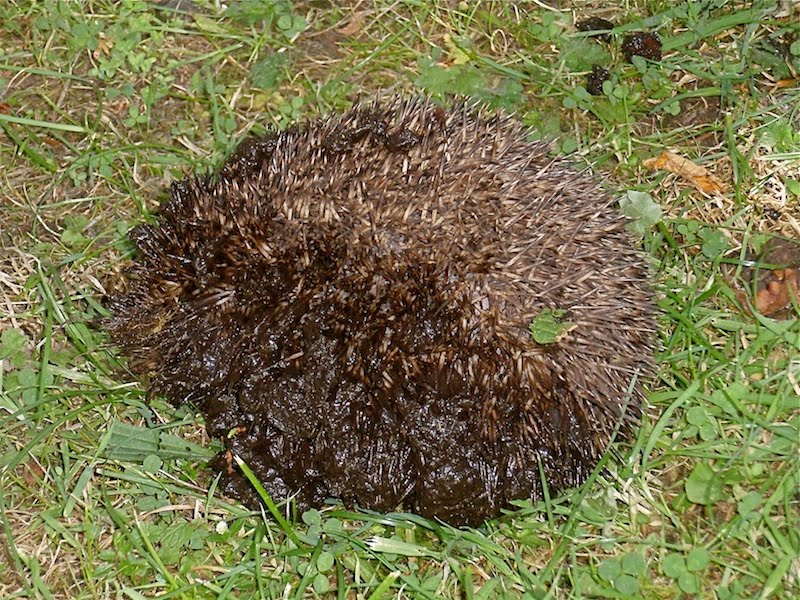
What's that down there inside the cattle grid?
Looks like a hedgehog has fallen in and is stuck in the mud.
Gardener comes to the rescue.


That's him out.
Let's see if he's dead or alive.


Can't tell clearly,
 but I think I can detect the prickles rising and falling.
Is he breathing?
He is encased in mud and I can't tell his back end from his front end.


An hour later and he hedgehog is still motionless, apart from what appear to be
signs of breathing. We put a saucer of bread crumbs soaked in milk close
to where he lay on the lawn and kept other creatures off. 
No movement.

We added a portion of wet dog food and a saucer of water to the provisions.

To stop other animals eating the food and to stop them investigating the smelly little heap 
on the lawn, we covered him and his various sources of nourishment with
a wooden box, well ventilated.

At midnight we took another look.
Hurrah, he had eaten and drunk the lot, breadcrumbs, dog food and water.

As he played dead again, we left him under the box all night, 
adding another spoonful of dog food and some more water.

Six am today,
no further food had been eaten, the hedgehog lay dead.
Seemingly.

Eight am I lifted the box off him and left him to his fate.


This is what I saw from the window at ten am:
one perky little hedgehog scuttling off towards a flower bed at high speed,
button-and-bright-eyed,
and nose end and tail end clearly visible.


Mission Accomplished.

Friday, 16 July 2010

The Great Fire Of London And How It Could Have Been Avoided


Thomas Faynor was still awake at midnight, banking the fire in the bread ovens, ready for rekindling in a few hours’ time for early morning baking. When he was finally done he went up the steep stairs to his  bed in the room above, which was the family’s living and sleeping quarters, disturbing his wife, who had turned in an hour earlier. On his way he stumbled over the baker’s boy’s pallet at the foot of the stairs, kicking it for good measure, making sure that Annie, the maid, was nowhere near the boy’s bed but that she was lying on her own straw pallet in the corner of the bakehouse, half hidden behind a makeshift curtain. The boy grunted, cursing his master under his breath for being late to bed. He would miss Annie tonight. Even on Sunday people wanted fresh bread and he was to rise first to see to the ovens, fanning the flames to bring them to the required temperature. Sleepily, he yawned and dug himself deeper into the straw.

It was Sunday, the 2nd September 1666.

The night was as silent as a night within the old Roman Walls of the City of London could be. A few revellers were still about, but here, on Pudding Lane, not far from St. Paul’s Cathedral, only a few taverns kept really late hours and soon the only noise in the bakery was the rustling of rats in the rushes, and the crackling of the fire in the ovens. 

The boy went back to sleep. The noise from the room above, where the baker had roughly woken his wife, had stopped. All was quiet. 

The boy dreamt. He dreamt that a fire was breaking out in the bakehouse. He dreamt that he was the only one awake and it was up to him to stop the blaze. It was almost as if he could feel the heat coming closer, sweeping across the rushes and licking the wattle and daub walls.  He rose from his pallet and there was a strange apparatus waiting for him. He bent to pick it up and lo and behold, the strange apparatus belched its white breath at the fire. The boy and the apparatus fought the fire, inch by inch, step by step, until they had vanquished it. In his dream he became a hero and the Mayor of London praised him in front of the multitudes and the King himself called him to the Palace of Westminster. Annie came to his bed every night. He could feel the heat of her body scorching his skin.

The boy awoke.  


Wednesday, 14 July 2010

Multiple Choices


Have you noticed what a huge virtue ‘being able to choose’ has become?

Every time I go to the supermarket, wanting to buy even the most common kind of food staple, cleaning agent, or beverage, I am faced with a bewildering choice.  What brand, kind, country of origin do I want my coffee or tea to be, which kind of biscuit, tinned beans or rice do I want today, which floor cleaner or sink scourer will be the only one suitable  for my specialized flooring, or the material my kitchen sink is made of. The purchase of the most mundane, boring, commonplace household item requires a conscious decision. 

It’s enough to make my head ache.

Shopping is a bore at the best of times, having to use valuable thinking capacity doing it is a waste of human resources. Sell me the stuff I need, make it a decent quality at a reasonable price and I’ll be yours forever.

Consumer goods, whether white, electrical, digital, leisure, whatever, come in dozens of varieties nowadays. Just invent the best washing machine you can, do away with inbuilt obsolescence, show me how it works and I’m away. And, for heaven’s sake, why do I need a dozen or more different washing powders, gels, liquids, concentrated, not concentrated, long-life, flavoured, spring-scented for whites, for coloureds, for delicates, for  woollens, his ‘n’ her’s, the kid’s and old uncle Tom Cobley ‘n’ all ? 

Choice is everything. Women were told that having the choice between household drudgery and an exciting working life was like finding the holy grail. In the end we chose to have it all, juggling paid work, household drudgery, husbands, and childrearing. What a con that turned out to be.

I am all in favour of  weighing up the pros and cons of any specific issue, moral, political, cultural, commercial and financial. We can choose how to have our children, even what sex they should be. We chose our children’s school. We chose our environmental footprint by choosing our car, our holidays, our home. Not every choice we make is wise, there is room for disagreement. Ethics come into it. 

I wish we didn’t have to make some choices: all schools should guarantee a decent education for our children, we shouldn’t have to elbow other parents aside to get our kids into the best schools. I wish we didn’t have to park our old people in dreadful care homes, which are anything but caring. I wish we hadn’t attacked our planet with such gusto in the past and were now free to choose to live a life that shares the earth’s resources generously and justly.

I wish choosing one politician over another, one political party rather than another, made a real difference. I wish that believing one set of promises over another makes my choice a genuine one; instead, so very often, they are cynically discarded for the sake of expediency, making my choice a fool’s errand. 

If I might have a choice in the matter, could I please have quality rather than quantity, the best the wisest  can come up with, choose with the benefit of all in mind.

Then, and only then, you can keep your 57 varieties, one of everything will do me fine. 


Monday, 12 July 2010

What To Blog About ?


What to blog about?

The cupboard is bare.

I look out of the window and, for the first time in weeks, it’s raining.
Good. The rain is badly needed. I should feel newly energized. Sadly, I don’t.

What to blog about?

There are ideas, some notes, a few headings, some half completed scribblings, but nothing that has any substance as yet. It’s there in my head, now it needs writing. Writing it is the hard part. Can non-writers suffer from writer’s block?

Summer is a slow time, the living may be easy, but the heat saps energy, thoughts run like treacle, sticky and viscous. All I want to do is sit in the shade and read.

I went to the village barbecue, hoping for some blogging material. After all, I am good at people-watching, people-dissecting. The barbecue is an annual event, run by the ladies who run all such activities, like coffee mornings, the Women’s Institute, the bring-and-buys, I’m sure you know the sort of thing I mean. On the face of it, the barbecue represents  the perfect milking parlour but I came away with nothing.

Sure, Colonel Blimp was there, full of his glory years, still reliving the  Empire; the Squire and his lady put in an appearance, smiling graciously,  instantly surrounded by a fawning coterie; the local MP, a worthy man, no doubt meaning well, but a politician nevertheless and therefore happy to take from the poor to give to the rich, showed his face briefly.

The Church was represented too, several vicars, male and female, in dog collar and black or dusty grey garb, were huddled around the same table, occasionally rising to tend to a particular member of their flock.

The village idiot family was there, middle-aged children keeping close to Mum and Dad, enjoying the outing.

The village intelligentsia mingled nicely, dripping words of wisdom and allowing the run of the mill villagers the benefit of their superior intellect.

The artist colony flapped and gesticulated, laughed a lot and, having made sure that everybody had noticed their presence, made their prolonged exits.

In other words, everybody had fun, everybody was kind to everybody else and ate the burnt meats and bland salads with a good grace. Wine flowed, at £1.50 a glass an easy treat. The accordion lady played her instrument in the middle of it all.The evening was balmy, the gardens lovely and the surrounding fields a picture of bucolic innocence.

Yes, I came away with nothing. Singling out any particular grouping at this friendly, enjoyable event to use as blogging fodder would have been too unkind.

So, what to blog about?


Friday, 9 July 2010

False Hopes


The garden was long and thin. Eva had permission to play in it if she stayed off the vegetable beds and kept away from the chicken coop. She was allowed to go down the narrow path to the gate at the bottom which led to the rear access for the terraced houses.

Whenever she came out the man who owned the garden kept a close eye on her. It was summer and his vegetables were ripening. She had been told not to touch any of the fruit and vegetables and she was too timid to disobey.  But she could look.

On her way to the bottom of the garden she passed a row of tomato plants. Their fruits fascinated her; she had been watching them develop from the moment the flowers appeared and now, several weeks later, the fruits had set and begun to show colour. Every day she visited the plants, measuring them with her eyes, looking at them from underneath, above, sideways on.

Along with the tomatoes, a plan ripened in her. She would take one, perhaps the one which was at the back of the truss, and therefore slightly hidden. Her visits became more frequent. She was going to wait until her chosen tomato had turned fully red, plump, and juicy looking. She would say it had fallen off and been eaten by animals.

Another day maybe and then she’d come out while no one was about and she’d pick it, take it into the alley behind the gardens, and eat it. Just thinking about it made her mouth water.

On her chosen day she came out early and made straight for the tomato plants. There was no red anywhere, only green and yellowish fruits remained. The man had picked all the ripe tomatoes during the previous evening, after she been sent to bed.


For more tomato stories visit


Tuesday, 6 July 2010

A July Day In Nature and Poetry


Fledgling Blackbird


As late as the first week in July there are still baby blackbirds who cannot fly. I found this one on a table on the terrace after a night of high winds.  Every time it hopped away from me it lost more bits of fluffy feathers. In the end it hopped, skipped and stumbled off the table and under a large lilac bush, where it hid, issuing pitiful little gurgles, a sound like a blunt pebble being rolled on a rough, earthy surface.

I stood well away and mother turned up, clucking and fussing.


VIII

I know noble accents
And lucid, inescapable rhythms,
But I know, too,
That the blackbird is involved
In what I know.

Wallace Stevens
From Thirteen Ways to look at a Blackbird


A sparrow's nest ?


This tiny nest came down with the wind,  
It is bowl-shaped, very shallow, and
no more then 4 inches wide.
Whenever I find  birds' nests I am always surprised  how spotless they are.
Birds truly do not 'foul their own nests'.


The married birds with nice selection cull
Soft thistledown, gray moss, and scattered wool,
Line the secluded nest with feathery rings,
Meet with fond bills, and woo with fluttering wings.

Erasmus Darwin
from Reproduction of Life


A Dead Mole


I found this mole by the compost heaps, just lying there, stiff and cold, without any discernible injury.
I hope Moley died of old age, after a riotous night at Toad Hall with Ratty and Badger and Mr. Toad.

Benno and I gave him a decent burial, reading a poem as part of the ceremony:

A Dead Mole

Strong-shouldered mole,
That so much lived below the ground,
Dug, fought and loved, hunted and fed,
For you to raise a mound
Was as for us to make a hole;
 What wonder now that being dead
Your body lies here stout and square
Buried within the blue vault of the air?

Andrew Young


Except, of course, the poet must eventually have done what we did,
buried him in a hole in the ground. Air burials are not at all the thing round here.

How many of these will it have taken to make moleskin waistcoats?


Rural England


An English scene, 
a sky that cannot decide whether it should rain or shine,
a hay meadow, cut,
a field where sheep may safely graze,
and fields of crops, like the barley field in the middle of the picture 
all divided by hedgerows.


Each rural sight, each sound, each smell, combine;
The tinkling sheep-bell, or the breath of kine;
The new-mown hay, that scents the swelling breeze,
Or cottage chimney smoking through the trees.

Gilbert White


Wild Orchid


Common spotted orchid
I found this orchid on the edge of the woods,
between the path and the field, with a small stream running alongside.


the orchid blossoms
and I can't explain why it
moves my heart, why such pleasure
comes from one small bud,
and a long, spindly stem.

Sam Hamill
From The Orchid Flower


When Evening Shadows Fall


The view from my window in summer.


When day declining sheds a milder gleam,
What time the may-fly haunts the pool or stream;
When the still owl skims round the grassy mead,
What time the timorous hare limps forth to feed;
Then be the time to steal adown the vale, 
and listen to the vagrant cuckoo's tale;


Gilbert White
From The Naturalist's Summer Evening Walk.


Monday, 5 July 2010

NIGHT


Three a.m.

For the moment I have given up on sleep.
I am at peace, the night welcomes me with open arms.
The whole world is mine.
Yesterday is long gone, tomorrow is no more than the thinnest shadow of light just over the horizon.
There’s nothing on my mind to disturb my equilibrium.

I put down my novel, pick up the poetry anthology on my night table; read a favourite poem.

I decide to get up, draw the curtains and open the window wide.
The night air is balmy, it caresses my face tenderly.
The waning moon pierces the velvet sky, creating a silvery sheen above the deeper blackness of trees and the edge of the hills.
Bright Venus is in attendance.

All is still, all is silent.

As my spirit settles into the night, my eyes distinguish minute differences in the texture of the darkness, here and there a man-made light glimmers and the gentlest breeze shifts the tops of trees.

My ears become attuned to far-off sounds.
An owl hoots; there is an answering shriek from across the valley.
In a distant farmyard a dog barks briefly, disturbed perhaps by the call of a vixen.

I hear a hum, a delicate, yet deep-throated hum; like a blanket of sound covering all other sounds.
It is the river, flowing low after weeks of blue skies and no rain to fill its bed with new vigour.

The river carries my spirit and I become one with the night.


Saturday, 3 July 2010

Gardener's Reprieve


It's July,
and a period of leisure has at long last arrived for those
engaged in gardening for recreation only.
Now is the time to sit back and enjoy.

Round about the time of the Chelsea Flower Show
I give clumps of many herbaceous perennials what is known as
"The Chelsea Chop",
i.e., I cut them down almost to ground level.
This ensures a second period of flowering fairly quickly,
and it means that flower beds remain interesting - and tidy - for most
of the season. Pruning of shrubs that have finished flowering
 is over, those that are still flowering can wait until later.
 Birds are busy with second and possibly third clutches,
which means that I leave hedges alone until I am sure that
the youngsters have flown the nest.

The only work to be done in ornamental gardens now
is watering during dry periods, deadheading, feeding, weeding
and, of course, mowing the lawn.


Siting in the garden,
admiring,
and not getting up to work,
is far harder than working,
as any gardener will tell you.

So I went round and took a few photos.


This is part of  my 'hot' border,
where I grow herbs like this thyme,
wavy-hair grasses and houseleeks.


Dublin Bay performs year after year.
She embraces and smothers her large metal climbing frame
and flowers with abandon for many weeks over the summer.


The sea holly (Eryngium)
also does best in a dry and sunny border. As its name name implies, 
sea holly is very happy in gardens by the sea.
But it does equally well here in the Shropshire Hills.


Nevada is a large rose, 7ft by 7ft.,
with creamy white, semi-double blooms of about 4" across.
At dusk they remind me of  floppy white handkerchiefs.

In my experience, Nevada likes fairly drastic removal of old wood if it is
to keep up its performance over the years. It gives a wonderful show early in the
season, when it is smothered with blooms all along its stems.
It has intermittent, less generous  crops later on.


 This is 'Graham Thomas',
an English Rose, widely sought after for
its wonderful colour and delicate tea scent.
 This photograph doesn't fully show the 
very unusual, rich and deep,  pure yellow colour,
without a hint of lemon.

   The blooms are cup shaped, and formed like a Paeony;
It will flower profusely all summer and is very easy to grow
and undemanding.


Another beauty, "Guinee", a climber.
Very hard to photograph; 
I've tried it in bright sunshine, on gloomy days, at dusk, early in the morning.
This rose is the darkest of all garden roses, almost black.
Its velvet like texture makes it appear dull and lifeless in our cloudy
English climate. But on bright, sunny days it glows with a smooth, purplish sheen.
It is very pleasantly scented, not sweet, but fragrant and slightly tangy.

Guinee flowers profusely in late June and early July, but subsequent flowering is sparse.
It has stiff and rigid stems and is best grown on walls.

Guinee is one of these rare, very showy beauties, very demanding, needing a lot of attention, 
instant and constant deadheading, lots of feeding and treatment for mildew.
You either love it or hate it.
Not many gardeners grow it.
 Everybody who sees it at its best is instantly smitten.
It is the one rose which has knots of admiring visitors standing in front of it
on 'Open Garden' days, sniffing it, cradling a bloom in both hands, feeling the texture,
writing down its name.

 I always warn people about its capricious nature, 
 It can be exasperating, but I wouldn't want to be without it. 


Rosa Rugosa is a completely different animal. Easy to grow, will sucker almost
like a weed, is very large and prickly and therefore wonderful in hedges.
There is nothing special about rosa rugosa, it comes in purplish pink and white,
needs no special treatment, can be cut down to ground level, yet still comes back obediently.
A proper workhorse.

Apart from its usefulness, rugosa has one special, redeeming feature, 
namely the huge, orangey hips in autumn,
which will look very attractive for a long time and my birds love them.


I couldn't resist taking this close-up
of the tiny open flowers of the common thyme.
A herb is a herb is a herb, 
there's little to say about it,
but, by golly, a patch of flowering thyme can stop you in your tracks.


PS:  For anybody wondering, gardener is still alive.
He's been chain-sawing trees today, under strict supervision.


Thursday, 1 July 2010

None Of My Business

What I am about to write here is not really a very good post. You might say, that none of it is any of my business, but I want to get it off my chest, because the whole thing is making me very sad.

One of my old ladies had what she and others like her would call 'a bit of a turn', probably a small stroke.
Her 88 year old husband called the ambulance and she was promptly taken to hospital.

This is where it gets complicated.

Let's call the old lady Margaret and the husband Richard. Richard was due to go on a trip to Europe with a younger friend of his within two days of Margaret being taken ill. Margaret, who has not been well for some time, was due to spend the time of his absence with her daughter, who lives in another part of the UK.

Margaret falling ill was really most inconvenient and she upset a lot of plans.

Margaret has other family living in the valley, nieces and great nieces, who have been very good to Margaret's sister during her last years. Margaret's sister had no children to look after her and the nieces more or less took over. Margaret's sister had let it be known that she had made a will in which she would thank them for their kindness towards her.

Margaret and Richard have two children, a daughter and son, both living a long way away.

With Margaret taken care of in hospital, Richard decided he would stick to his plan and go on holiday.
The evening before he left, he rang round a few kind ladies living in Valley's End and asked them to visit Margaret in whatever hospital - there are several possibilities after the acute stage is over -  she would find herself. Margaret's and Richards's daughter, who had been called to come over for the emergency, also left again for home and work.

The nieces decided they couldn't possibly do for Margaret what they had done for Margaret's sister.

Which left the three kind ladies, who got in a huddle and debated what to do. Nobody had been left in charge. The three kind ladies had no idea what, if anything, Margaret had taken into hospital with her, whether she had clothes and underwear available, simple things like soap, towels, tissues, etc.

In the end it was left to the three kind ladies to find out these things. They got in touch with the daughter and  the hospital - who were rather curt and unwilling to give out information to strangers.

Finding out where Margaret was, what needed doing and getting permission from the daughter to do it, all took time.

Margaret was admitted on Friday, husband and daughter had left her by Sunday. The following Wednesday the first of the three kind ladies finally managed to visit her in hospital.

She found Margaret much improved, but desperate for company, and for all the small bits and pieces that make a stay in hospital bearable. Luckily, the kind ladies being practical souls,  had anticipated Margaret's needs and were able to supply everything necessary.


None of this is any of my business, it's family business, nobody else's. Nobody was ill treated, nobody was seriously neglected. The daughter will be back at the weekend and the niece has actually relented and paid a visit herself since.

And yet . . .  . . . .
I am one of the three kind ladies. Even though we don't want to sit in judgement, we can't help but feel
a little sad.

Do you understand why?