Wednesday, 31 August 2011

How To Beat A Cold Caller At His Own Game


You've just sat down to a nice hot plateful when the phone rings. You're almost certain it will be a telemarketing call. No matter how many times you register with the Telephone Preference Service, there's always a new company to sneak through the firewall to pester you with unsolicited direct marketing calls.

"Is that Mrs. Smith?"

You were right, the bubbly foreign voice at the other end confirms your fears, but you will neither hang up instantly, nor start swearing. Well, I won't, I don't know about you, of course.

"Speaking", with a question mark in your voice.

"This is John/Robert/Uncle Tom Cobbley an' all", in the thickest Far Eastern accent, to a background of a beehive of murmuring voices. "How are you today, Mrs. Smith? "I still don't swear but now I hang up.

Except the other day I didn't.

The voice was that of a woman, an ordinary English voice. 

After we had established that I am Mrs. Smith and that I'm fine, thank you very much for asking,  she let out a stream of words, presumably a sentence with some meaning; as each word ran into the next at breakneck speed I only understood the odd word here and there. I'm not as young as I was, my brain needs time to get rolling.

"What is it you're selling?"

"I'm-not-selling-anything-we-are-doing-a-survey-on . . . .." She'd lost me, I really had no idea what she was talking about. "I'm sorry, I didn't catch that, could you repeat what you said?"

She did. Still no luck. And again. She must have used exactly the same words so many times in her daily working routine, that there was no way she could slow them down.

Again.

"I really am awfully sorry, but. . . "

By now her voice had a slight edge to it. Perhaps her supervisor was close by, perhaps the connection showed up as being unbroken on her monitor; she had to continue.

Finally, I took pity on her.

"Thank you so much for your patience, but I simply cannot understand you. Could you please put this IN WRITING?"

A snort of disgust, "Yachch", and the line went dead.

I really enjoyed that.


Tuesday, 30 August 2011

Any Thoughts on the Matter?


The other day I had a long email from a blogger friend, with whom I have been in contact behind the blogging scenes for several years. She is very worried about her husband who was diagnosed with MCI (mild cognitive impairment) some time ago. There is a possibility that he is suffering from early onset Alzheimer's; it would take further tests to establish the presence of the disease.

My friend is a very capable woman, well able to take care of herself and her husband, whatever happens. But she now has to decide between two alternatives: to find out what is wrong and start some form of treatment, the outcome of which is doubtful, or to leave it at the previous diagnosis and hope for the best. Whatever she decides, her husband will accept; he himself is no longer able to make an informed choice.

Mary (not her real name) is deeply troubled, as anybody would be in her situation. To know or not to know, that is the question to which she will have to find the answer. She hasn't asked for my advice and I won't be offering it.

People rarely ask for advice in such important matters unless they know that the advice they will be given coincides with what they secretly already know is their preferred course of action. We really wish to be given the reassuring green light to go ahead or moral support for our own decision not to face up to things.

I have an excellent example of this in my closest family.  My mother was very ill for about a year before her death. All the signs were that she had cancer. She never asked her doctor for a full diagnosis and preferred to ignore his hints. She could have spoken to me at any time, in fact, I frequently encouraged her to do so.

My mother never did. When she was hospitalised the doctors told her that any meaningful treatment depended on full knowledge of her condition. During one of my brief absences she telephoned my cousin for advice. My mother absolutely knew what my advice would be and she also knew that my cousin's advice would be the total opposite to that. She knew that I would want to know as much as possible about the situation in order to be able to make an informed decision; as far as I am concerned, it is only the full possession of facts which allow me to face, and deal with, an enemy, which is what cancer is. My cousin, however, is the exact opposite; her way of dealing with things is not to know anything. "was ich nicht weiss, macht mich nicht heiss"  (I can't get worked up about something I know nothing about).

Mum preferred the second option, which had been her solution all along. My cousin, in effect, gave her permission to stick to it. In the end, it didn't much matter, she had left it too long for effective treatment.

Mary's situation is somewhat different, in that there is so far no permanent treatment for Alzheimer's, and certainly no cure; all she could hope for is a slowing down of symptoms, at best.  But somewhere, perhaps only at the back of her mind, she knows what she will do.

Would you know?

"Forewarned is forearmed" or  "Where ignorance is bliss, 'tis folly to be wise"?


Sunday, 28 August 2011

Married Life

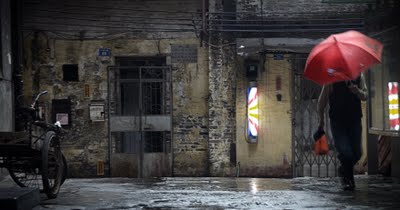
The Red Umbrella - Christopher Shay


Him, at home, looking out of the window:

Didn't she say she'd be on the later train because she was going to have her hair done after work ?
Oh no, it's raining hard. She won't like that.
I know what I'll do. I'll see if I can get to the station in time to get her brolly to her.
I'll take the bike, that's quicker.


Him, at the station, looking round:

No sign of her. No sign of anybody. The train must be late.


Passenger, hurrying, coming up from the platform:

You missed the train, mate, it's been and gone.


Him, on the platform, standing in the rain, wondering what to do:


Where can she be? Perhaps she waited for the next train?
I'll hang about a bit, see if she's on that one.


Her, at home, sitting over a cup of tea, as he walks in:


Where have you been? You are wet through. What was so urgent that it couldn't wait until after the rain? I've been back ages. When I came out of the hairdresser's and saw how hard it poured, I took a cab. Didn't fancy getting soaked.


Friday, 26 August 2011

August Miscellany - Of Birds, Plays And The House of Virgo

Ciclo dei Mesi - Agosto
1390-1400


Having nearly missed the monthly round-up of small bites, I'd better get straight into it:


A baby siskin flew into the conservatory window and sat, dazed, just outside the door for at least fifteen minutes. This shot is taken through the glass of the door and therefore less clear than it might have been.
The red geranium leaf in the right-hand corner gives you an idea of the tiny size of the fledgling.

Siskins (Carduelis spinus), belong to the finch family; they depend heavily upon the seeds of pines and spruce for food in early summer. Last year we had hardly any in the garden, hard winters take a heavy toll on them; their numbers seem to have recovered a little this summer. This fledgling must have been from a second clutch; the first clutch of pale blue eggs is usually laid in April/May. They hatch within two weeks and stay in the nest for another two.

Siskins are delightful little birds, like flashes of the brightest goldleaf thrown up into the air. The male circles the treetops on slow, deliberate wing-beats, with plumage fluffed up and tail fanned. Both partners take part in a fast-moving display flight, in which the male rises to a considerable height with tail spread and wings quivering rapidly, and the female follows close behind.


Eduardo De Filippo is not a playwright I know much about. He is not performed very often in this country. My programme notes say that : "prior to his funeral in 1984, no fewer than 60.000 people filed past his coffin as it lay in state in Rome and the ceremony was screened live on Italian television."

He was obviously much loved and respected in Italy. "The bastard son of two actors ended his days as a senator of the Italian Republic, adored by audiences and revered by his fellow professionals."

"The Syndicate" is a play is about "Tough Love Mafia Style", with tremendous roles for the three main male characters. I was never quite sure if I was watching a morality play, a comedy with very dark undertones, or a straightforward thriller about  the Mafia underworld.


August has been a miserable month weather wise in  my corner of the world. Far too dry for the garden, with an almost permanent cloud cover which never kept what it promised, neither rain nor a break to let the sun through. This has been the third non-summer in a row for us. 


The Sun may have entered the House of Virgo but it must have missed Friko's Castle at Valley's End.

"The man born under Virgo shall be a good householder, ingenious and solicitous to his work, shamefast and of a great courage, but he will soon be angry. Scarcely shall he be a while with his first wife. He shall be in peril by water, he shall have a wound with iron, and shall live seventy years after nature."

"The woman shall be shamefast, ingenious and painstaking. She ought to be wed at twelve years, but she shall not be long with her first husband. Her life shall be sometime in peril; she shall have dolour at ten years, and if she scape shall live seventy years. She shall bring forth virtuous fruit, and everything shall favour her."

"Man and woman both shall suffer many temptations; they shall delight to live in charity, but they shall suffer much, wheresoever it be."

The Kalendar of Shepheardes 1604


Tuesday, 23 August 2011

Dog Training


As sure as eggs is eggs, you can rely on a labrador's greed. I know of no other creature which will do as much for food as a labrador. A banker might come a close second in the greed stakes, but he's not usually after food. By nature a lab is very accommodating, but promise him food and he'll do anything.

 A ramp? What's that for?

You want me to go up a ramp?

Benno is getting very old, his arthritic hind legs and back frequently trouble him and, jumping up into the  car he sometimes misses his step and his back legs and belly hit the lip of the boot. It takes a mad and probably painful scramble to get upright. He is too large and heavy for us to lift him in.

Let's try putting a few bits of his favourite nibbles on the ramp.
Hey, that's cheating!

So is this!


Next we put the nibbles right at the top of the ramp and stood either side of it, blocking the way up from the sides and forcing him to start walking on the ramp.

After many attempts, it finally worked. Benno got the message that if he wanted food, he'd have to climb up the ramp for it.


It was hard work for all three of us. Benno was huffing and puffing and we needed a break and a cuddle and lots of reassurance that he was our best boy, our lovely boy, our very good boy, our very clever boy. He took it all in his stride; a labrador can lap up any amount of cuddling and petting. All the same, he was keeping a close eye on the box of treats in his master's hand.

There was another lesson yet to come: how to get down again. He would have been able to jump but he jars his joints jumping and negotiating the ramp would be less painful. As he had learned to get up, he'd learn to come down.

This looks interesting!

There! Made it!

It looks easy, but, believe me, it wasn't. This was the third attempt. Twice before we gave up and we were ready to get rid of the ramp altogether. But needs must. If he wants to come with us, he has to get into the boot. Unless we have a dog sitter, I hate leaving him behind for more than two hours. 

The next attempt will be for real, I'll tell you how we get on. With all these treats, he might grow too fat for the ramp!


Monday, 22 August 2011

The Way We Were


"These old photographs could go", she says. "Who would ever want to look at them again? There's only me now and I have no further interest in them. There won't be room for them in the retirement home".

She rummages around in the shoebox on the table in front of her and picks a photo at random.  Peering at the faded print with her short-sighted eyes, she says to her carer:  "Pass me my glasses, there's a dear. I might as well have a quick look through, although nothing much will come of it. It's all so long ago".

The picture is clearer now, she recognises faces. "Why, that's me and Ted and  ........
She stops. A sudden flush of shame, hot and unpleasant, rises up in her. She feels her stomach turning over and a wave of nausea hits her.Who'd have thought that after all these years she'd suddenly feel guilty.

She stares at the picture. A window into the past opens up and, for the first time in sixty years, she allows herself to come face to face with the way she was.

She and Ted and . . . . yes, Shirley, that was her name . . . .
Best friends they were, the three of them; together as children and together as teenagers, all adventures, all secrets shared; others called them "The Three Musketeers"; there was no separating them.

How young they were, how innocent, a world of boundless possibilities awaiting them, the road ahead straight and even. When they were small they had sworn to be friends eternally; whatever happened, they would remain true to each other.

And then Ted and Shirley fell in love.

Suddenly, they were not three but two plus one; still friends, still close, still spending time together; like here, in the photo. She continued to stare at it, her hand shaking a little. She remembered clearly now, they were all off to the lake for a day's swimming and picnicking;  happy and carefree, Ted and Shirley sitting in the back seat, probably holding hands, while she sat next to the driver, her dad, alone, in the front.

The shock of the realisation that her world was collapsing, that she was no longer part of an inseparable unit, hit her hard. She could see it in the eyes looking out at her from the photo; could also see the beginnings of the scheming girl she was about to become. Suddenly, she hated Shirley. She did not, and never could, hate Ted, for she too loved him.

She put the photo down.

It hadn't been hard to separate Ted and Shirley; she flirted and promised, she flattered and beguiled, until Ted had lost his head one summer's evening and kissed her.

No, it hadn't been hard at all.

Her eyes clouded over. Her marriage to Ted had been happy and contented for the most part, neither better nor worse than most marriages. She had no regrets.

"Get rid of the box", she said to the carer, as she slid the photograph back in between the others.


Saturday, 20 August 2011

Gardener's Big Adventure


Gardener last summer


"Summat wrong here, I thought."

Gardener came by for a cup of tea yesterday.  A loud knock on the back door, a shout of 'hello" and "where's the gardener, canna see her working" ( meaning me), and he's in the kitchen. Bright and cheerful. When I asked if the doctors had given him permission to drive again, he said "Didn't ask them". Of course, what was I thinking. Gardener doesn't ask questions to which he might not like the answer.

"So there I was" he said, "sawing logs on the saw bench; I had the tractor with me and the saw box on the back and sometimes I had to use the chainsaw as well; lifting the trunks on the bench and piling the logs in the box. It was a big job and I thought I'd better get it done."

"I'd been having this pain in me chest for a couple of weeks but I thought I'd just pulled a muscle or summat. Then I got this pain, and it was bad, so I rested a bit and it eased off, so I started again. Every time the pain came, I stopped and then went at it again. And then I broke into a sweat and was sick".

"Hallo", I thought", he continued, "this is not good. Summat wrong here. I knew Mr. Beresford was up the field and wouldn't be back for a twenty minute or so, so I lay on the ground. The pain was summat awful".

"When the amblance come, the chap kept asking how bad the pain was. Nought to Ten, he said. Well,  I didn't know.  Anyway, after he give me the morphine, I didn't have no pain no more".

"In the air amblance they only put me flat on the stretcher and I couldn't see a thing except the roof". Gardener seems genuinely aggrieved that he wasn't given a window seat.

"No windows in the roof, see. So I asked  if they could take me home again by amblance; I've never been up in the air before. It would of bin nice to see everything on the ground".

Throughout his tale he interrupts himself now and then to cackle heartily and take a big gulp of tea. Beloved has given him his usual mug which holds close on twice as much as an ordinary mug.

"When we landed there were all these people round the 'elicopter. This woman bends over me and says she's Sister Margaret and how she's in charge of me. Next thing I know they got me on an hoperating table, slapping summat icy cold on my arm and I'm gone. I don't know nothing".

Clearly, he is still totally surprised by how quickly and efficiently they dealt with him. His foxy grin shows how pleased he is to be telling the tale.

He goes on: "And then I'm in the ward, no pain nor nothing, and the nurse comes and asks if I want a cup of tea. Sure, I tell her, and you can tell them amblance drivers they can fly me home again. She says, no, not yet, we'll have to keep you here for a few days".

"And they've got all these machines on me, and I've got tubes in me arm and me hand and they've got me pinned down. And they keep coming for blood all the time too. So I asks them, what they're gonna do with it all, if they're gonna sell it".

It looks like this part of the tale is coming to an end. He was indeed taken home three days later, by road. But now he goes into medical details.

"So now I've got this stent in me hartery, and they blow it up and it opens the hartery so I get enough hoxigin to me heart. They said that I had a blood clot blocking the hartery and that's where all the pain come from. That Dr. Lambert should have known summat was wrong when I went to see her".

He is right,  his GP did miss the danger signals three weeks earlier; she should have known that Gardener, who never sees a doctor unless he is practically on his death bed, wasn't visiting her from boredom.

Anyway, he is feeling well, if a little scared. "How many lives have I had now", he asks wistfully. He's fallen out of trees, has had several operations on his back and limbs and isn't always careful when it comes to operating machinery or lifting heavy weights. A little of the cockiness has been knocked out of him this time, I think. Knowing him, it'll probably come back before long.

We finished the visit by taking a stroll round the garden. "I see you've had the 'edge done", he says. "Tidy job", he says. That's praise, coming from him. He's never very complimentary about other people's work. I think he is secretly very glad that he won't have to do it himself. "They got me doin' these hexercises", he says. "I must hexurt myself." This is obviously a new word in his vocabulary, he makes several false starts before he trusts himself with it. "Waste of time, if you ask me. They got me on a bike and a treadmill and when I get going properly, they tell me not so fast, take it easy. Better to start doing little bits of work, maybe an hour or two". He means it.

But he knows as well as I do, that he needs to heal first, to build up his strength and that he must be sensible and take care. He cracked one of his cheeky jokes. "When I get back, we'll have to swap. You do what I did and I'll do what you did".

I can't wait to have him back, but I'll be keeping a very close eye on him. I am, however, under absolutely no illusion that he'll listen to me.


Thursday, 18 August 2011

Begone, Dull Care!


Away, loathed melancholy!

Such friends as you drive gremlins clean away.
My heartfelt thanks to all of you who came to say you cared.


The sun was out, the river sparkled and winked at me as if to say "enough with gloom and doom". A sturdy man brought his sturdy wife and between them they cut and tidied and cleared away overgrown hedges all around the garden. A job well done and off my mind. I too worked outside, until I collapsed, exhausted, into an easy chair to watch the third repeat of a favourite TV show; not exactly stimulating, but soothing and reassuring. "There, there", the detective said to me, "you know the outcome, all will be well tomorrow".

What is this indefinable sense of yearning and loss, that overcomes so many of us; what is it that we long for? This 'it' that  has the power to sadden our hearts and allows us to be aware of only shadows even on  the brightest day: what is 'it'?

In retrospect, I wouldn't even call the place that had me confined the pit of depression. On the surface, I functioned perfectly well; hard to believe though it might be,  but on two occasions a different 'me' took over and became the life and soul of two intensely animated dinner parties. The real 'me' stood aside and watched me perform, all the while questioning the purpose of it all.

It just so happens that I've read a few blogposts on 'reasons to be grateful' recently. Although I wouldn't go quite as far - the day I am inspired to count my blessings will be a very sad one  for me - perhaps I must remember to open my eyes to the wonders of this world rather than focus on the darkness. Melancholia always has and always will be a part of who I am; from the replies to my previous post it seems that there are many who share this trait.

This bloggers' universe we inhabit is a strange and wonderful one. Who'd have thought that a simple apology for absence, due to a temporary disturbance of mind, would bring forth such an outpouring of sympathy. Again, thank you for your concern and your kindness, knowing that there are people out there who care, makes all the difference.

It would, of course, be even better if you knew the remedy.


Monday, 15 August 2011

Melancholia


Nobody wants to know you when you're down; 
A dark cloud deadens the sparkle 
and muddies the waters.
I'm in hiding.


"Laugh, and the world laughs with you;
Weep, and you weep alone;
For the sad old earth must borrow its mirth,
But has trouble enough of its own.


So says Ella Wheeler Wilcox,
and so say I.


The Decorettes


For the moment I lack the mental fleet-footedness that comes with a healthy mind in a healthy body; all I can come up with in response to  Tess Kincaid's Magpie Tales No. 78 is a picture of The Decorettes. Lynn and Lorraine and their dog are having a break from painting the outside of my house last summer.

See you soon -   

The mere fact that I've stuck my head above the
parapet to post this apologia is a good sign.

Actually, why should you care. 
What's one more blogger more or less.


Thursday, 11 August 2011

Handy Hints for Garden Visitors

Clematis 'Polish Spirit'

There is still plenty of time to go garden visiting. In fact, some gardens reach their full, spectacular potential not until the second half of summer, when the range of magnificent herbaceous perennials seems endless, from asters and dozens of daisy-like flowers to the stately spikes of salvias; not to mention the summer flowering clematis, like the one above.

Sadly, we won't be opening the garden this autumn; I need gardener's help with the hard graft. As it is, I'm having to pay a 'gardener and designer' a small fortune to cut the hedges. While I'm on the subject, I'd like to mention that 'my' gardener is doing fine; he is chirpy and bright and full of hope that he'll eventually be able to do a few days again, although I doubt that he'll work again like he did before his heart attack. It has frightened him into stopping smoking!

If you are planning to spend a few hours looking at someone's garden or if you think it might be a nice thing to do next year, let me give you a few handy DOs and DON'Ts, which would certainly make you into my favourite visitor:


  • leave scissors, dampened tissue and plastic bags at home, unless permission to take cuttings has been given.
  • keep dogs and children on leads.
  • do not march through, looking barely to left and right; the owners are proud of their garden and have expressly invited you in; you do not need to feel embarrassed about being there.
  • that doesn't mean, however, that they want you in their house: do not ask to visit the loo, unless you are absolutely desperate; it's best to avoid accidents of an embarrassing nature; never visit if you are unwell, particularly with tummy gripes.
  • talk to the gardener about particular plants or aspects.
  • but do not give unwanted advice.
  • do not criticise; gardens are like children: whatever parents may say about their children, they are proud of them.
  • do not commiserate with the owner about weeds until you are certain they are not prized wild flowers.
  • do not commiserate with the owner about the demise of a plant until you are certain that s/he has noticed.
  • form small groups and and discuss pleasing or interesting features.
  • say 'interesting' frequently,
  • but keep your superior knowledge well hidden. 
  • if the owner has temporarily mislaid the name, age or serial number of a plant and cannot find it in the garden books on display, don't hang around waiting for inspiration to strike; use the books yourself, or take a photo and quietly remove yourself.
  • do not point and laugh at a feature or plant unless you are absolutely certain that it's meant to be amusing; if you are absolutely certain that it is, point, draw others' attention to it and laugh.
  • admire particular features, like fountains, specimen trees, statuary old and new.
  • never say : you have enough work here to keep you busy/out of mischief/fit;  it's patronising.
  • praise the garden, and, if you can't, at least say 'thank you'.
  • enjoy yourself and take home plenty of inspiration.


Monday, 8 August 2011

Showtime! - That's My World


Every year in August Valley's End holds its Village Show And Carnival on the meadow between the castle hill and the river.  It's a much less raucous affair than the Green Man Festival in May. This event is organised by the village for the village, there are no commercial booths, every booth is run by a village committee and all the money raised is for a village charity. The event itself usually makes a loss, which doesn't seem to deter the organisers.


We always have a brass band imported from the nearest Welsh town,  The Knighton Town Silver Band, who play tirelessly all afternoon. They are very good too.


The big show tent is the main attraction. That's where gardeners,  craftspeople, photographers, flower growers and arrangers, cake and bread bakers, jam makers and others exhibit their prize efforts and compete fiercely with each for first, second and third prize.


Blooms from the garden winner.
You would be shot if you cheated and added a bought flower!


There is something for everybody, This is the winning entry in the best dressed Teddy bear class.


Third prize in the Victorian tableau, which I liked better than 2nd and 1st prize entries.


The winning and possibly only entry in the quilting class. 
It is a beautiful quilt, made by a young girl.


There are always lots of things for children to do.
The Bouncy Castle is a great favourite.


For Dads there is the historic car exhibition. This tractor caught my eye instantly.


It's impossible to show pictures of all the events: dog shows, ferret racing, a fairground organ, puppet shows, an obstacle course, a beer tent and tea tent, even Appalachian dancers appear. When the brass band and the organ take a break, a jazz band plays. And sometimes, all three play at the same time, and the man with access to the PA system can hardly make his voice heard above the din. But he doesn't give up, oh no! He has a microphone and knows how to use it!


My contribution to That's My World for this week.

Sunday, 7 August 2011

Three Meals

The Dinner Table
Henri Matisse - 1896/7 


This has been an extraordinarily well-fed few days; there has been expensive restaurant food, free food, and home-cooked food, always in good company.

Although we both enjoy good food, we are by no means greedy eaters, but during the second half of the week the focus on food has been marked. Only the restaurant meal was planned; eight of us went to The Checkers at Montgomery over the border in Powys, once a humble coaching inn and pub, now a restaurant serving classic French food.

A mini-bus taxi had been booked for us; when you get a group of civilised and dignified adults together, all of them looking forward to a pleasant evening,  and take them on a charabanc outing, no matter how serious they normally are, several layers of restraint melt in the warm feelings of friendship and anticipation. Being driven by a professional, everybody enjoyed their drink; my table neighbour who speaks only English and a few words of Spanish, suddenly became fluent in French, which caused the young man training to become a silver service waiter to giggle helplessly. In spite of a generous supply of wine nobody drank too much, but everybody talked too much. Whenever we get together we talk about music, books, history, and travel; although we know each other's tastes and preferences, we still find plenty to add.

There must still be money around, even in these straitened times. The restaurant was full and therefore very noisy. I'd have hated to be at a table for two.


The free meal, i.e. dinner at friends's house was different, and a lot quieter, but equally enjoyable. I was introduced to a South American dish,
moqueca de peixe; for those of you who are as
ignorant in such matters as I am, it's a fish stew
with vegetables, and very tasty indeed.
Our friends had very carefully excluded all dairy
produce from the menu, which allowed me to eat heartily
and without worrying about after effects.

We were six at table, professionally a similar mix as before, but with totally different topics of conversation. We talked about Africa and the need for education as well as assistance. We talked about the destruction of the environment which is making such catastrophes as the one happening in the Horn of Africa at the moment ever  more likely. One of our number is a journalist with a particular interest in Latin America; she had stories to tell about the continuing destruction of the rain forest which made the outlook for our planet appear most unhealthy.

There is something almost perverse about the white, professional middle class sitting at table, eating and drinking splendidly, discussing the ills of the world and high-handedly solving the problems of poorer nations, so many of which we have caused in the past, and are still causing today. Think about it!

Today we were at home, joined by friends for a somewhat simpler, but still good, Sunday luncheon. We had melon and parma ham, guinea fowl and chocolate and pear upside-down tart, dishes out of my standard repertoire and therefore presenting no difficulties. We could sit back and gossip with our guests.
The conversation was as relaxed as the meal.

It has been a rather hectic week altogether and I'm looking forward to having beans on toast in front of the TV, with my feet up on a cushion.


Thursday, 4 August 2011

The Thief In The Night, or Life Is Too Short To Sleep Through


It came to me, quite suddenly, last night.
Perhaps I should amend this to: today,
it came to me today.
Bright shining hands informed me without passion,
that yesterday had been and gone,
more than an hour ago.

My pillows plumped, I lay
in the uncertain dark of  summer's night,
a single church bell
measuring segments of deathly silence,
sliced into equal portions,
reminding me that sleep is of the essence.

Tomorrow is another day,
a phrase to browbeat me into submission,
the tyranny of sleep a burden on my thoughts.
Everyone else around me has succumbed
to  dead of night,
trusting, anaesthetised.

The chattering noises of the day are stilled.
Demands on me have ceased.
Now I can breathe, my life my own,
no telephone, no world wide web,
all newscasts hushed,
the music of the night the only sound.

Body and soul at peace, I rest.
And then it came to me:
why must the book be closed,
the lamp extinguished,
the circling thoughts imprisoned and subdued,
the tyranny of sleep obeyed,
obligatory yet elusive.

For once, let me be free of this constraint,
Let me be wakeful,
the hanging moon my only company
until dawn's tender hand
dissolves the shadows of the night and brings
clamorous day once more to call on me.

Monday, 1 August 2011

Acton Burnell - My World - The Beauty of Shropshire


Acton Burnell is a small and picturesque village some eight miles south east of Shrewsbury. The name seems to have come from Achetune, meaning Oaktown.

Robert Burnell was Bishop of Bath and Wells between 1275 and 1292, but he was also politically influential as Chancellor to Edward I. For more than thirty years he was friend, confidant and advisor to the king.  Robert Burnell obtained a licence to build himself a partly-fortified manor house, which was begun in 1283 (he was granted the licence to crenellate in 1284);  its ruins, incorrectly called a castle, still stand in near proximity to the church.


In spite of its thick walls and a tower at each end of the rectangular structure, it was a fortified domestic residence rather than a military fortress or castle.


The church of St. Mary has been described as one of the most complete 13th century churches in Britain. The monuments include one with alabaster effigies to Sir Richard Lee (1591) and Sir Humphrey Lee (1632) forebears of Robert E. Lee of American Civil War fame.


The large house (Acton Burnell Hall) near the church and the castle was the home of the Smythe family for many decades. At the outbreak of the Second World War in 1939 the Sisters of the Order of Sion established their Convent there and formed a girls school which continued until about 1970, when the nuns vacated the Hall.

The Hall is now Concord College, a private institute of further education catering mainly for overseas students. Occasionally, visiting chamber music groups perform here, when the Hall is opened to the public to attend concerts.


In the parkland belonging to the school, and close to, but only just visible from the church and the castle since a hedge was planted between school grounds and public grounds, are the end walls of a central hall of a very early structure. It must have been a very large hall - the space between the two gables is about 157 feet x 40 feet - and  local people to this day call the two gable ends the 'parliamentary barn'. 

When Edward I was staying at Acton Burnell in the autumn of 1283, he summoned one of the first   Parliaments to be attended by the Commons as well as the Lords. It passed a law for the protection of creditors, which the king ratified here at the castle, and which is therefore known as the Statute of Acton Burnell.  There is, however,  no direct evidence that the traditional 'parliamentary barn' is the site where  deliberations took place.

From a postcard
 "Parliamentary Barn' in Acton Burnell - Discover Shropshire


In the 18th century the ruins of Acton Burnell Castle became an ornamental feature in the grounds of Acton Burnell Hall. Today, the historic site is in the care of English heritage. 

This is my contribution to That's My World for this week.