Sunday, 31 October 2010

The Place Where We Live


Nancy of  Life In The Second Half recently published an excellent post on the gated community
she calls home for the time being. She calls it the most sterile environment she has ever lived in.


Personally, I have no experience of a gated community. They exist in the UK too, are often born out of a fear of crime and usually very expensive places to live. You would therefore think that they are meant  solely 'for people like us', you would think that the residents have a lot in common and would band together in a real community.

Not so, according to Nancy.  Far from it, in fact. It seems that the word 'community' is a misnomer here.

Here at Valley's End there is not a 'Keep Out' gate anywhere, the only gates we have are front gates, picket gates, garden gates, gates to keep stock in, and gates for decorative purposes only.

All roads and lanes lead to open country all around, secretive footpaths invite rambling without let or hindrance. If you meet someone unknown, you greet them, and if they give you half a chance, you involve them in a conversation about the weather, where they come from, what they are doing in the area, where they are staying if they are on holiday; most importantly, how they like it here.

So far I have met only with friendliness and courtesy from visitors. Nobody has yet said: "it would be paradise if it weren't for the nosy locals".

According to the Valley Diary, which is  produced entirely by people in our community, there are currently 27 local societies, as well as Church groups, school related groups, good neighbour groups,  groups providing emergency transport. We have a village hall and a Museum. We also have our own surgery and dispensary, a hardware shop, 2 butchers, a small supermarket, a shop selling flowers and a few groceries, a newsagent's and a hairdresser's. All that for about 700 inhabitants and a further 200 people living in the outlying hamlets and on farms.

All societies flourish; admittedly, it is mainly incomers who do the work, provide the meals on wheels, run the elderly to hospitals or sit with them and pick up prescriptions. Much is run by committee, on the whole, people mean well and are kind, even if some might try to boss others around.  Much is achieved by a small number of volunteers and large amounts of money are collected almost weekly through the many fundraising events held by the societies.

In a small community like ours good neighbourliness is all, without it, many people would find daily life difficult.  You pop in to see if Mrs. Smith is alright, minding your own business is not an option. Of course, that can cause problems, Mrs. Smith sometimes resents the interfering busybody who checks on her, but at other times she is very grateful.

Having moved here from the big city, I find this community a little claustrophobic at times; we don't have any of Nancy's gates, but there is the danger  of living in a different kind of enclosure, that of small
horizons and closed minds; rural communities in the UK tend to look inwards.

But closed minds and small horizons are to be found in big cities too and if being part of this community means that everybody and his wife knows that I crashed into the gateposts of Mrs. Brown's wide open gate and pulls my leg over it, so be it. At least Mrs. Brown isn't reporting me and the matter is settled as it should be: in a neighbourly fashion.

Friday, 29 October 2010

Aunt Little Kate


Aunt Little Kate of the smiling eyes,
apple-cheeked, with upturned nose,
was mine by marriage, mine by law.
No blood connected us, But when I knew her,
O, how I wished it had.

I was reminded of her on my nameday,
one of many days to be celebrated
according to aunt Little Kate’s calendar.

Aunt Little Kate’s main aim in life was to spread joy.
Aunt Little Kate loved life,
genuinely loved people,
and in turn was loved by many.
When she married into the dour, joyless family,
ruled with a rod of iron by my politics obsessed grandfather,
she simply carried on, innocently, sweetly, softly,
always pliable, yielding, never breaking.
Still celebrating.

War came, took my uncle, her husband away
and made him a prisoner in a far distant land.
Aunt Little Kate lived with grandfather,
who, true to his nature, tried to bend her to his will.
She looked after the old man, on whose charity she depended,
bit her tongue, made a fist in her pocket and waited for better days.
Her smile a little less radiant, her eyes a little cloudier,
she carried on, innocently, sweetly, softly,
always pliable, yielding, never breaking.
Still celebrating life.

When her husband returned, a broken man,
years after the war had ended,
Aunt Little Kate picked up the pieces.
She had a child and two men to look after now,
two men who soon were bitter enemies,
One despising, the other cowed in impotent anger.
Aunt Little Kate carried on, the buffer between the two,
taking each by the hand, sweetly, softly,
always pliable, yielding, never breaking.
Celebrating life and love, joyful once more.

Life, which she loved so much, treated her harshly.
Aunt Little Kate accepted it all,
discord and strife,
illness and pain,
unkindness and loss.
Her eyes still glowed, her smile still shone,
her joy a constant beacon to warm the saddest heart.
Aunt Little Kate never stopped celebrating,
her calendar a crowded record of reasons to be joyful,
to mark each special day in the life of all those dear to her
with a token of her love.


Wednesday, 27 October 2010

Intimations of Mortality


MAGPIE No. 38


The cemetery gates stand open,
Broken tombstones line the paths,
Forlorn reminders of the lives of those
Whose dreams of love have turned to dust.

Here the living feel a shiver of foreboding,
Withered wreaths lie silent underfoot,
We turn away, our dreams of love held close.
We know, as stone does crumble, the living also must.


Tuesday, 26 October 2010

Isn't Life Grand?

For the past three weeks I have been secretly very worried about some nasty blisters behind Beloved's ear.
It all started with an angry red patch which rose into blisters, one of which bled profusely, then apparently healed. The next time I looked another blister had appeared, the patch had grown.

I've been having a few very short nights over this, waking up long before dawn and lying in bed, thinking unpleasant thoughts and playing out some serious scenarios in my head.

We finally saw a dermatologist at the local hospital today, who very quickly, without any hesitation at all, diagnosed Basal Cell Carcinoma, a very common, non-spreading cancer, which can and must be removed as soon as possible, but shouldn't cause any further trouble.  Once you've had it, it'll probably return at some stage, but it almost never turns malignant. Just keep an eye on sore patches in exposed areas of your skin and have a specialist look at them if they worry you.

Guess who is feeling on top of this wonderful world  this evening?

Monday, 25 October 2010

It's Not What You Know But Whom You Know.


Sir Adrian' s Head  . . . . . . . .

A young musician, a female clarinettist, having played in an orchestra for a few years, decided that medicine was her first love after all and she gave up her job and returned to medical training. During an important anatomy exam, she stood at the dissecting table and watched an attendant carry a tray holding an object covered with a cloth towards her. Students were not given exam details in advance and she therefore awaited disclosure of the object nervously.

The cloth was removed and to her utter amazement, there, on the tray, rested the head of Sir Adrian Boult, which she recognized immediately and which she had last seen attached to his body, very much alive, conducting her and the orchestra from the rostrum.

Sir Adrian Boult had died and left his body to medical science.


. . . . . . .  and Sir George’s Reputation.


It is a well-known fact that medicine and music have a great affinity for each other. Medics often love music as much or even more than musicians do.

Beloved tells a story, which goes something like this:

When he was in imminent danger of losing the use of his fingering arm (i.e. the arm that holds up a string instrument), a very serious and potentially life-threatening operation to his neck was the only option. The famous medic, who happened to be the Queen’s official Neurosurgeon, who was to perform the operation, found time for a chat during prepping.

“I hear you are a musician at Covent Garden; what do you think of Solti”?

Beloved was one of only two members of the orchestra who actually liked and admired Sir George Solti for his rigorous and exacting approach to music and who was therefore known as a bit of a slave driver.  Beloved admitted his admiration with a clear conscience.

“That’s good”, said the great man, “ the last time I had dinner with George . . . “

The operation went well, the arm and Beloved’s career were saved.


Sunday, 24 October 2010

Housework on Offer - Any Takers?

It’s no go good, no good at all,

The time has come to admit
that housework is a fact of life
I have to face,
squarely; bravely.

It can no longer be put off.

Dust bunnies have grown up
To become tumbleweeds,
The larder is empty,
There is more ice in the freezer than food.

I caught the dog at the back
Of his sleeping hole
Under the scullery work surface
studying his adoption papers;

He’s threatened to leave home.

So that is what I’ve been doing
Instead of visiting and writing blog posts,
Taking photos,
Going for pleasant walks.

Housework.


It’s a crying shame.

Gardening and cooking
I’ll do with pleasure,
But scrubbing floors, polishing furniture,
Ironing clothes,

Are all jobs I hate.


How wonderful, in olden days,
In the town of Cologne,
On the banks of the river Rhine,
When Heinzelmannchen,
Bustling, busy, benevolent little spirits came out
When all the world and his wife
Were fast asleep.
They took care of
Home and hearth,
Built houses, made tables and chairs,
Tilled the fields and picked plums and apples,
Milked the cow and fed the dog,
Made sausages and bacon and ham,
Baked bread, brewed beer and watered the wine.
The kicked the cat, wove the cloth
And stitched the tailor’s stuff.

It was the tailor’s wife
Who did for the good burghers of Cologne,
Who had become used to lying a-bed
And all their work done for them.

She grew ever more curious,
Until she could bear it no longer
And strewed peas about
All over the house one evening.

Alas, the foolish woman.

Softly, softly, out came the Heinzelmannchen
When all in the house were in their bed.
They slipped on the peas,
Clattered and clanged, cried and cursed,
tripped and tumbled, all in a heap.

And were gone in a flash, never to return.


all cartoons borrowed here.


Wednesday, 20 October 2010

Looking into Mirrors can get you into deep Trouble, or Friko's Version of the Lady of Shalott


Once upon a time,
When the world was full of knights and princes 
And ladies living in ivory towers,
One such lady’s tower stood all alone
On an island in the river.

Poets and painters knew of this island
Since time immemorial,
Or at least since the first of them told the story
Of the lady in her tower;
And they all rushed to re-tell it in their own way,
Because it was so very sad.
As well as salutary.

But I digress.

Being all alone - servants didn’t count in those days -,
The lady sat at her loom, 
Weaving by day and by night.
She wove a wondrous web of many colours, 
And while she wove she sang,
But no one heard her – servants not counting, of course.

It so happened
That one of the contractual conditions 
On the tower’s lease was
That the lady must not look upon 
The beautiful landscape surrounding 
The island in the river
Directly.

When she ran out of subjects for her web
She installed a mirror,
In which were reflected 
Shadows of all the world surrounding her,
Rivers and fields and woods, hills and dales,
Highways and byways,
Girls and boys, men and women,
It kept her busy for a long time.

It couldn’t last, idylls never do.

One day a handsome, 
Nay, gloriously beautiful knight,
A veritable hunk,
Rode by on the riverbank,
Singing lustily,
Tirra lirra, he sang.
His song rang over hill and dale,
And reached the lady in her tower.

Overcome by the strains wafting across the river
The lady forgot the rules,
Rushed to the window.
Smitten at first glance, her senses awakened,
Her desire stirred, she leaned over,
Stretching out her arms in eager anticipation.

O, woe, o woe,
She had broken the terms of her lease,
Mirror and idyll  shattered into a thousand pieces.

The Mirror cracked from side to side;
"The Curse is come upon me", cried
The Lady of Shallots.

The handsome, nay, gloriously beautiful knight,
Who was, in fact, none other than Sir Chancealot,
Heard the commotion above him.
Just then, as he looked up, the lady, 
Having overreached herself, 
Came flying out.
Gallantly, he spread his arms wide to catch her.

The Lady breathed at him in ecstasy.
“Mine, all mine”, she cried, kissing him deeply.

Came the reply of Chancealot's:

“I’ll gladly save your life my dear,
But marry you, I won’t, I fear.

There would be no tiny tots,
‘cause I’d never get the hots,
I’d be put off by the odour of shallots",


Tuesday, 19 October 2010

Good Night Gardening


Goodnight Cherry Tree

October gardening is mainly about putting things to bed; it's a long drawn-out goodnight. A bit like the goodnights on Walton's Mountain. where the final credits were always accompanied by all those fond giggles and sugary-sweet voices, calling from room to room. Didn't they have doors to shut and privacy to safeguard? Did nobody ever get up to anything at night, that they didn't want to share with the whole clan?


Goodnight Nasturtiums.
You've outstayed your allotted span already.
It's time you went to sleep,
 the frosts will get you any night now.


The dahlias are getting very tired,
low October sunlight turns
the petals transparent.
Dahlias can't go to bed until they've
been frosted once or twice.
In the meantime, they are yawning, mouths open wide,
taking a last sip of sunwine to store for next year's growth.


It is definitely goodnight to leaves and prunings.
Gardener is belatedly testing the air for wind directions.
We don't want another disaster like last time,
when he scorched and burned some of my favourite
shrubs and miniature trees.


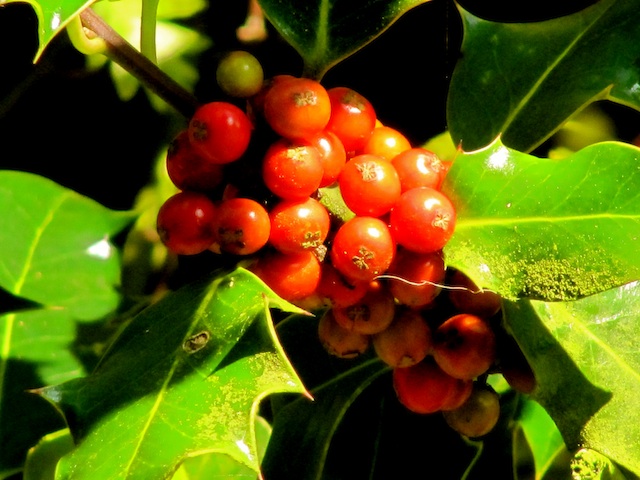
Crab Apples and Holly Berries
will remain awake for a while yet.
In fact, they will be eaten alive and
 provide nourishment for birds
until about Christmas.
I do hope the blackbirds will leave some of the
holly berries for my Christmas wreath.


The beech tree at the top of the field stands guard 
over garden and paddock. 
It's unfortunate that there is no beast to feast on the mast,
but I am fresh out of pigs.


No pigs but plenty of these.


And sadly, they will all go to sleep too,
hidden in cracks and crevices, in walls,
in the stones edging paths, under water butts,
in drainpipes and log piles.
They will all appear happily next year, fatter 
and more voracious than ever.

Drat them!


Monday, 18 October 2010

A Handy Hint For When The Blogging Muse Fails You


Sometimes it’s hard to find an interesting subject to post, particularly if you’ve been at it for a year or more, as I have. Going over old ground will only serve once or twice  -  readers change and if they haven’t been with you for long, they probably won’t know warmed-up fare from freshly concocted dishes.

There is one way to make sure the news is always sensational: invent it!

Decades ago there was a free-lance journalist working for any London newspaper which would buy his stories; Beloved knew him when he was a young man; the two of them collaborated on a long forgotten piece of film, for which Beloved wrote the score.

One day Eric asked “Did you ever see the piece about Margaret Truman singing at Covent Garden in the press? I wrote it.”

Beloved, who was already employed at the Royal Opera, couldn’t believe his ears. Margaret Truman was a singer? Surely not.

“Well” Eric said, “I needed a story, so I rang the White House, giving the name of The Times Of London, got through to the Press Office and asked them, if they could they please confirm the rumour that Margaret Truman was to appear on  stage at Covent Garden as a singer.”

“As there had never been such a rumour, naturally, they denied it,” Eric added, "which made the piece ‘White House denies rumour that the President’s daughter is to appear at Covent Garden’ the absolute truth”.

If you didn’t already, now you know how it’s done.


Friday, 15 October 2010

Kaffeeklatsch


The seven of them all lived in a small town in the South of England; they met, at irregular intervals, in each other’s homes; they served home baked cakes and brewed large pots of coffee, which they took while sitting around the dining table. They competed with each other to lay the prettiest, daintiest table, using lacy cloths and napkins and their best, matching china. Each one followed the rules, as their mothers had before them, and their grandmothers before them.

They didn’t all come from the same country, home had been Austria and Germany, Hungary and what was once Czechoslovakia.

Winter and summer, spring and autumn, they met. Before and after the coffee table ritual they sat, talked, listened to music which had long been forgotten by everybody else even in their home countries; they sat in deep chairs by the fire on cold afternoons, by wide-open windows on hot days, in kitchens and sitting rooms, garden rooms and sometimes, not often, they strayed out of doors, into the shade of the very ordinary English trees they had planted in their gardens.

All of them had found a new home in England, several had found English husbands and raised English children; had you asked them, they would all have sad they were happy and contented with their lives.

The seven had very little in common, three were educated professionals, three were housewives, one was a widow and long retired. They spoke English with each other, more or less fluently, with the harsh guttural sounds and rolling RR’s of Central European languages always present. Although five of them had enough German to communicate easily, shyly genteel Edith, who came from Budapest, spoke little English and no German. Agnes, also from Budapest, her exact opposite, loud and buxom, spoke both languages fluently but badly, and helped out when necessary. But it wasn’t often necessary, because the ladies appeared to communicate on a mysterious level, where each could use a mix of several languages and still be fully understood. Esther from Prague was by far the eldest; she preferred to speak nothing but English, She felt safer that way. She always wore long sleeves that covered her wrists and the number tattooed on one of them.

When they met, they found common ground from deep within them, the folk memory of what life had been like long before they became adults, before they were children even, from a time before they were born. Fate had destined them to be eternal wanderers, always searching, always carrying their lives’ stories with them. In spite of their settled domesticity their roots stretched far into the distance and the past.

Lucy, once a statuesque Viennese beauty, was the one who insisted on music, although it always made her cry. In the old way, the ladies took a drink after coffee, a brandy, a liqueur, a glass of wine; that, together with endless talk about the old days, the ‘people back home’, the sadness of lost youth, lost family, the yearning for ‘the way things used to be’ provoked a little tear on many occasions.
Christine, also from Austria, from mountain stock, unsentimental and as beautiful, yet harsh, as the landscape that bred her, found her compatriot overly sentimental; her flame-red hair bespoke her fiery temper and her quick tongue whipped across the tears.

The two Germans held back their tears for private moments. Both North European in outlook and nature, and therefore a little repressed, they were rarely loud, usually calm, and invariably amused when the Austro-Hungarian temperament enlivened the afternoon. Hedwig, a very elegant lady, who never left home without a hat, smiled graciously and blamed the drink when the noise levels rose.

By late afternoon cheeks had reddened and faces grew flushed; coffee, open fruit tarts, friendship, baked cheese cakes and creamy confections, followed by a convivial, lady-like sip of the cup that cheers yet only slightly inebriates, had had a benevolent effect on the company. The meetings were a means to unburden themselves of slights or put-downs they felt they had received at the hands of the host country, as well as finding the freedom to regret the host country’s indisputably alien way of life.

The ladies had all had to leave their homelands for one reason or another and these meetings were the only way they had to keep the past alive and real.

For one bitter-sweet afternoon they forgot they had been uprooted.

As these things go, the ladies were not connected by close friendship, but they certainly understood each other. Their bond was deeper than the bond of friendship.


Thursday, 14 October 2010

Rapunzel


Willow's Magpie Tale No. 36


Once upon a time,
In the land of wicked witches, pretty maidens, princes 
And credulous peasants,
There stood a tower, impregnable, tall,
With sheer walls.
And one window,
Right at the top, 
Just wide enough
For one skinny witch,
One snake-hipped but well-muscled Prince,
Said pretty maiden,
And said pretty maiden’s very thick, very golden braid.

The wicked witch, having tricked a pair of credulous peasants
Into parting with their infant daughter 
For the sake of a root,
By the name of Rapunzel,
For which credulous peasant wife 
Had developed a craving during pregnancy,
Proceeded to lock infant daughter,
Having become a teenager,
Into said impregnable tower.
Why she would do so, is anyone’s guess.
Mr. Grimm didn’t say.

Teenage daughter became pretty maiden,
(well she would, being locked up)
Much given to singing lustily, 
Standing by the small window.
Mr. Grimm didn’t specify the song,
But it must have been melodious enough
To attract snake-hipped, well-muscled Prince,
Accidentally riding by said impregnable tower.
Hearing the siren song
And falling in love
Was but the work of a moment.

“Lean out of the window, Goldenhair,
I heard you singing a merry air”.

Being a pretty unprincipled maiden, she did.
(Having a man in your bedroom was 
not the done thing in those far-off days)
Mr Grimm omitted to point this out.
Snake-hipped, well-muscled prince 
Climbed the golden rope ladder with ease.
Pretty maiden’s maidenly blushes
Soon faded.
Least said, soonest mended here, I think.
The impregnable tower was impregnable no more.

All Mr. Grimm will say in the matter is that,
After many months of ups and downs,
Pretty maiden’s waistband became tight with happiness.
Snake-hipped Prince realised
That the day had come for a decision.
Overcome the wicked witch,
Rescue pretty maiden,
Or make his adieus,
The course of true love having run its course.
The choice was his.

Prince was not called Prince for nothing,
Rescuing pretty maiden
By means of her own hair,
Which would once again be braided
And hooked up on the window catch,
Was his decision.
No sooner said then done.
Except, when it came to it,
Pretty maiden was no longer able
To slip through the window frame.

She squeezed and wriggled,
She held her breath,
She pulled and pushed.
He pulled and pushed.
She was stuck.
Mr. Grimm had no solution to the problem either.
Still snake-hipped and well-muscled Prince
Sighed deeply,
As he slithered down.

He sighed again.
He sighed for a third time,
As he mounted his trusty steed which had been waiting
Patiently at the foot of the tower.

“You can’t win ‘em all”, he said to the horse.


Monday, 11 October 2010

October Bunting


October, the eighth month according to the Ancient Roman Calendar, always strikes me as slightly mad, the month that likes to go ‘over the top’. Just think of the balmy days of Indian Summer, the colours of the leaves, both as a shimmering, multi-coloured flame of light on the trees as well as a carpet of pure gold, bronze, red and orange underfoot. Think of the last heroic efforts of the garden to repay the gardener for all his hard work during the year; you will surely agree with me.


The ground underfoot and the late afternoon sky seem to be in a competition as to who can produce the most magnificent spectacle. The hues exactly complement each other, I feel like the filling in a sandwich of gold.


October holds on to the affirmation of life by giving us plentiful reasons for celebrating nature's bounty in the form of fairs and festivals.

After the September rains, the river is finally in spate again, carrying brown soil stolen from the fields and banks further upstream on its back. The generous flow keeps trees and bushes growing alongside  green and fresh for a little while longer. Even the river seems to want to join in the celebrations, the greens and browns and the silver sparkle of the rippling water add to the carnival of colours.


There is a flourish, an abundance, a fabulous cheerfulness and unashamed boastfulness about October that ill-prepares us for the reminder of death and decay that November brings.

But for now, we celebrate, the bunting is out.


Saturday, 9 October 2010

Memories? What Memories?

Twenty five years ago to the day yesterday Beloved and I met in a London pub.  I've already mentioned this historic day in an earlier post, so I won't go into further details, except to say that we are not only still celebrating, but also talking to each other.A meal at our favourite hostelry is always an occasion, it's a bit pricey, as places that have left their humble beginnings behind and become fashionably Michelin-starred are, but we don't go very often, and the food is really very good indeed. Simple ingredients beautifully cooked and presented, it's a pleasure to eat there.

Twenty five years ago we wouldn't have spent the money as readily, but that was not the only difference. We had a much better memory then. Yesterday, in the restaurant, while eating all this wonderful food, we were trying to work out whether he had gone to work after that first meeting, or if he'd had the evening off; neither of us could remember. By a process of elimination we worked it out: 

a) he was dressed in jeans and a shabby anorak, and 
b) both of us recalled eating a pancake in each other's company  during that first evening of meeting,
  
so we must have taken enough time over it to decide to meet again.

Memory may have gone but we still have brilliant ideas.

How would it be if some clever boffin invented a kind of memory stick, to be used by humans, a kind of Neuro-Transmitter which automatically records all your fleeting thoughts, the memos-to-self stuff. You could then plug it into your brain at a later date and retrieve the memories as and when needed.

The only problem remaining then, is :

WHERE DID I LEAVE THAT BLASTED STICK!

Wednesday, 6 October 2010

Autumn


Willow's Magpie Tales no. 35


The time has come.
Abundant summer and his gifts have left, the harvest has been gathered
And the last fruits are ripening on the bough in the rays of autumn’s cooling sun.

This is the time we children knew to go into the fields,
The season came upon us with a breath of autumn from the woods,
A breath we felt but once, and not before and not again
The whole year through.
And we knew the time had come to light the fires.
We watched the flames and owned the land,
The streams, the woods, the fields of all the Earth were ours.
We gladly gave the wandering swans, the cranes and geese
A share of this, our Earth.

This is the time when man had best return to shelter, 
If he has none, he will not build one now.
This is the time to say goodbye to Earth’s great bounty,
Withdraw to firesides, to books, to thoughts and silent walks
Among the fallen leaves.

Monday, 4 October 2010

Birmingham

The Golden Boys
Boulton, Watt and Murdoch


Although condemned to a life of country bumpkinism, I get let out occasionally.

I get taken to the big city on a coach, in the company of a zooful of chattering monkeys, who find enough to say to keep tongues wagging for a solid two hours there and another solid two hours back. My therapist, on whose shoulder I wept bitter tears at such folly afterwards, advised me to erect a barrier between me and the wall of noise by means of another wall of noise, brought to me via earphones and one of these new-fangled gadgets that usually come attached with a young person in a public place.

Whatever happened to admiring the scenery out of the window and thinking aimless thoughts?

I am not sure that the young man who stood on the railings over a busy motorway for two days, threatening to jump, had not had a similar experience. Having thoroughly and very effectively disrupted the traffic on a busy main road into the city –  exacting revenge? – during that time, the police, who did their best to help with the disruption, finally charged him with ‘causing a public disorder’ or something and he agreed to come down. The waiter in the theatre restaurant next door told us the young man had felt peckish during his time of elevation, whereupon the authorities kindly supplied him with sandwiches; fingerfood is so much easier to manage on these occasions than balancing a plate and cutlery.


The set
The new play, ‘The Habit Of Art’, is excellent. I am beginning to think that Alan Bennett has reached an age where he can indulge himself and use as many rude words, filthy ideas and sad old men as he likes. The audience at a matinee is usually of  late middle age and over, and is given to tittering in all the wrong places; at the beginning of a play every slightly salacious reference and possible double-entendre provokes a storm of giggles. Luckily the playwright, having thus got the audience’s attention, calms down by and by, and so does the audience, saving me from spontaneous combustion.


Birmingham, proud of its self-awarded title, “The UK’s Second City”, is a very ambitious city indeed; the new library being built is of heroic proportions. Being unable to get through to the Art Gallery due to the afore-mentioned road blockage, we watched the dance of the cranes on the gigantic construction site instead, a different kind of art, but fascinating all the same. Unfortunately, we were chased away by a young man in a hard hat. Did he think we were going to hurl ourselves into the building chaos below?


All that remained before we were shepherded back on to the bus was to have fun with the many fractured buildings all around Centenary Square, a Hall of Mirrors of gigantic proportions.


Saturday, 2 October 2010

The Delights Of A Picnic

James Tissot
French Painter
1836-1902


Now that autumn is fully with us there is no longer any danger of having to find an excuse to turn down invitations to picnics. Gone are the days when tables and chairs were arranged in the shade of trees, if you were lucky, or in the full sun under an inadequate umbrella, if you were not. Sitting under trees in the garden brought you the added interest of bits of tree or a large variety of bugs falling down on you, while flying insects bit and stung you. Roasting in the sun is a particular pastime indulged in by the natives of these shores; at the first hint of a sunny day, Beloved will take off as many items of clothing as he can get away with, while still remaining decent, and spend all the hours of the day basking in the rarely glimpsed rays of the fireball in the sky. Siesta? Whatever for?

Picnicking close to home, in your own garden or the garden of a near neighbour will at least allow those squeamish souls who prefer to stay under cover during the hottest part of the day to find solace indoors; offering to do some washing up or freshen the salad bowl are accepted gladly and the prospect of a confidential gossip out of earshot of the party on the lawn will always find several takers.

Much, much worse is the summer picnic away from hearth and home, the kind of picnic which requires a general to organise and an army of foot soldiers to execute.

You set off in a convoy of cars, having spent the previous day assembling most of the food and drink to be taken. You get up early to cut sandwiches and make salads on the day.

The hour of departure arrives and you find that several parties are missing, aunt Edna and George and Kate are late; they finally turn up in a huff of bad temper; somebody got the time wrong and George spent half an hour searching for his favourite bottle opener.

However, you drive off and get there, only one car losing contact with the others; but, thanks to modern technology and mobile phones, which miraculously stayed on signal, this car is soon shepherded off the wrong turn and away from the motorway and back into the fold, delaying the start of proceedings by no more than a bearable forty-five minutes.

The picnic spot has been chosen in advance, an isolated clearing halfway up a hillside, reached by a bumpy track through a wood. When Dennis and Jacky first found the spot several years ago, they raved about it; the views were spectacular, they said, nobody ever went there and the air was fresh and clean.
Paradise, they said.

Dennis and Jacky are almost certain that the spot you finally arrive at is the one they chose all those years ago, but what is this? The view down the valley has turned into a huge new housing estate, partly ready and partly still being built; you have an uninterrupted view of JCBs, trench diggers and bulldozers, trundling up and down, as well as a camp site of caravans and pre-fabs to house the workers.

However, nobody complains; you assure each other that this couldn’t have been foreseen and that you won’t let this setback spoil your picnic. You spread blankets and cushions on the grass and bring out the picnic baskets, flasks, bottles, bowls and plastic utensils. Kevin and Mary have forgotten their share of the food; Mary admits it is sitting on the kitchen counter at home where she left it in full view, to make sure she wouldn’t leave it behind.  You all laugh gaily, say ‘typical Mary and Kevin’; assuring each other that there is enough for everybody even so.

Sitting on the ground is not easy, stones dig into your bottom and you need a hand to prop yourself up. You bite into a sandwich with a squishy filling, egg mayonnaise, say, and half the filling shoots out and slithers down your pretty top.

George, ever the gentleman, reaches over and wipes the goo off you with his napkin, upsetting the open bottle of red wine propped up precariously between you; the wine which does not end up in the bowl of limp lettuce lands in Aunt Edna’s lap. Aunt Edna is elderly and unable to get out of the way quickly enough, but she does manage to swing her knees sideways, tipping up the dish holding chicken drumsticks, which were deliciously crisp when you packed them, and causing them to roll off the blanket in all directions.

There are a few giggles at this, but the laughter is just a touch strained by now.


Tea and coffee are poured, both tepid, the tea badly stewed. Slices of fruit cake are handed out and eaten quickly, before the army of ants, which has suddenly appeared out of nowhere, can get to the loaf.

The men make a half-hearted attempt to lie back, Dennis, embarrassed at not having checked out the location before persuading the others to choose it for their summer picnic, even raises his arms and puts his hands under his head, saying ‘this is the life’, but his remark falls rather flat. Although they would all bite off their tongue rather than admit publicly that the picnic has been a bit of a disaster, each one of them secretly vows ‘never again’.

I think I’ll start practising my excuses for next year now.